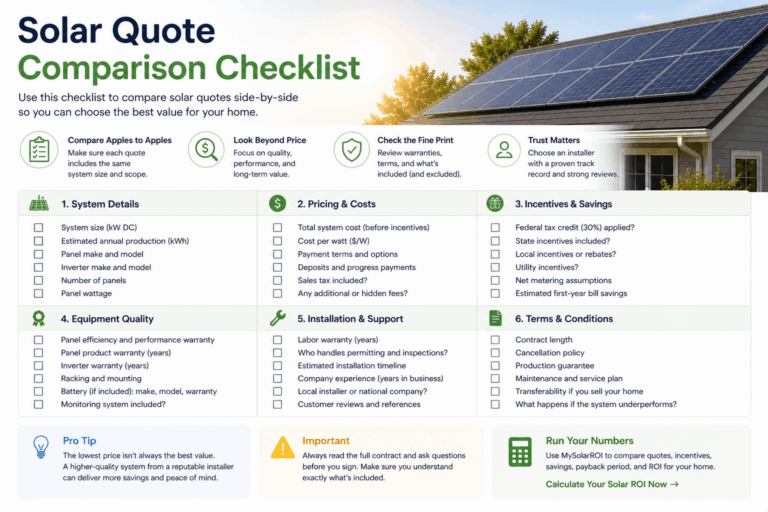
Solar Quote Comparison Checklist: Documents to Collect
Collect solar quote prices, equipment, production inputs, utility rules and contract terms. Use this checklist to track missing information before comparing.

Collect solar quote prices, equipment, production inputs, utility rules and contract terms. Use this checklist to track missing information before comparing.

If you are considering solar panels without the federal tax credit, the decision comes down to one question: Do the savings, incentives, utility rules, and long-term benefits still justify the cost? For many years, the federal Residential Clean Energy Credit made solar economics easier to understand because qualifying homeowners could

Use the official PVWatts calculator to estimate solar electricity production for your location. This independent MySolarROI guide helps you choose inputs, understand the system-loss setting, and check an installer’s production forecast. Quick answer: PVWatts documentation gives a system-loss default of about 14%. That setting excludes inverter conversion and temperature effects,
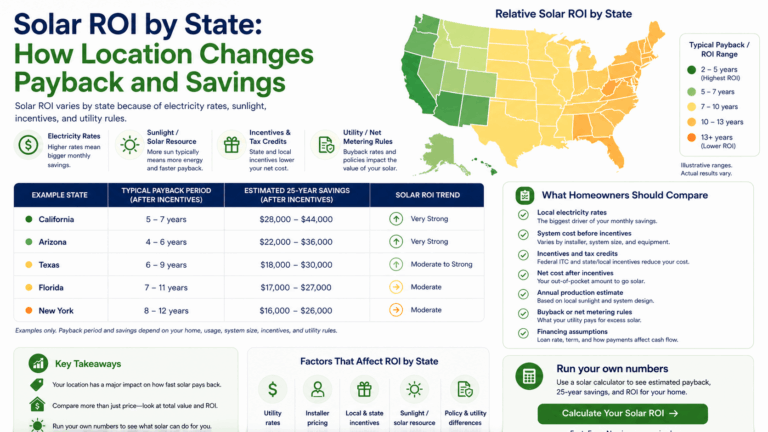
If you are comparing solar ROI by state, the most important thing to understand is that location changes almost every part of the solar calculation. The same solar panel system can have a short payback period in one state and a much longer payback period in another. That does not
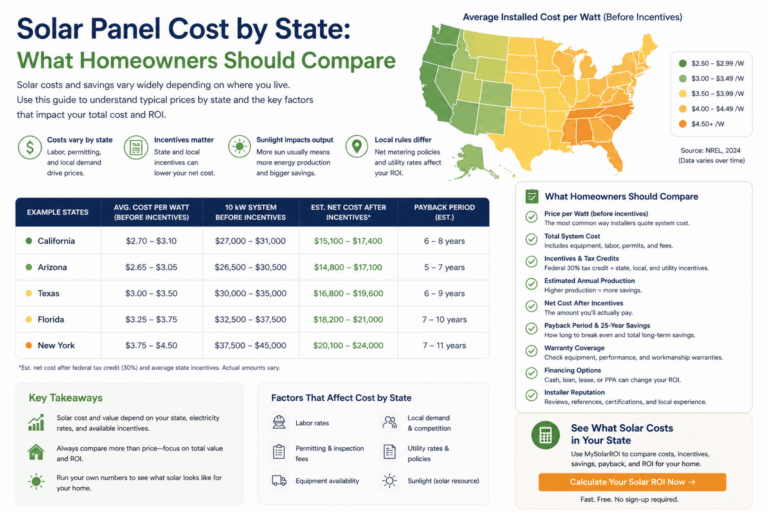
If you are researching solar panel cost by state, be careful with simple national averages. Solar pricing changes by state, but the installed price is only one part of the decision. A state with higher solar installation costs may still have strong solar economics if electricity rates are high, incentives
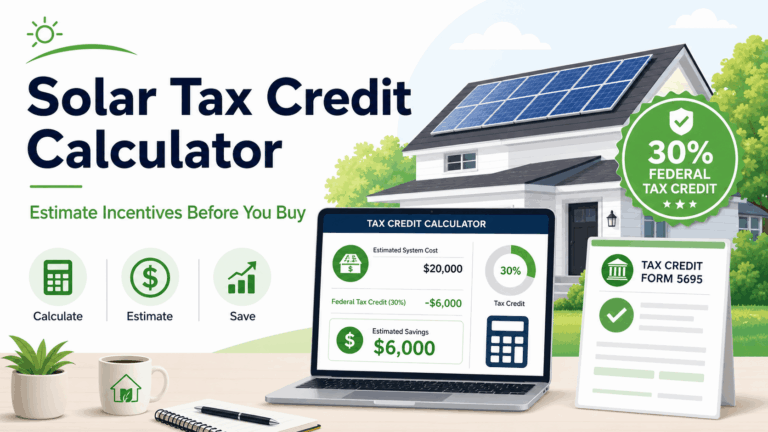
A solar tax credit calculator can help you understand how incentives may affect the true cost of going solar. But in 2026, homeowners need to be careful: the federal residential solar tax credit rules have changed, and many older solar articles still show outdated incentive assumptions. For systems placed in