A solar quote comparison is one of the most important steps before signing a solar contract.
Two solar quotes can look similar on the surface but be very different underneath. One may use a lower system price but weaker equipment. Another may show a low monthly payment but a higher financed price. A third may rely on optimistic savings, outdated incentives, or full retail net metering assumptions that do not match your utility rules.
The goal is not to find the quote that looks best on paper. The goal is to find the quote with clear assumptions, fair pricing, realistic savings, strong equipment, reasonable financing, and contract terms you understand.
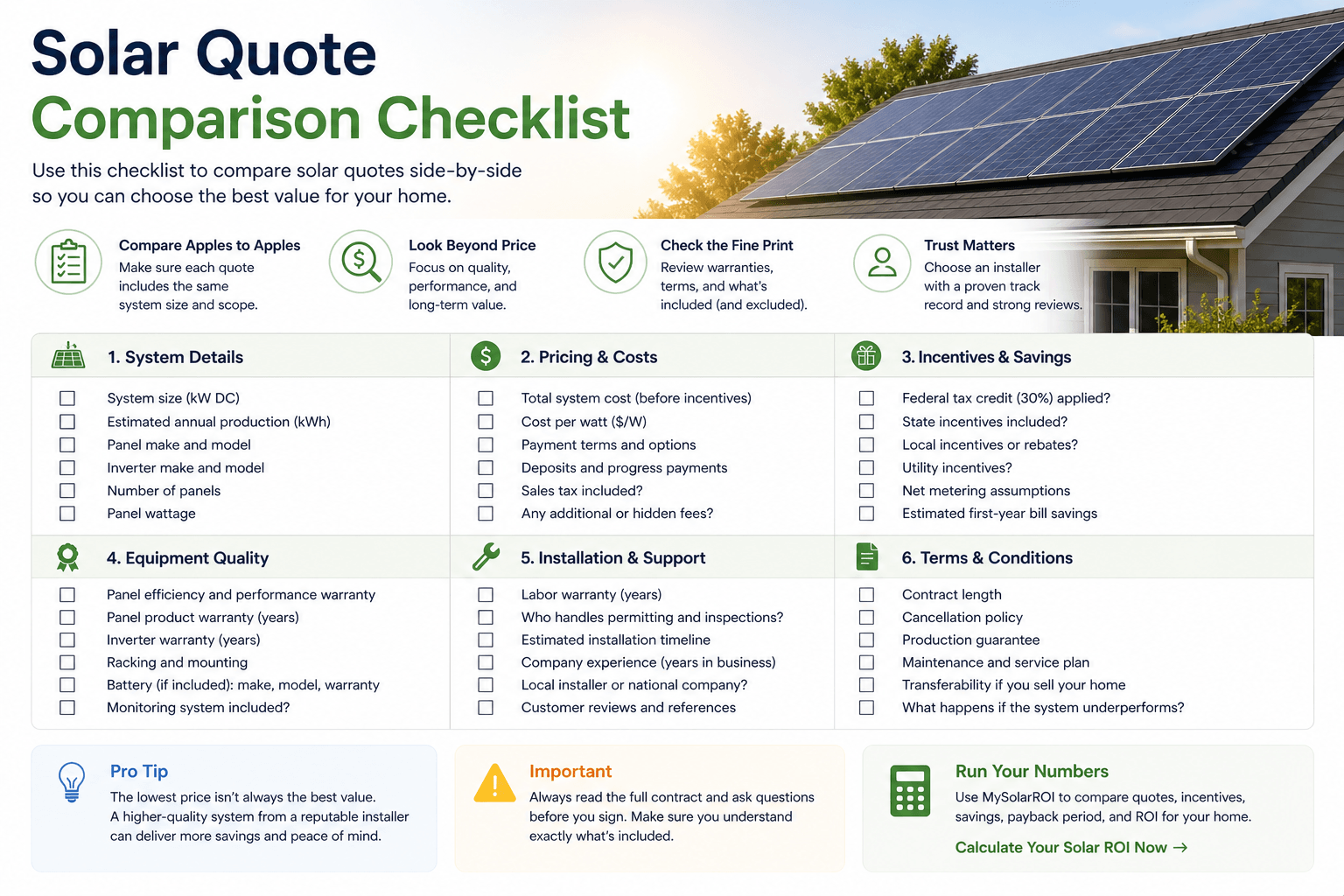
This solar quote comparison checklist walks through what homeowners should review before signing, including system size, cost per watt, production estimates, incentives, financing, warranties, utility assumptions, roof work, batteries, installer quality, and contract red flags.
Before comparing installer proposals, use the MySolarROI solar ROI calculator to estimate solar savings, payback period, and long-term ROI with your own cost, rate, incentive, and financing assumptions.
Solar Quote Comparison: Quick Checklist
Before reading the full proposal, compare the core numbers side by side.
| Quote Item | Quote A | Quote B | Quote C |
|---|---|---|---|
| Installer name | |||
| System size | |||
| Number of panels | |||
| Panel model | |||
| Inverter type | |||
| Gross installed cost | |||
| Cash price | |||
| Financed price | |||
| Cost per watt | |||
| Estimated annual production | |||
| Estimated annual savings | |||
| Incentives included | |||
| Battery included? | |||
| Roof or electrical work included? | |||
| Estimated payback period |
If a quote is missing these basics, ask the installer to clarify before moving forward.
Step 1: Compare System Size
Solar system size is usually measured in kilowatts, or kW.
A larger system may produce more electricity, but it also costs more. A smaller system may cost less, but it may offset less of your bill.
When comparing quotes, make sure the systems are actually similar.
| Question | Why It Matters |
|---|---|
| What is the system size in kW? | Shows how much solar capacity is included |
| How many panels are included? | Helps compare layout and equipment |
| What panel wattage is used? | Affects panel count and roof space |
| What annual usage offset is assumed? | Shows whether the system is designed for partial or full offset |
| Does the system account for future loads? | EVs, heat pumps, or pool pumps can change usage |
A cheaper quote may simply be smaller. A larger quote may not be better if extra solar production is exported at a low credit rate.
For sizing help, read how much solar power do I need.
Step 2: Compare Gross Cost, Cash Price, and Financed Price
Do not compare solar quotes only by monthly payment.
Ask every installer for three numbers:
- gross installed cost
- cash price
- financed price
The financed price may be higher than the cash price because of dealer fees, lender fees, interest structure, or financing-related pricing.
| Cost Item | What It Means | Why It Matters |
|---|---|---|
| Gross installed cost | Total system cost before incentives | Starting point for cost comparison |
| Cash price | Price if paid without solar loan financing | Helps reveal base system cost |
| Financed price | Price under the proposed loan or financing plan | Shows whether financing increases cost |
| Total repayment | Full amount paid over the loan term | Shows long-term financing impact |
The CFPB has warned consumers about problems and pitfalls in solar energy loans, especially when people are pressured to sign quickly or focus only on monthly payment instead of total cost. :contentReference[oaicite:1]{index=1}
Use the solar financing comparison guide before choosing a solar loan, lease, or PPA.
Step 3: Calculate Cost per Watt
Cost per watt helps compare quotes with different system sizes.
The formula is:
Cost per watt = gross installed cost ÷ system size in watts
Example:
$25,000 ÷ 7,500 watts = $3.33/W
| Quote | System Size | Gross Cost | Cost per Watt |
|---|---|---|---|
| Quote A | 7 kW | $23,100 | $3.30/W |
| Quote B | 8 kW | $27,200 | $3.40/W |
| Quote C | 6.5 kW | $20,800 | $3.20/W |
Cost per watt is useful, but it is not the only thing that matters. Also compare equipment, warranties, roof work, electrical work, battery storage, production estimate, and financing terms.
For pricing context, read the solar panel cost 2026 guide.
Step 4: Compare Equipment
Solar equipment affects production, warranty coverage, monitoring, reliability, and long-term service.
At minimum, compare:
- solar panel brand and model
- panel wattage
- panel efficiency
- product warranty
- performance warranty
- inverter type
- inverter warranty
- racking system
- monitoring platform
- battery model, if included
| Equipment Item | Question to Ask |
|---|---|
| Solar panels | What brand, model, wattage, and warranty are included? |
| Inverter | Is it a string inverter, optimizer system, or microinverter system? |
| Racking | What mounting system is used, and how is the roof protected? |
| Monitoring | Can I track production and detect underperformance? |
| Battery | What usable capacity, power rating, warranty, and backup capability are included? |
A cheaper quote may not be better if it uses weaker equipment, shorter warranties, or unclear monitoring.
Step 5: Compare Production Estimates
Estimated annual production is one of the most important numbers in a solar quote.
Production is usually measured in kilowatt-hours per year, or kWh/year.
Ask every installer:
- What is the estimated first-year production?
- What software or method produced the estimate?
- What shade assumptions were used?
- What roof tilt and azimuth were used?
- What system losses were assumed?
- Does the estimate include degradation over time?
- Is there a production guarantee?
For an independent check, use NREL PVWatts. It estimates energy production for grid-connected photovoltaic systems and can help homeowners compare production assumptions. :contentReference[oaicite:2]{index=2}
For more detail, read the PVWatts calculator guide.
Step 6: Compare Savings Assumptions
Solar production is not the same as solar savings.
Savings depend on how much your solar electricity is worth under your utility rate plan.
A solar savings estimate should explain:
- your current electricity rate
- annual electricity usage
- utility fixed charges
- minimum bills
- time-of-use rates
- net metering or export credit rules
- how exported solar is valued
- rate escalation assumptions
| Savings Assumption | Why It Matters |
|---|---|
| Retail electricity rate | Determines value of solar used directly at home |
| Export credit rate | Determines value of excess solar sent to the grid |
| Fixed charges | Some bill charges may remain after solar |
| Time-of-use rates | Production timing can affect value |
| Rate escalation | Future rate assumptions can heavily change long-term savings |
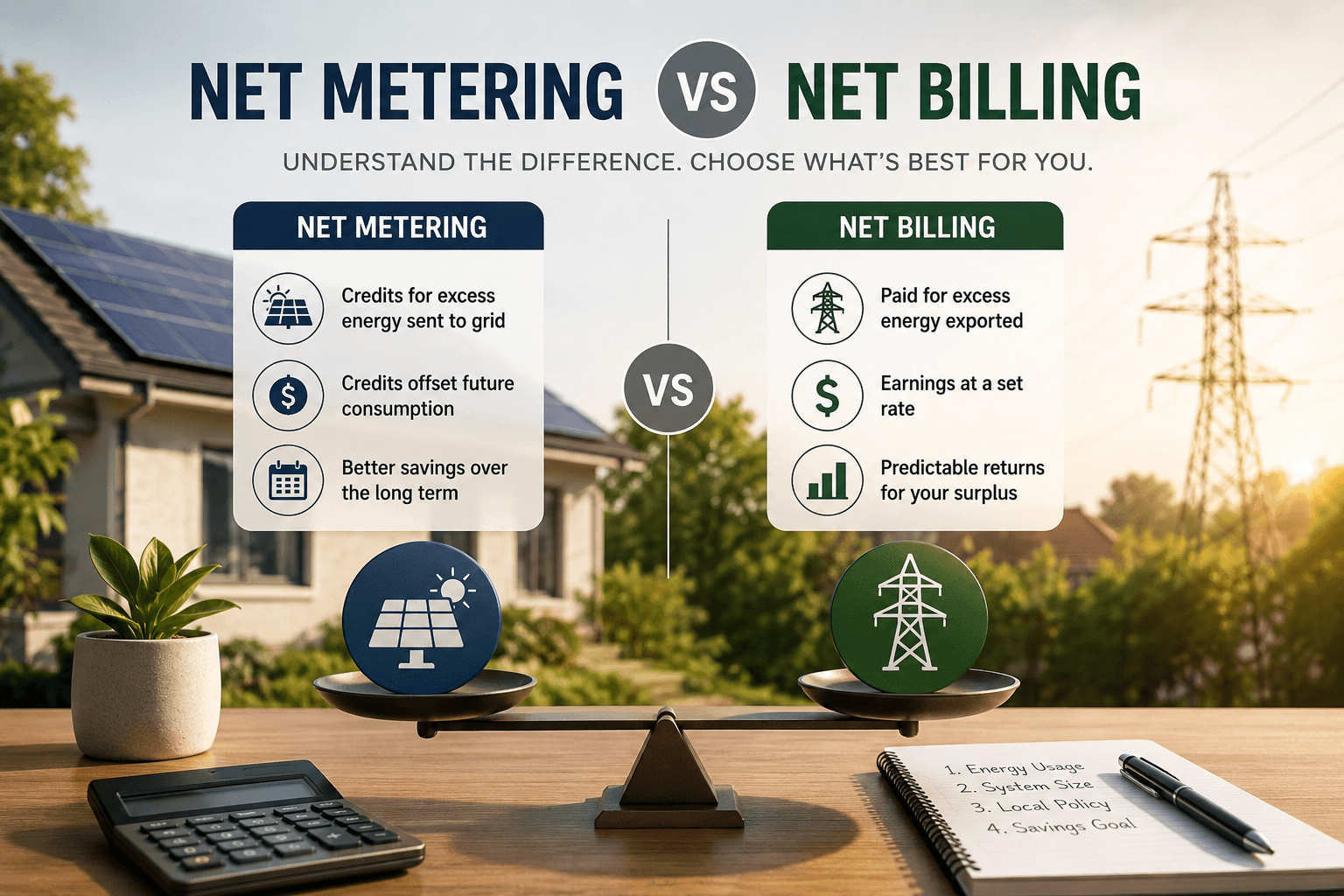
If a quote assumes full retail credit for all solar production, verify that your utility actually offers that treatment.
Read the net metering explained guide before trusting a savings estimate.
Step 7: Compare Incentives Carefully
Incentives can make a quote look much cheaper, but only verified incentives should be included in your base-case calculation.
Ask:
- Which incentives are included?
- Are they federal, state, local, or utility-based?
- Are they verified or estimated?
- Do I qualify based on my tax situation?
- Does ownership type affect eligibility?
- Is pre-approval required?
- Is program funding still available?
- What happens if I do not receive the incentive?
For new 2026 residential installations, be especially careful with federal tax credit assumptions. Do not automatically accept a quote that subtracts an old 30% federal residential credit unless eligibility is verified under current IRS rules.
For details, read the federal solar tax credit 2026 guide and the solar tax credit calculator guide.
Step 8: Compare Financing Terms
Solar financing can change the true cost of a quote.
FTC consumer guidance explains that homeowners may buy a solar system, lease a system, or sign an agreement to buy solar power, and that homeowners should understand what they are getting before agreeing to anything. :contentReference[oaicite:3]{index=3}
Compare these financing details:
| Financing Term | Question to Ask |
|---|---|
| Ownership type | Am I buying, financing, leasing, or signing a PPA? |
| APR | What is the interest rate? |
| Loan term | How many years will payments last? |
| Dealer fee | Is there a financing-related price increase? |
| Total repayment | How much will I pay over the full term? |
| Escalator | Do lease or PPA payments increase annually? |
| Prepayment | Can I pay off early without penalty? |
| Home sale terms | What happens if I sell the home? |
Energy.gov’s homeowner solar financing guide explains common residential solar financing choices such as loans, leases, PPAs, and cash purchase, and compares their advantages and disadvantages. :contentReference[oaicite:4]{index=4}
Step 9: Check Roof and Electrical Work
Some solar quotes exclude costs that may appear later.
Ask whether the quote includes:
- roof repair
- roof replacement coordination
- main electrical panel upgrade
- subpanel work
- trenching
- tree trimming
- structural work
- permit fees
- interconnection fees
- battery backup load panel
- solar removal and reinstallation if roof work is needed later
| Potential Extra Cost | Why It Matters |
|---|---|
| Old roof | May need replacement before solar |
| Main panel upgrade | Can add cost and time |
| Tree trimming | Can affect production and project cost |
| Interconnection requirements | Utility requirements can affect timeline |
| Battery backup wiring | May require additional electrical work |
A quote that excludes necessary work may look cheaper than it really is.
Step 10: Compare Warranties and Service
Solar warranties can include multiple layers:
- panel product warranty
- panel performance warranty
- inverter warranty
- battery warranty
- racking warranty
- workmanship warranty
- roof penetration warranty
- production guarantee, if offered
Ask who is responsible for each warranty and what happens if the installer goes out of business.
| Warranty Type | What to Ask |
|---|---|
| Equipment warranty | Who handles claims if equipment fails? |
| Workmanship warranty | How long is installation labor covered? |
| Roof warranty | Who is responsible for leaks around penetrations? |
| Production guarantee | What happens if the system underproduces? |
| Monitoring support | Who watches system performance? |
Do not assume “25-year warranty” means every part of the project is covered for 25 years. Ask for the warranty documents.
Mini Case Study: Two Solar Quotes That Look Similar
Here is a simplified example. These numbers are for illustration only and are not guaranteed.
Actual results depend on location, roof conditions, system design, installer pricing, equipment, utility rules, incentives, financing, and actual production.
| Quote Detail | Quote A | Quote B |
|---|---|---|
| System size | 7.5 kW | 7.5 kW |
| Gross cost | $24,750 | $23,500 |
| Cost per watt | $3.30/W | $3.13/W |
| Estimated annual production | 10,200 kWh | 9,400 kWh |
| Cash price shown? | Yes | No |
| Financing terms clear? | Yes | Unclear |
| Roof work included? | Yes | Not specified |
| Export credit assumption | Utility-specific | Assumes full retail credit |
At first, Quote B looks cheaper. But it has lower estimated production, unclear financing, unclear roof work, and a possibly optimistic export credit assumption.
Quote A costs more upfront, but it may be easier to evaluate because the assumptions are clearer.
This does not mean Quote A is automatically better. It means the homeowner needs to compare the full proposal, not just the price.
Run both quotes through the MySolarROI calculator using the same electricity rate, incentive, financing, and export credit assumptions.
Solar Quote Red Flags
Be cautious if a solar quote or salesperson does any of the following:
| Red Flag | Why It Matters |
|---|---|
| Pressures you to sign immediately | You need time to review the contract |
| Claims solar is free | Solar usually has a cost through purchase, loan, lease, PPA, or rate structure |
| Shows only monthly payment | Can hide total cost and financing terms |
| Automatically subtracts unverified incentives | May make net cost look too low |
| Does not show cash price | You cannot compare financing impact |
| Uses vague savings assumptions | Bill savings may be overstated |
| Ignores net metering rules | Export credit value can change ROI |
| Does not provide equipment models | You cannot compare quality or warranties |
| Refuses to provide contract documents | You cannot verify obligations |
FTC consumer guidance warns against companies that pressure you for a quick decision, tell you to sign without time to review, or ask for cash payment. :contentReference[oaicite:5]{index=5}
Questions to Ask Every Solar Installer
Before signing, ask each installer:
- What is the gross installed cost?
- What is the cash price?
- What is the financed price?
- What is the system size in kW?
- What is the cost per watt?
- Which panels and inverters are included?
- What annual production is estimated?
- What shade assumptions were used?
- What electricity rate is used for savings?
- What net metering or export credit rule is assumed?
- Which incentives are included?
- Are incentives guaranteed or estimated?
- Does the quote include roof work?
- Does the quote include electrical upgrades?
- What warranties are included?
- Who handles warranty claims?
- What happens if the system underproduces?
- What happens if I sell my home?
- Can I cancel, and what are the cancellation rules?
- What costs are excluded?
Ask for answers in writing. The written contract matters more than verbal promises.
How to Compare Solar Quotes Fairly
To compare quotes fairly, normalize the assumptions.
Use the same:
- electricity rate
- annual usage
- export credit value
- incentive assumptions
- analysis period
- financing treatment
- roof work assumptions
- battery inclusion or exclusion
Then compare:
- gross cost
- cost per watt
- annual production
- net cost after verified incentives
- estimated annual savings
- payback period
- long-term ROI
- warranties and service quality
For the full ROI calculation, read the how to calculate solar ROI guide.
External Sources to Check
Before signing a solar contract, review consumer guidance and verify key assumptions.
- FTC consumer advice on solar power for your home
- CFPB consumer advisory on solar loans
- Energy.gov homeowner solar financing guide
- NREL PVWatts solar production calculator
- DSIRE incentive and policy database
- Your local utility’s current net metering, net billing, or solar buyback tariff
FAQ About Solar Quote Comparison
How do I compare solar quotes?
Compare system size, gross cost, cash price, financed price, cost per watt, equipment, annual production, savings assumptions, incentives, warranties, roof work, utility rules, and estimated payback period. Do not compare only monthly payment.
How many solar quotes should I get?
Many homeowners benefit from getting at least two or three quotes. Multiple quotes help you compare pricing, equipment, financing, production assumptions, and installer quality.
What is the most important number in a solar quote?
There is no single most important number. Cost per watt, annual production, cash price, financed price, estimated savings, and payback period all matter. The assumptions behind the numbers matter even more.
Should I choose the cheapest solar quote?
Not automatically. The cheapest quote may exclude roof work, electrical upgrades, better equipment, or realistic production modeling. Compare what is included and whether the assumptions are clear.
What is cost per watt in a solar quote?
Cost per watt is the gross installed cost divided by system size in watts. It helps compare quotes of different sizes, but it should be reviewed alongside equipment, production, financing, and warranties.
How do I know if a solar savings estimate is realistic?
Check whether the estimate uses your actual electricity rate, utility tariff, net metering or export credit rules, annual usage, system production, fixed charges, and financing costs. Ask the installer to show all assumptions.
What solar quote red flags should I watch for?
Watch for pressure to sign quickly, “free solar” claims, missing cash price, unclear financing, unverified incentives, vague savings assumptions, missing equipment models, and contracts that are not available for review.
Should I use a solar calculator before comparing quotes?
Yes. A solar ROI calculator can help you test system cost, electricity rates, incentives, financing, and payback assumptions before comparing installer proposals.
Conclusion
A strong solar quote comparison looks beyond the lowest monthly payment.
Before signing, compare system size, cost per watt, gross cost, cash price, financed price, equipment, production estimate, savings assumptions, incentives, warranties, roof work, utility rules, and contract terms.
The best quote is not always the cheapest. It is the quote with fair pricing, clear assumptions, realistic savings, strong equipment, transparent financing, and contract terms you understand.
Before choosing an installer, use the MySolarROI solar ROI calculator to compare payback period and long-term ROI using the same assumptions for every quote.