If you are researching solar panels, you have probably seen the term net metering in quotes, utility documents, or solar savings estimates.
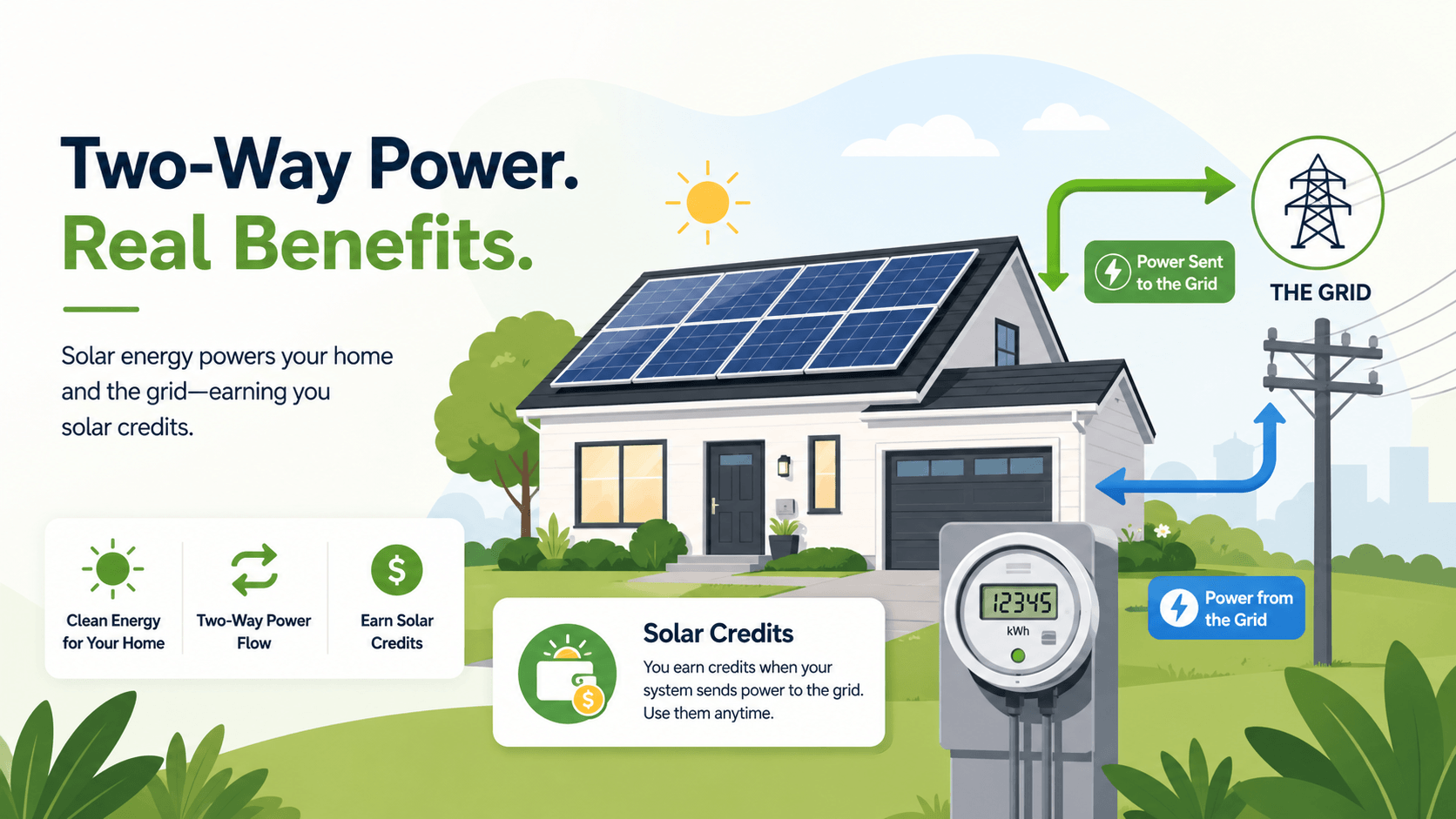
It sounds technical, but the basic idea is simple: when your solar panels produce more electricity than your home is using, that extra power may be sent to the electric grid. Depending on your utility rules, you may receive a bill credit for that exported electricity.
The details matter.
Net metering explained in plain English means understanding how your utility credits extra solar electricity, how those credits affect your electric bill, and how the rules change your solar savings, payback period, and long-term ROI.
Net metering can make a big difference in whether solar is financially attractive. But rules vary by state, utility, system size, rate plan, billing structure, and installation date.
Before comparing installer quotes, use the MySolarROI solar ROI calculator to test how system cost, electricity rates, export credits, incentives, and financing assumptions may affect your payback period and solar ROI.
Net Metering Explained: The Simple Version
Net metering is a billing arrangement that gives solar homeowners credit for extra electricity their solar panels send to the grid.
During sunny hours, your solar panels may produce more electricity than your home is using. That extra electricity can flow back to the utility grid. Your utility may then apply a credit to your bill.
Later, when your home uses more electricity than your solar panels are producing, such as at night, you buy electricity from the grid.
The “net” part means your bill may reflect the difference between:
- electricity you import from the grid
- electricity you export to the grid
- the credit rate your utility applies to exported electricity
- fixed charges, minimum bills, and other utility fees
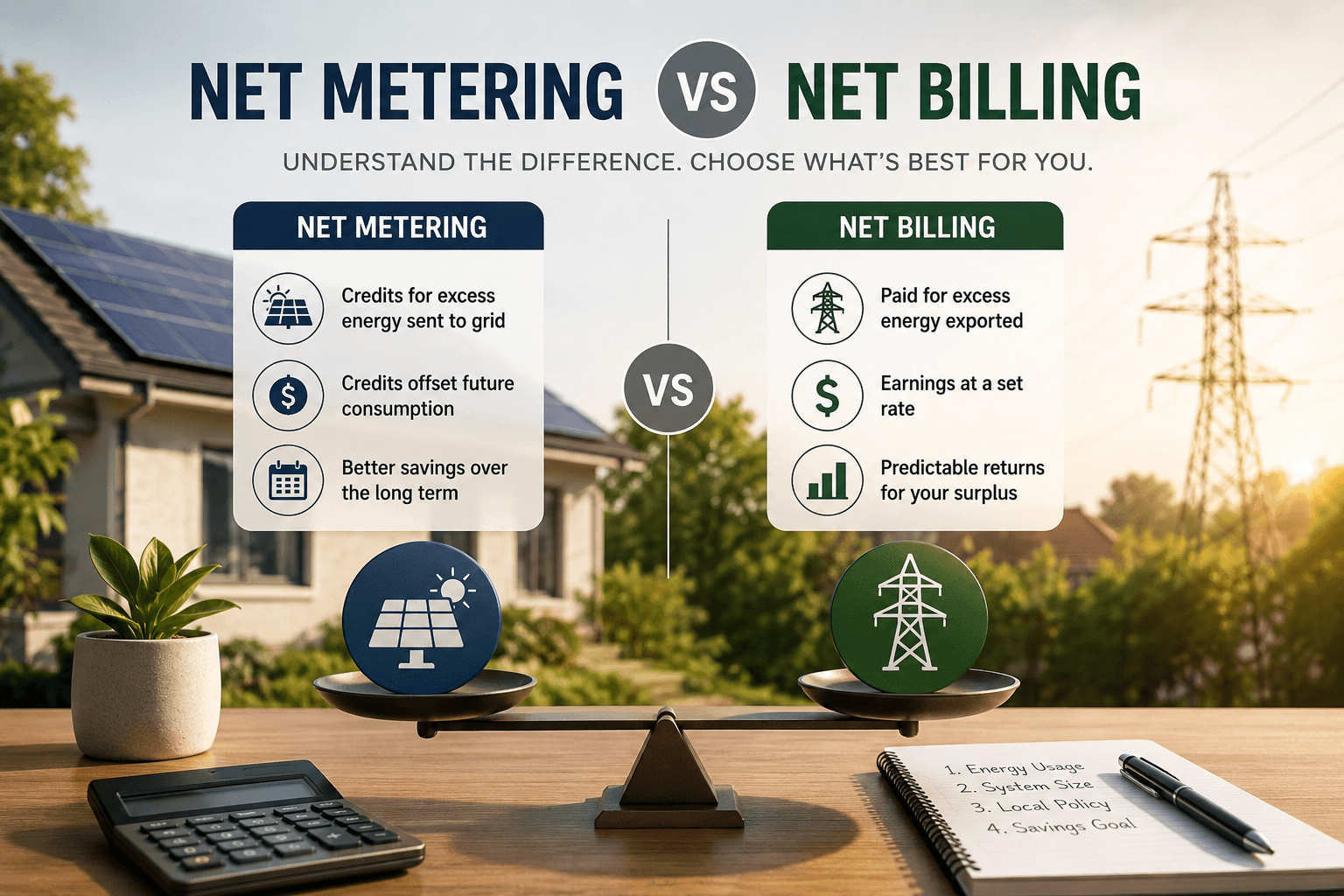
A common misunderstanding is that every exported kilowatt-hour is always credited at the full retail electricity rate. That is not always true. Some utilities offer full retail net metering. Others use net billing, avoided cost credits, time-of-use export rates, or solar buyback rates that may be lower than the retail rate.
How Net Metering Works on Your Electric Bill
A solar home usually interacts with the grid in two directions.
| Energy Flow | What It Means | Bill Impact |
|---|---|---|
| Solar used directly at home | Your panels produce electricity your home uses immediately | Can reduce how much electricity you buy from the utility |
| Solar exported to the grid | Your panels produce more than your home is using | May earn a bill credit depending on utility rules |
| Electricity imported from the grid | Your home needs more power than solar is producing | You pay the utility based on your rate plan |
| Net monthly usage or credit | Your bill accounts for imports, exports, credits, and charges | Determines your final bill amount |
For example, your solar panels may produce excess electricity during the afternoon. Then your home may use utility electricity in the evening when solar production drops.
Net metering or export credit rules determine how valuable that exported afternoon electricity is when calculating your bill.
Net Metering vs Net Billing vs Solar Buyback
Not every solar credit program is true full retail net metering. Many utilities now use different compensation structures.
| Program Type | How It Usually Works | Why It Matters for Solar ROI |
|---|---|---|
| Full retail net metering | Exported solar earns credit close to the retail electricity rate | Often supports stronger bill savings and shorter payback |
| Net billing | Imported electricity and exported electricity are valued separately | ROI depends heavily on the export credit rate |
| Solar buyback rate | The utility pays or credits a set rate for exported solar | May be lower than the retail rate |
| Avoided cost credit | Exported solar is credited based on a utility cost-based value | Can reduce the value of excess solar production |
| Time-of-use export credit | Export value changes by time of day or season | System design and battery timing may matter more |
This is why homeowners should not assume “solar production” and “solar savings” are the same number.
A system may produce a lot of electricity, but if much of that electricity is exported at a low credit rate, the savings may be lower than expected.
Why Net Metering Matters for Solar Savings
Net metering or export credit rules affect how much financial value your solar system creates.
The same solar system can have very different savings in two utility territories.
| Scenario | Export Credit Rule | Potential Savings Impact |
|---|---|---|
| Utility A | Exported solar credited near retail rate | Savings may be stronger |
| Utility B | Exported solar credited below retail rate | Savings may be lower |
| Utility C | Time-of-use rates and lower midday export value | Battery or load shifting may become more important |
| Utility D | Limited export credit | System sizing and self-consumption become critical |
This matters because many solar estimates start with annual production. But your actual bill savings depend on how that production is used and credited.
Ask your installer to separate:
- solar electricity used directly in the home
- solar electricity exported to the grid
- credit rate for exported electricity
- utility charges that remain after solar
- time-of-use rate assumptions
- monthly minimum charges or fixed fees
For a broader financial view, read the how to calculate solar ROI guide.
Example: How Export Credits Can Change Payback
Here is a simplified example. These numbers are for illustration only and are not guaranteed.
Actual results depend on location, utility rates, net metering rules, roof conditions, system design, incentives, financing terms, battery use, and household electricity usage.
| Assumption | Example Value |
|---|---|
| Solar system cost | $24,000 |
| Verified rebate | $1,000 |
| Net cost before tax considerations | $23,000 |
| Annual solar production | 9,500 kWh |
| Retail electricity rate | $0.20/kWh |
| Solar used directly at home | 5,500 kWh |
| Solar exported to grid | 4,000 kWh |
Now compare two export credit assumptions.
| Scenario | Direct Solar Value | Export Credit Value | Estimated Annual Value | Simple Payback |
|---|---|---|---|---|
| Higher export credit | 5,500 kWh × $0.20 = $1,100 | 4,000 kWh × $0.18 = $720 | $1,820 | 12.6 years |
| Lower export credit | 5,500 kWh × $0.20 = $1,100 | 4,000 kWh × $0.06 = $240 | $1,340 | 17.2 years |
Simple payback calculation:
$23,000 ÷ $1,820 = 12.6 years
$23,000 ÷ $1,340 = 17.2 years
The same system can look very different when export credits change. This is why net metering assumptions should be visible in every solar savings estimate.
Run your own numbers with the MySolarROI calculator before comparing installer quotes. Test higher and lower export credit scenarios so you can see how sensitive your payback period is.
What Remains on Your Electric Bill After Solar?
Solar panels can reduce your electric bill, but they do not always eliminate it.
Even with a well-sized system, your bill may still include:
- fixed monthly customer charges
- minimum bills
- grid connection fees
- delivery or distribution charges
- non-bypassable charges
- taxes and public purpose charges
- demand charges in some rate plans
- time-of-use charges
- seasonal charges
This matters because a solar quote that says “100% offset” may refer to annual electricity usage, not a $0 bill.
Ask your utility or installer:
- Which charges remain after solar?
- Is there a minimum monthly bill?
- Are delivery charges offset by solar credits?
- Are exported solar credits applied to all charges or only energy charges?
- Do unused credits roll over month to month?
- What happens to credits at the end of the year?
How Net Metering Affects Solar System Size
Net metering rules can change how large your solar system should be.
If your utility gives strong credit for exported electricity, a system that offsets most of your annual usage may make sense.
If your utility gives low credit for exported electricity, oversizing the system may weaken ROI because excess production may not be very valuable.
| Utility Rule | System Sizing Implication |
|---|---|
| Strong net metering | A larger annual offset may be financially reasonable |
| Low export credit | System should focus more on electricity used directly at home |
| Time-of-use rates | Production timing matters, not just total annual production |
| Export limits | System may need to be sized below technical roof capacity |
| Battery-friendly rate plan | Storage may help shift solar value to higher-rate periods |
A good solar design should match your usage, roof, utility rules, and financial goals. Bigger is not automatically better.
For cost and sizing context, read the solar panel cost 2026 guide.
Net Metering and Time-of-Use Rates
Some utilities use time-of-use rates. That means electricity costs more during some hours and less during others.
Under time-of-use pricing, solar value depends not only on how much electricity your system produces, but also when it produces and when your home uses electricity.
For example:
- solar production may be high during midday
- household demand may be higher in the evening
- export credits may be lower during some hours
- imported electricity may be expensive during peak periods
This can make load shifting more important.
Examples of load shifting include:
- running appliances during sunny hours
- charging an EV when solar production is high
- pre-cooling or pre-heating the home when rates are lower
- using a battery to store solar energy for evening use
Do not assume a time-of-use plan is good or bad without modeling it. The details depend on your utility tariff, household habits, system design, and battery options.
Do Batteries Help With Net Metering Changes?
Batteries can help in some net metering or net billing situations, but they are not automatically worth it for every homeowner.
A battery may help if:
- export credits are low
- time-of-use rates are high during evening hours
- you want backup power
- your utility offers battery incentives
- your home can use stored solar electricity during high-rate periods
A battery may be less attractive if:
- your utility offers strong retail net metering
- your outage risk is low
- the battery cost is high
- there are no battery incentives
- you do not need backup power
| Solar Setup | What to Evaluate |
|---|---|
| Solar only | Best for understanding basic bill savings, payback, and ROI |
| Solar plus battery | Evaluate backup value, export credit changes, time-of-use savings, and battery cost |
| Battery-ready solar | May allow storage later if utility rules change |
If your main goal is ROI, compare solar-only and solar-plus-battery scenarios separately.
How Net Metering Affects Solar Financing
Net metering assumptions also matter when comparing cash, loans, leases, and PPAs.
If savings are overstated because export credits are assumed too high, financing may look better than it really is.
Before financing solar, ask:
- What export credit rate is used in the savings estimate?
- Does the estimate assume full retail net metering?
- Does the estimate include utility fixed charges?
- Does the monthly loan payment depend on optimistic savings?
- What happens if net metering rules change?
- Does a lease or PPA rate increase each year?
- Who benefits from exported solar credits in the contract?
Use the solar financing comparison guide before deciding whether a loan, lease, or PPA makes sense.
Common Net Metering Mistakes
| Mistake | Why It Can Hurt the Estimate | Better Approach |
|---|---|---|
| Assuming every state has full retail net metering | Export credits vary widely by utility and tariff | Check your utility’s current solar tariff |
| Assuming solar production equals bill savings | Some production may be exported at a lower value | Separate direct usage from exported energy |
| Ignoring fixed charges | Some bill charges remain after solar | Ask what charges solar credits can offset |
| Oversizing the system | Extra exported power may have low value | Size the system based on usage and export rules |
| Ignoring time-of-use rates | Production timing can affect savings | Model rates by time period when relevant |
| Assuming batteries always improve ROI | Batteries add cost and may not pay back financially | Compare solar-only and solar-plus-battery scenarios |
| Relying only on installer claims | Sales estimates may use optimistic assumptions | Verify utility rules and run independent scenarios |
Questions to Ask Your Utility or Installer
Before signing a solar contract, ask these questions:
- Does my utility offer net metering, net billing, or a solar buyback rate?
- What is the export credit rate?
- Is the export credit equal to the retail electricity rate?
- Are credits applied monthly or annually?
- Do unused credits roll over?
- What happens to unused credits at the end of the year?
- Are fixed charges offset by solar credits?
- Are delivery charges offset by solar credits?
- Does my rate plan change after installing solar?
- Are there time-of-use rates?
- Are there system size limits?
- Are there export limits?
- Are existing solar customers grandfathered if rules change?
- What tariff will apply to my installation date?
Ask for the answers in writing or link to the utility tariff. Do not rely only on verbal explanations.
Where to Check Net Metering Rules
Net metering rules are local. National articles can explain the concept, but your utility tariff controls your actual bill treatment.
Start with:
- your electric utility’s solar or distributed generation page
- your utility’s official net metering, net billing, or solar buyback tariff
- your state public utility commission
- your state energy office
- DSIRE incentive and policy database
- your installer’s written savings assumptions
Do not stop at a general state summary if your utility has a specific rate plan or successor tariff. The exact tariff matters.
External Sources to Check
Before relying on a net metering assumption, verify current rules with official sources.
- U.S. Department of Energy net metering overview
- DSIRE incentive and policy database
- EIA electricity data
- Your state public utility commission
- Your local utility’s current net metering, net billing, or solar buyback tariff
FAQ About Net Metering
What is net metering?
Net metering is a utility billing arrangement that credits solar homeowners for excess electricity their solar panels send to the grid. The credit amount and billing rules depend on your state, utility, rate plan, and solar tariff.
Does net metering eliminate my electric bill?
Not always. Even with solar, your bill may still include fixed charges, minimum bills, delivery charges, taxes, or other fees. Solar credits may not offset every part of the bill.
Is net metering the same in every state?
No. Net metering and solar export credit rules vary by state, utility, system size, rate plan, and installation date. Always check your utility’s current solar tariff before relying on a savings estimate.
What is the difference between net metering and net billing?
Net metering often credits exported solar electricity near the retail rate, depending on the program. Net billing usually values imported electricity and exported electricity separately, often with a different export credit rate.
How does net metering affect solar payback?
Net metering can strongly affect solar payback. Higher export credits may shorten payback, while lower export credits may reduce annual savings and lengthen the time it takes to recover your net system cost.
Should I oversize my solar system if I have net metering?
Not automatically. Oversizing may make sense under strong net metering, but it can hurt ROI if exported electricity receives a low credit. System size should match your usage, utility rules, roof conditions, and goals.
Do batteries help if net metering is weak?
Batteries may help if export credits are low or time-of-use rates make evening electricity expensive. But batteries add cost, so compare solar-only and solar-plus-battery ROI before deciding.
Can net metering rules change after I install solar?
Yes, policy changes are possible. Some programs include grandfathering for existing customers, while others introduce successor tariffs for new customers. Ask your utility what rules apply to existing and future solar customers.
Conclusion: Net Metering Can Make or Break Solar Savings
Net metering explained simply: it is the set of rules that determines how your utility credits extra solar electricity sent to the grid.
Those rules can strongly affect solar savings, payback period, system size, battery economics, and long-term ROI.
The big takeaway is this: do not evaluate a solar quote based only on system size or total production. Ask how much solar electricity you are expected to use directly, how much will be exported, what export credit rate applies, and what charges will remain on your bill.
Before you sign a contract, run your numbers with the MySolarROI solar ROI calculator. It can help you compare solar costs, bill savings, incentives, net metering assumptions, financing, and estimated payback in one place.