If you are comparing a solar lease vs PPA, the most important thing to understand is that both options usually involve third-party ownership.
That means you may get solar panels installed on your home, but you may not own the system.
With a solar lease, you typically pay a fixed monthly amount to use the solar system. With a solar power purchase agreement, or PPA, you typically pay for the electricity the system produces at a contract rate.
Both options may lower upfront cost compared with buying a system. But both can also affect incentives, savings, home sale terms, contract flexibility, and long-term solar ROI.
This guide explains the difference between a solar lease and a solar PPA, what homeowners should compare before signing, and how to decide whether third-party-owned solar makes sense for your situation.
Before choosing any solar financing option, use the MySolarROI solar ROI calculator to compare savings, payback period, financing impact, and long-term ROI.
Solar Lease vs PPA: Quick Comparison
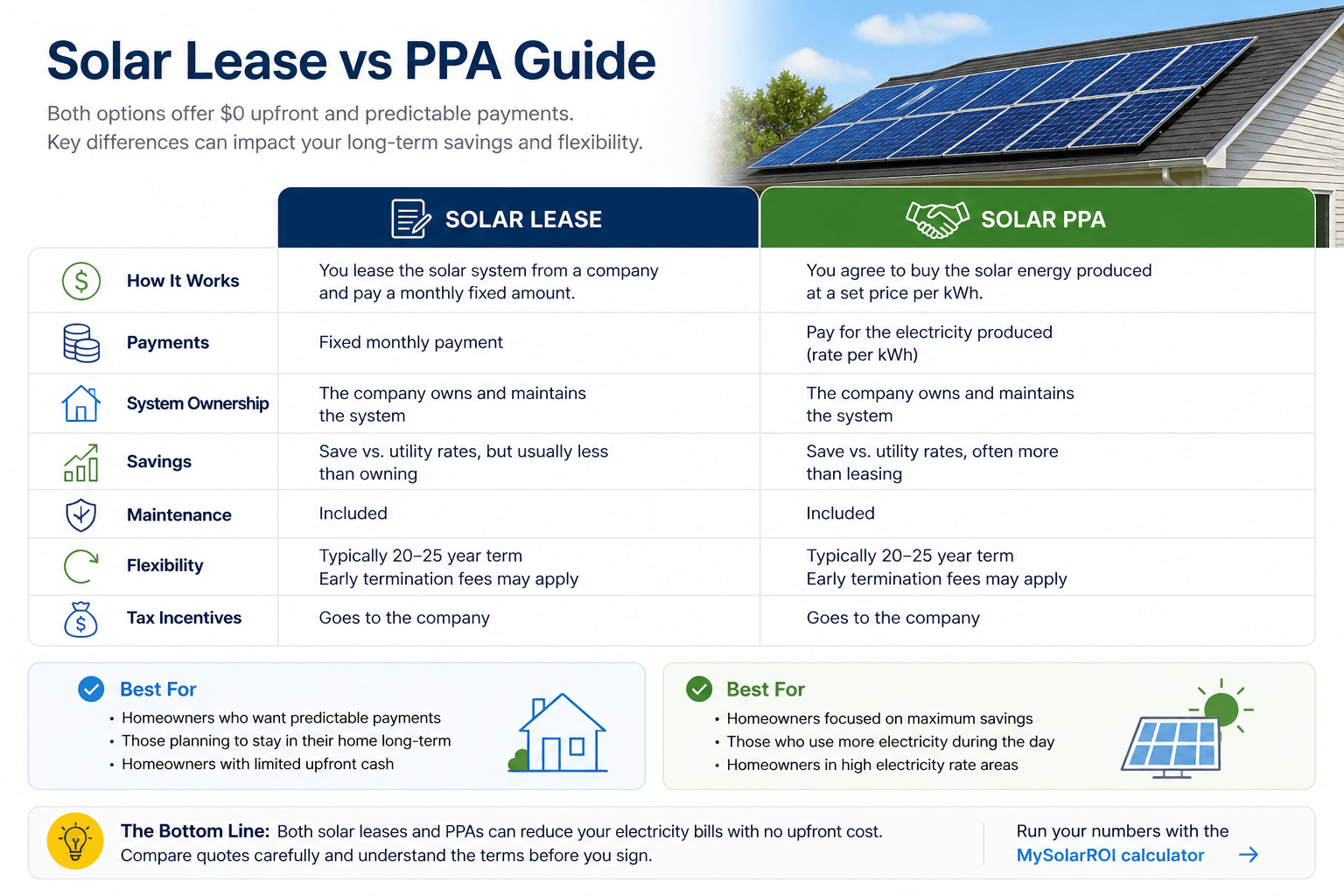
A solar lease and a solar PPA are similar because a solar company or financing company usually owns the system. The main difference is how you pay.
| Feature | Solar Lease | Solar PPA |
|---|---|---|
| Who usually owns the system? | Solar company or financing company | Solar company or financing company |
| How you pay | Fixed monthly lease payment | Per-kWh rate for solar electricity produced or used |
| Upfront cost | Often low or $0 | Often low or $0 |
| Payment increases | May include annual escalator | May include annual escalator |
| Incentives | System owner may receive incentives | System owner may receive incentives |
| Maintenance | Often handled by system owner, depending on contract | Often handled by system owner, depending on contract |
| Home sale impact | Transfer or buyout may be required | Transfer or buyout may be required |
| Best for | Homeowners who want predictable solar payments without owning the system | Homeowners who want to pay based on solar electricity output under contract terms |
Neither option is automatically good or bad. The contract terms decide whether the deal is reasonable.
What Is a Solar Lease?
A solar lease is an agreement where a solar company usually installs and owns a solar panel system on your property. You pay a monthly lease payment for the right to use the system or benefit from the electricity it produces.
In many lease arrangements, the solar company is responsible for monitoring, maintenance, and repairs, but the exact responsibility depends on the contract.
The U.S. Treasury consumer advisory on solar leases notes that during the contract term, the homeowner is entitled to use the power the system produces, and the contract may allow the monthly payment to increase over time. :contentReference[oaicite:2]{index=2}
Potential benefits of a solar lease
- Often little or no upfront cost.
- Monthly payment may be predictable.
- System owner may handle maintenance.
- May reduce electricity bills if payment is lower than utility savings.
- Can make solar accessible without buying equipment.
Potential drawbacks of a solar lease
- You usually do not own the system.
- You generally should not assume you personally receive ownership-based incentives.
- Payments may increase if the contract includes an escalator.
- Long-term savings may be lower than owning the system.
- Home sale can be more complicated if the buyer must assume the lease.
- Buyout or removal terms may be restrictive.
What Is a Solar PPA?
A solar PPA, or power purchase agreement, is a contract where a solar company usually owns and operates a solar system on your property. Instead of paying a fixed lease amount, you pay for the solar electricity the system produces at a contract rate.
For example, your PPA might say you pay a certain number of cents per kWh for solar energy produced by the system.
The U.S. Treasury consumer advisory says a power purchase agreement is a binding legal agreement and can be complex, so homeowners should review the terms carefully and seek legal help when possible if they have questions. :contentReference[oaicite:3]{index=3}
Potential benefits of a solar PPA
- Often little or no upfront cost.
- You may pay based on solar electricity production.
- The solar company usually owns and maintains the system.
- The starting PPA rate may be lower than your utility rate.
- May provide bill savings without system ownership.
Potential drawbacks of a solar PPA
- You usually do not own the system.
- The PPA rate may increase over time if there is an escalator.
- Savings depend on the PPA rate compared with your utility rate.
- Contract terms may last many years.
- Home sale may require transfer, buyer approval, or buyout.
- You may have less control over the system.
Solar Lease vs PPA: Payment Structure
The biggest practical difference between a lease and a PPA is how your payment is calculated.
| Payment Question | Solar Lease | Solar PPA |
|---|---|---|
| Do you pay a fixed monthly amount? | Usually yes | Usually no |
| Do you pay per kWh? | Usually no | Usually yes |
| Can payments increase? | Yes, if there is an escalator | Yes, if there is an escalator |
| Does payment depend on production? | Usually less directly | Usually yes |
| What should you compare? | Lease payment vs expected utility savings | PPA rate vs utility rate |
With a lease, ask whether your payment changes over time. With a PPA, ask whether the per-kWh rate increases over time.
A first-year savings estimate may look attractive, but an annual escalator can reduce savings later if the solar payment rises faster than your utility savings.
Solar Lease vs PPA: Ownership and Incentives
Ownership is one of the most important differences between third-party-owned solar and homeowner-owned solar.
With both a lease and a PPA, the solar company or financing company usually owns the system.
| Question | Solar Lease | Solar PPA |
|---|---|---|
| Do you usually own the system? | No | No |
| Who may receive ownership-based incentives? | System owner | System owner |
| Can incentives lower your payment? | Possibly, if reflected in pricing | Possibly, if reflected in PPA rate |
| Should you assume you get tax credits? | No | No |
FTC consumer guidance notes that depending on whether you buy, lease, or sign an agreement to buy solar power, you might get certain tax breaks or need to take extra steps before selling your home. :contentReference[oaicite:4]{index=4}
For 2026 projects, be especially careful with federal residential tax credit assumptions. Read the federal solar tax credit 2026 guide and the solar tax credit calculator guide.
Solar Lease vs PPA: Savings and ROI
Solar leases and PPAs are usually evaluated differently from a cash purchase or solar loan because you may not own the system.
Instead of calculating ROI on an owned asset, homeowners often compare:
- solar lease payment vs reduced utility bill
- PPA rate vs utility electricity rate
- annual escalator vs expected utility rate changes
- total contract payments vs total projected savings
- home sale flexibility
- maintenance and performance terms
| Financial Question | Solar Lease | Solar PPA |
|---|---|---|
| How do I estimate savings? | Compare lease payment plus new utility bill against old utility bill | Compare PPA energy cost plus utility bill against old utility bill |
| What can reduce savings? | High lease payment or escalator | High PPA rate or escalator |
| What should I review? | Total payments over contract term | Total energy purchases over contract term |
| What is the biggest risk? | Payment rises while savings are lower than expected | PPA rate becomes less favorable over time |
For a full ownership-based comparison, read the solar financing comparison guide.
Solar Lease vs PPA: Escalators
An escalator is a contract term that increases your payment or energy rate over time.
For example:
- A lease payment may increase by a set percentage each year.
- A PPA rate may increase by a set percentage each year.
Escalators matter because solar savings depend on the difference between your solar payment and what you would have paid the utility.
| Escalator Issue | Why It Matters |
|---|---|
| Starting payment | Shows first-year affordability |
| Annual increase | Shows how payments change over time |
| Utility rate comparison | Savings depend on whether utility rates rise faster or slower |
| Total contract cost | Shows full long-term obligation |
Do not evaluate a lease or PPA only by the first-year payment. Ask for a year-by-year schedule.
Mini Case Study: Lease vs PPA Savings Comparison
Here is a simplified example. These numbers are for illustration only and are not guaranteed.
Actual results depend on electricity rates, utility rules, system production, contract terms, escalators, roof conditions, maintenance, and how long you stay in the home.
| Assumption | Solar Lease | Solar PPA |
|---|---|---|
| System ownership | Solar company | Solar company |
| Payment type | $120/month lease payment | $0.14/kWh PPA rate |
| Annual production | 9,000 kWh | 9,000 kWh |
| Old utility rate | $0.20/kWh | $0.20/kWh |
| First-year solar cost | $1,440 lease payment | $1,260 PPA cost |
| Estimated utility value of production | $1,800 | $1,800 |
| First-year estimated savings before remaining charges | $360 | $540 |
This example makes the PPA look better in year one. But the final comparison depends on:
- whether payments escalate
- whether utility rates change
- whether solar production changes
- whether fixed utility charges remain
- how exported solar is credited
- what happens if you sell the home
- whether you can buy out the contract
Run lease and PPA scenarios through the MySolarROI calculator using conservative assumptions before signing.
Home Sale Issues: Lease vs PPA
Home sale terms are one of the biggest reasons to review solar leases and PPAs carefully.
If you sell your home before the contract ends, the buyer may need to assume the lease or PPA. The solar company may need to approve the transfer. In some cases, you may need to buy out the agreement or negotiate with the buyer.
| Home Sale Question | Why It Matters |
|---|---|
| Can the agreement transfer to a buyer? | Some buyers may not want or qualify for it |
| Does the buyer need credit approval? | Can affect closing timeline |
| Is there a buyout option? | You need to know cost and timing |
| Can the system be removed? | Removal may be limited or expensive |
| Are there filings or notices? | May affect real estate paperwork |
FTC guidance specifically notes that homeowners may need to take extra steps before selling their home depending on the solar option they choose. :contentReference[oaicite:5]{index=5}
Ask for home sale terms in writing before signing.
Maintenance and Performance Guarantees
One potential advantage of leases and PPAs is that the system owner may handle monitoring, maintenance, and repairs.
But you should not assume everything is covered.
Ask:
- Who monitors system performance?
- Who repairs the system if something fails?
- What happens if the system underproduces?
- Is there a production guarantee?
- Who handles roof leaks related to installation?
- Who pays for removal and reinstallation if roof work is needed?
- What happens if the company sells the contract?
| Contract Area | What to Review |
|---|---|
| Monitoring | Who tracks system output? |
| Repairs | Who pays and how quickly? |
| Production guarantee | What compensation applies if output is low? |
| Roof work | Who pays to remove and reinstall panels? |
| Contract transfer | Can obligations move to another company? |
Maintenance coverage is valuable only if the contract clearly defines responsibilities.
Solar Lease vs PPA vs Solar Loan
A solar loan is different from a lease or PPA because the homeowner usually owns the system while repaying the lender.
| Feature | Solar Loan | Solar Lease | Solar PPA |
|---|---|---|---|
| System ownership | Homeowner usually owns | Solar company usually owns | Solar company usually owns |
| Payment | Loan payment | Fixed lease payment | Per-kWh solar electricity rate |
| Incentives | Homeowner may qualify if eligible | System owner may receive incentives | System owner may receive incentives |
| Long-term upside | Can be stronger after loan payoff | Usually limited by contract | Usually limited by contract |
| Maintenance | Homeowner relies on warranties and installer | Often system owner responsibility | Often system owner responsibility |
| Home sale | Loan payoff or transfer may matter | Lease transfer or buyout may matter | PPA transfer or buyout may matter |
For a direct comparison, read the solar loan vs lease guide and the solar loan calculator guide.
When a Solar Lease May Make Sense
A solar lease may make sense when:
- you want low upfront cost
- you do not want to own the system
- you prefer predictable monthly payments
- maintenance coverage is important
- the lease payment is clearly lower than expected bill savings
- the escalator is reasonable or absent
- home sale and buyout terms are clear
A lease may be less attractive when:
- you want maximum long-term savings
- you want ownership-based incentives
- you may move soon
- the escalator is high
- buyout terms are unclear
- you do not understand transfer terms
When a Solar PPA May Make Sense
A solar PPA may make sense when:
- you want low upfront cost
- the PPA rate starts below your utility rate
- the annual escalator is reasonable
- you understand how much energy you may buy
- the contract explains what happens if production is lower than expected
- home sale and transfer terms are clear
- you prefer not to own or maintain the system
A PPA may be less attractive when:
- the PPA rate is close to your utility rate
- the escalator is high
- you may sell the home soon
- you want ownership-based incentives
- you want control over the system
- contract terms are difficult to understand
Questions to Ask Before Signing a Lease or PPA
Before signing, ask these questions:
- Who owns the system?
- What exactly am I paying for?
- Is the payment fixed or based on kWh?
- Does the payment increase each year?
- What is the annual escalator?
- What is the total contract term?
- Who receives incentives?
- Who maintains the system?
- What happens if production is lower than expected?
- What charges remain on my utility bill?
- What happens if I sell my home?
- Can the buyer assume the agreement?
- Is there a buyout option?
- Can the system be removed?
- What happens if I need roof work?
- Can the contract be sold to another company?
- What are the cancellation rules?
Get every important answer in writing. Do not rely only on verbal explanations.
Common Solar Lease and PPA Mistakes
| Mistake | Why It Can Hurt You | Better Approach |
|---|---|---|
| Comparing only first-year savings | Escalators can reduce savings later | Review year-by-year cost |
| Assuming you own the system | Third-party ownership affects incentives and control | Confirm ownership in the contract |
| Ignoring home sale terms | Transfer or buyout can complicate selling | Review sale and transfer clauses |
| Assuming all maintenance is covered | Some responsibilities may remain with homeowner | Read maintenance terms carefully |
| Not comparing with a loan or cash option | Ownership may produce stronger long-term savings | Compare all financing options |
| Trusting verbal promises | The written contract controls | Get promises in writing |
| Signing under pressure | You may miss important terms | Take time to review before signing |
FTC warns consumers to avoid companies that pressure them into quick decisions, tell them to sign without time to review, or ask for cash payment. :contentReference[oaicite:6]{index=6}
How to Compare Lease and PPA Offers
Use the same assumptions for each offer.
| Comparison Item | Lease Offer | PPA Offer |
|---|---|---|
| System owner | ||
| System size | ||
| Estimated annual production | ||
| First-year payment or PPA rate | ||
| Annual escalator | ||
| Contract length | ||
| Maintenance responsibility | ||
| Production guarantee | ||
| Home sale transfer terms | ||
| Buyout option | ||
| Total estimated savings |
Then compare both options against a solar loan and cash purchase if available.
External Sources to Check
Before signing a lease or PPA, review official consumer guidance and verify contract terms.
- FTC consumer advice on solar power for your home
- Energy.gov homeowner solar financing guide
- U.S. Treasury guide before signing a solar lease
- U.S. Treasury guide before signing a power purchase agreement
- Your state consumer protection office
- Your local utility’s solar billing and interconnection rules
FAQ About Solar Lease vs PPA
What is the difference between a solar lease and a PPA?
With a solar lease, you usually pay a fixed monthly amount to use the solar system. With a solar PPA, you usually pay for the electricity the system produces at a contract rate per kWh.
Do I own the system with a solar lease?
Usually, no. In a typical solar lease, the solar company or financing company owns the system installed on your property.
Do I own the system with a solar PPA?
Usually, no. In a typical PPA, the solar company owns the system and sells you the electricity produced by that system under contract terms.
Which is better: solar lease or PPA?
It depends on the contract. Compare payment structure, starting cost, escalator, utility rate, maintenance, home sale terms, buyout options, and total projected savings. Neither option is automatically better.
Can I claim solar tax credits with a lease or PPA?
In a typical lease or PPA, the homeowner does not own the system, so the homeowner generally should not assume they can claim ownership-based solar tax credits. Ask who owns the system and who receives incentives.
What happens if I sell my home with a solar lease or PPA?
The buyer may need to assume the agreement, qualify for transfer, or negotiate a buyout. Review transfer, buyout, and removal terms before signing.
Are solar leases and PPAs bad?
Not necessarily. They can work for some homeowners who want low upfront cost and less maintenance responsibility. The risk is signing a long-term contract with unclear escalators, weak savings, or difficult home sale terms.
Should I compare lease and PPA offers with a solar loan?
Yes. A solar loan may provide ownership and stronger long-term upside, but it can also include interest and fees. Compare lease, PPA, loan, and cash options before deciding.
Conclusion
The solar lease vs PPA decision comes down to payment structure, contract terms, ownership, savings, and flexibility.
A solar lease usually means you pay a fixed monthly amount. A solar PPA usually means you pay per kWh of solar electricity. In both cases, the solar company or financing company usually owns the system.
Before signing, review the escalator, contract length, maintenance terms, incentives, home sale transfer rules, buyout options, and total projected savings.
Then compare lease and PPA offers against ownership options such as cash purchase or a solar loan.
Use the MySolarROI solar ROI calculator to estimate how each option affects savings, payback period, and long-term solar ROI before you commit.