A solar payback calculator helps estimate how long it may take for your solar savings to recover the net cost of installing solar panels.
For many homeowners, this is one of the clearest ways to understand whether a solar quote makes financial sense.
The main question is simple:
How many years will it take for my solar panels to pay for themselves?
But the answer depends on more than system price. Solar payback depends on your installed cost, incentives, electricity rate, solar production, financing terms, net metering rules, roof conditions, battery costs, and how much electricity your home actually uses.
This guide explains how a solar payback calculator works, what inputs matter, how to avoid misleading estimates, and how to compare payback period with long-term solar ROI.
Before comparing installer quotes, use the MySolarROI solar ROI calculator to estimate your payback period, savings, incentives, financing impact, and long-term return using realistic assumptions.
What Is a Solar Payback Calculator?
A solar payback calculator estimates the number of years it may take for solar bill savings to equal your net solar system cost.
It usually uses this basic formula:
Solar payback period = net solar system cost ÷ annual electricity bill savings
Example:
$23,000 ÷ $1,800 = 12.8 years
In this simplified example, the homeowner may recover the net system cost in about 12.8 years if the savings estimate is accurate.
A good calculator should also show the assumptions behind the estimate, including:
- gross system cost
- verified incentives
- net system cost
- annual solar production
- electricity rate
- utility export credit rules
- financing costs
- estimated annual savings
- analysis period
If a calculator gives a payback number without showing assumptions, treat the result as a rough estimate, not a decision-ready answer.
Solar Payback Calculator Formula
The basic formula is:
Net solar system cost ÷ annual electricity bill savings = solar payback period
| Input | Meaning | Example |
|---|---|---|
| Gross system cost | Total installed price before incentives | $25,000 |
| Verified incentives | Rebates or credits you reasonably expect to receive | $2,000 |
| Net system cost | Gross cost minus verified incentives | $23,000 |
| Annual bill savings | Estimated yearly electric bill reduction | $1,800 |
| Simple payback period | Net cost divided by annual savings | 12.8 years |
This simple formula is useful, but it does not capture every detail. A more complete calculator should also consider financing, rate changes, panel degradation, maintenance, battery costs, and utility rule changes.
For the full concept, read the solar payback period guide.
Solar Payback vs Solar ROI
Solar payback period and solar ROI are related, but they are not the same.
| Metric | What It Answers | Why It Matters |
|---|---|---|
| Solar payback period | How long until savings recover the net cost? | Shows break-even timeline |
| Solar ROI | How much total return may the system create? | Shows long-term financial return |
| Lifetime net savings | How much may you save after costs over time? | Shows total value over the analysis period |
| Monthly cash flow | How do bill savings compare with solar payments? | Helps evaluate financed systems |
A short payback period is usually attractive, but it does not tell the whole story.
For example, two systems may both have a 10-year payback period. One may still produce stronger lifetime ROI if it has lower financing costs, better production, stronger warranties, or a longer useful life.
For the broader return calculation, read the how to calculate solar ROI guide.
Inputs You Need for a Solar Payback Calculator
A useful solar payback estimate starts with accurate inputs.
| Input | Where to Find It | Why It Matters |
|---|---|---|
| Gross installed cost | Installer quote | Starting project cost |
| Cash price | Installer proposal | Shows base cost without financing |
| Financed price | Loan proposal | Shows whether financing increases cost |
| Verified incentives | Official program sources | May reduce net cost |
| Annual electricity usage | Utility bill | Helps size the system and estimate savings |
| Electricity rate | Utility bill | Determines value of avoided grid electricity |
| Annual solar production | PVWatts or installer model | Determines energy available for savings |
| Net metering rules | Utility tariff | Determines export credit value |
| Financing terms | Lender or installer | Interest and fees can lengthen payback |
| Battery cost | Installer quote | Storage can add cost and change payback |
The more accurate these inputs are, the more useful the payback result will be.
Step 1: Start With Gross Solar System Cost
Gross system cost is the total installed price before incentives.
It may include:
- solar panels
- inverter or microinverters
- racking
- labor
- system design
- permitting
- interconnection
- electrical work
- monitoring
- sales and overhead
If the quote includes a battery, roof work, main panel upgrade, or EV charger, ask whether those costs are included in the payback calculation.
For a cleaner comparison, calculate both:
- solar-only payback
- solar-plus-battery or solar-plus-upgrades payback
For cost details, read the solar cost calculator guide.
Step 2: Subtract Only Verified Incentives
Incentives may reduce net cost, but they should not be treated as guaranteed unless verified.
Possible incentives may include:
- state rebates
- utility rebates
- local incentives
- state tax credits
- property tax exemptions
- sales tax exemptions
- battery incentives
- renewable energy credit programs
For new 2026 residential solar projects, be especially careful with federal tax credit assumptions. Do not automatically use outdated 30% federal residential credit assumptions without checking current rules and eligibility.
For more detail, read the federal solar tax credit 2026 guide and the solar tax credit calculator guide.
Step 3: Estimate Annual Solar Production
Solar production is the amount of electricity your system may generate each year.
It is usually measured in kilowatt-hours, or kWh.
Annual production depends on:
- system size
- location
- roof direction
- roof tilt
- shade
- weather
- panel type
- inverter type
- system losses
- snow, dust, or soiling
Use an installer production model or a tool such as PVWatts to estimate annual production.
For a walkthrough, read the PVWatts calculator guide.
Step 4: Estimate Annual Bill Savings
Annual bill savings depend on how much solar electricity is worth under your utility rules.
A simple first estimate is:
Annual solar production × effective electricity value = estimated annual savings
Example:
9,500 kWh × $0.18/kWh = $1,710 estimated annual value
But real savings may differ because utility bills can include:
- fixed monthly charges
- minimum bills
- delivery charges
- time-of-use rates
- tiered rates
- different rates for imported and exported electricity
- net metering or net billing rules
For detailed savings math, read the solar savings calculator guide.
Step 5: Include Net Metering or Export Credit Rules
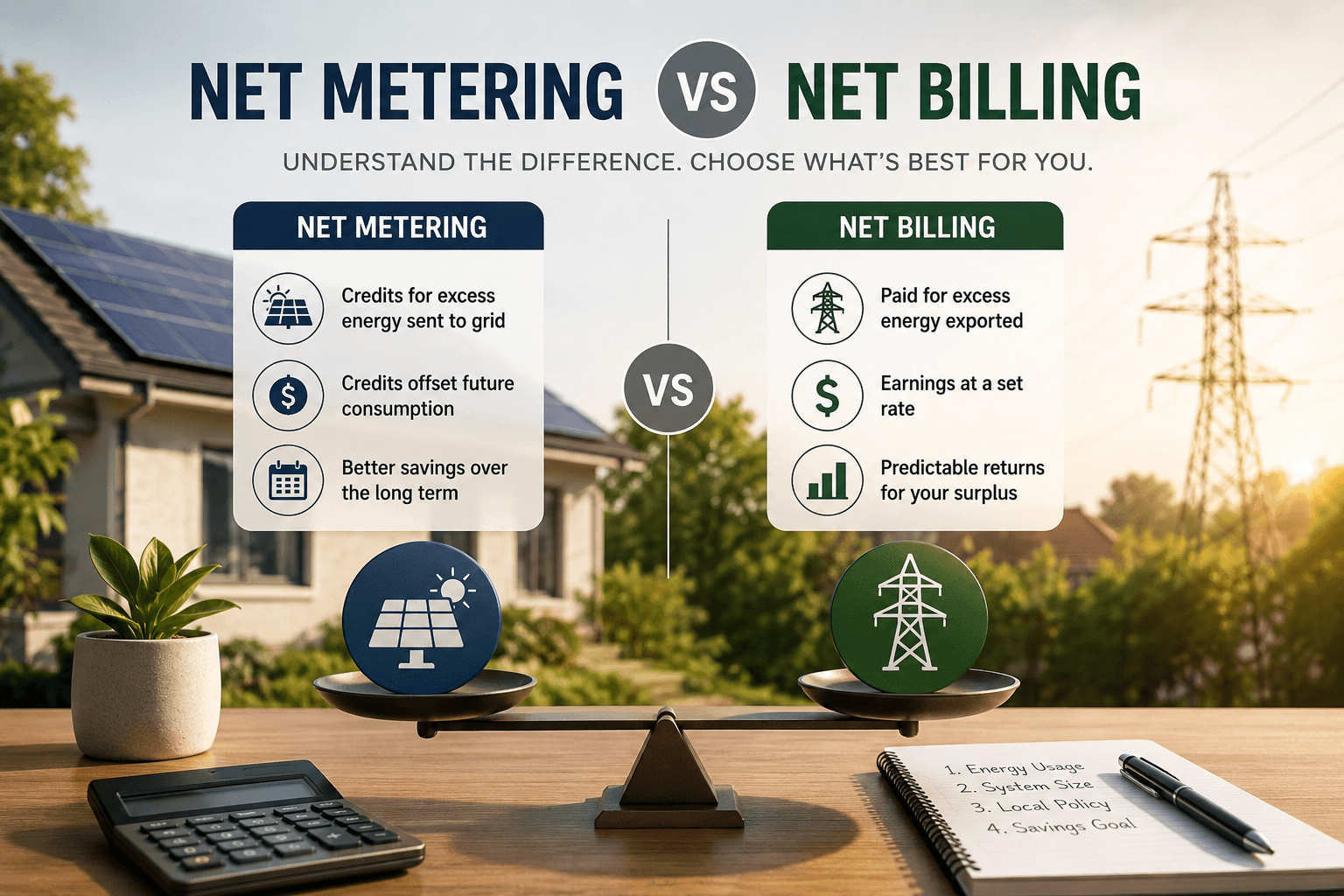
Net metering and export credits can strongly affect solar payback.
If your utility gives strong credit for exported solar electricity, annual savings may be higher. If exported electricity earns a lower credit, savings may be lower and payback may take longer.
| Utility Rule | How It Can Affect Payback |
|---|---|
| Full retail net metering | May shorten payback if credits are strong |
| Net billing | Payback depends on the export credit rate |
| Avoided cost credit | May lengthen payback if export value is low |
| Time-of-use rates | Production timing can change savings |
| Low or no export credit | System sizing and self-consumption become more important |
Do not assume every kWh of solar production has the same dollar value.
Read the net metering explained guide before trusting a payback estimate.
Step 6: Account for Financing
Financing can change solar payback in a major way.
If you pay cash, the simple payback calculation is more direct.
If you use a solar loan, include:
- cash price
- financed price
- APR
- loan term
- dealer fee
- monthly payment
- total repayment amount
- incentive paydown assumptions
A low monthly payment does not always mean a short payback period. A long loan term or high financed price can reduce long-term ROI.
For loan-specific math, read the solar loan calculator guide.
Step 7: Calculate Simple Payback
Once you have net cost and annual savings, calculate payback:
Net system cost ÷ annual savings = solar payback period
| Input | Example |
|---|---|
| Gross system cost | $25,000 |
| Verified rebate | $2,000 |
| Net system cost | $23,000 |
| Estimated annual savings | $1,800 |
| Simple payback period | 12.8 years |
Calculation:
$23,000 ÷ $1,800 = 12.8 years
This is a useful starting point, but it should not be the only number you use.
Mini Case Study: Using a Solar Payback Calculator
Here is a simplified homeowner example. These numbers are for illustration only and are not guaranteed.
Actual results depend on location, system cost, electricity rates, roof conditions, incentives, utility rules, financing, solar production, and actual energy use.
| Assumption | Example Value |
|---|---|
| Gross installed cost | $26,000 |
| Verified state or utility incentive | $1,500 |
| Net cost before financing | $24,500 |
| Estimated annual solar production | 10,000 kWh |
| Effective electricity value | $0.19/kWh |
| Estimated annual savings | $1,900 |
| Simple payback | 12.9 years |
Calculation:
$24,500 ÷ $1,900 = 12.9 years
This estimate could improve if the homeowner has higher electricity rates, lower system cost, stronger verified incentives, or better solar production.
It could weaken if financing costs are high, export credits are low, roof work is needed, or the system produces less than expected.
Run this scenario in the MySolarROI calculator, then test conservative, base-case, and optimistic assumptions.
What Is a Good Solar Payback Period?
A good solar payback period depends on your goals and assumptions.
Instead of using one universal benchmark, ask:
- Is the payback period shorter than the time I plan to stay in the home?
- Are the savings assumptions realistic?
- Are incentives verified?
- Does the estimate include financing costs?
- Does the estimate use my actual utility rules?
- Does the quote include roof or electrical work?
- How does the payback compare across multiple quotes?
A shorter payback is generally better, but only if the assumptions are reliable.
How Batteries Affect Solar Payback
Battery storage can add backup value, but it also adds cost.
A battery may improve value if:
- your utility has time-of-use rates
- export credits are low
- you need backup power
- there are battery incentives
- you can participate in a utility battery program
A battery may lengthen payback if:
- your utility has strong net metering
- the battery is expensive
- outages are rare
- there are no storage incentives
- your main goal is shortest financial payback
Always compare solar-only and solar-plus-battery payback separately.
For storage details, read the solar battery ROI guide.
Common Solar Payback Calculator Mistakes
| Mistake | Why It Can Mislead You | Better Approach |
|---|---|---|
| Using gross cost instead of net cost | May overstate payback if verified incentives apply | Use net cost after confirmed incentives |
| Using unverified incentives | May make payback look too short | Use only verified incentives in base case |
| Ignoring financing costs | Interest and fees can lengthen payback | Compare cash and financed scenarios |
| Assuming full net metering | Export credits vary by utility | Check your utility tariff |
| Ignoring fixed utility charges | Solar may not eliminate every bill charge | Review your bill structure |
| Combining solar and battery costs | Can hide whether storage helps or hurts ROI | Calculate solar-only and solar-plus-battery separately |
| Using only optimistic assumptions | Can make the quote look better than reality | Run conservative, base-case, and optimistic scenarios |
Questions to Ask Before Trusting a Payback Estimate
Before accepting a payback estimate from an installer or calculator, ask:
- What gross system cost was used?
- What cash price was used?
- What financed price was used?
- Which incentives are included?
- Are the incentives verified?
- What annual production is assumed?
- What electricity rate is used?
- What export credit rate is used?
- Are fixed charges included?
- Are financing costs included?
- Is battery cost included?
- Does the estimate include roof work or panel upgrades?
- What happens if production is lower than expected?
- What assumptions create the biggest change in payback?
If the assumptions are not clear, the payback estimate is not strong enough for a final decision.
How to Use a Solar Payback Calculator Safely
Use this process:
- Enter gross installed system cost.
- Subtract only verified incentives.
- Enter estimated annual solar production.
- Use your actual electricity rate or effective rate.
- Apply net metering or export credit rules.
- Estimate annual bill savings.
- Add financing costs if relevant.
- Separate battery cost if included.
- Calculate simple payback.
- Compare payback with lifetime ROI.
- Run conservative, base-case, and optimistic scenarios.
For a broader calculator framework, read the solar calculator comparison guide.
External Sources to Check
Before relying on a solar payback estimate, verify assumptions with reputable sources.
- NREL PVWatts Calculator
- Energy.gov homeowner solar guide
- EIA electricity data
- DSIRE incentive and policy database
- FTC consumer advice on solar power
- Your local utility’s current net metering, net billing, or solar buyback tariff
FAQ About Solar Payback Calculators
What does a solar payback calculator do?
A solar payback calculator estimates how many years it may take for electricity bill savings to recover your net solar system cost. It uses system cost, incentives, annual savings, utility rules, and sometimes financing assumptions.
How do I calculate solar payback period?
Use the formula: net solar system cost divided by annual electricity bill savings. For example, a $23,000 net cost divided by $1,800 in annual savings equals a 12.8-year simple payback period.
What is a good solar payback period?
A good payback period depends on your system cost, electricity rates, incentives, financing, utility rules, roof conditions, and how long you plan to stay in the home. Shorter is usually better, but assumptions matter.
Does financing affect solar payback?
Yes. Loan interest, dealer fees, and a higher financed price can lengthen payback and reduce ROI. Always compare cash and financed scenarios.
Do incentives shorten solar payback?
Verified incentives can reduce net system cost, which may shorten payback. Unverified incentives should not be included in your base-case calculation.
Does net metering affect solar payback?
Yes. If exported solar energy receives a strong credit, savings may be higher and payback shorter. If export credits are low, savings may be lower and payback longer.
Should batteries be included in solar payback?
Include batteries if they are part of the project, but also calculate solar-only and solar-plus-battery payback separately. Batteries can add backup value but may lengthen simple financial payback.
Is solar payback the same as solar ROI?
No. Solar payback shows the break-even timeline. Solar ROI estimates the broader financial return over the full analysis period.
Conclusion
A solar payback calculator is a practical tool for understanding how long it may take solar panels to recover their net cost through electricity bill savings.
The basic formula is simple:
Net system cost ÷ annual bill savings = solar payback period
But the quality of the estimate depends on the assumptions behind it.
Use verified incentives, realistic production estimates, actual utility rates, current net metering rules, transparent financing terms, and clear system costs. Then compare solar-only, financed, and battery scenarios separately.
Before comparing installer quotes, use the MySolarROI solar ROI calculator to estimate payback period, long-term savings, and solar ROI using realistic assumptions.