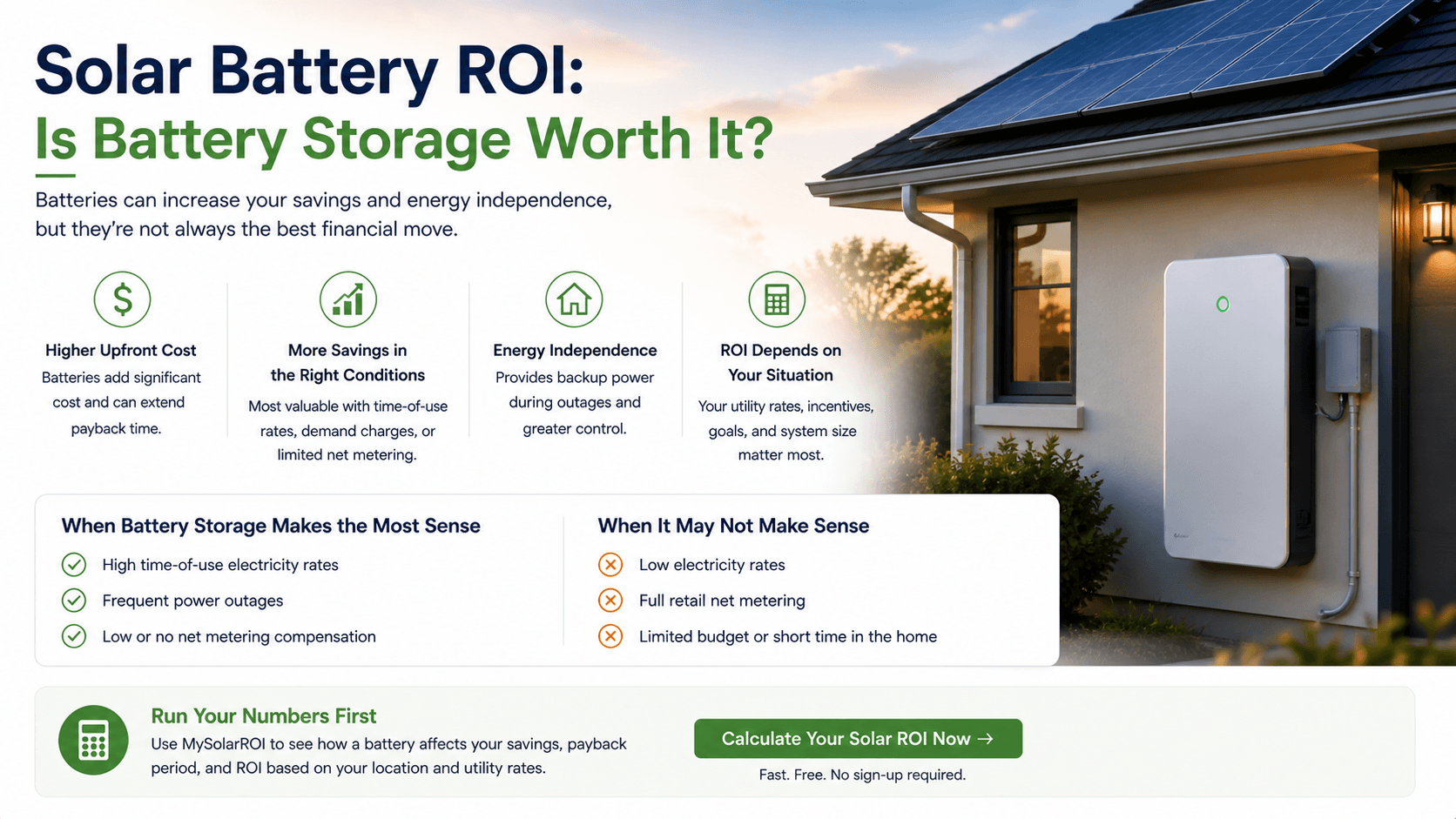
A battery can add real value. It can provide backup power during outages, store extra solar energy for later, help with time-of-use rates, and reduce reliance on the grid. But a battery also adds cost, and the financial return is not always as strong as solar panels alone.
That means the right question is not simply, “Should I add a battery?”
The better question is:
What problem is the battery solving, and is that value worth the added cost?
For some homeowners, battery storage may be worth it because backup power and resilience are high priorities. For others, a battery may not improve ROI enough to justify the cost, especially if net metering is strong and outages are rare.
This guide explains how solar battery ROI works, what affects battery payback, when storage may make sense, and how to compare solar-only vs. solar-plus-storage before signing a contract.
Evaluate storage using its additional cost and additional bill benefit relative to solar alone. Check capacity and power in the home battery sizing guide. The cash ROI calculator can compare user-supplied constant-year scenarios, but it does not simulate battery charging, dispatch, degradation or loan payments. Keep personal backup value separate from utility-bill savings.
Solar Battery ROI: The Quick Answer
Solar batteries can be worth it, but their value depends on why you are installing them.
A battery may make sense when:
- you experience frequent or costly outages
- your utility has high time-of-use rates
- your utility offers low export credits for excess solar
- you want backup power for critical loads
- your state or utility offers battery incentives
- you want to use more of your solar energy at home
- you value resilience even if simple financial payback is longer
A battery may be less attractive when:
- your utility offers strong full-retail net metering
- your power rarely goes out
- the battery price is high
- there are no storage incentives
- your rate plan does not reward shifting energy use
- you are focused only on shortest payback period
| Battery Value Driver | Financial Impact | Non-Financial Impact |
|---|---|---|
| Backup power | May not always create direct bill savings | Can be very valuable during outages |
| Time-of-use rates | Can save money if stored energy offsets high-rate periods | More control over energy use |
| Low export credits | May improve value by using more solar at home | Less reliance on utility buyback rates |
| Battery incentives | Can reduce net cost if you qualify | May improve payback |
| Grid services or virtual power plant programs | May provide compensation in some areas | Program rules vary widely |
The best way to evaluate storage is to compare solar-only and solar-plus-battery ROI separately.
What Is Solar Battery ROI?
Solar battery ROI compares the financial value created by battery storage with the added cost of installing the battery.
A simplified formula is:
Battery ROI = lifetime battery-related value ÷ net battery cost × 100
However, battery ROI is harder to calculate than solar panel ROI because the value of a battery may include both financial and non-financial benefits.
Battery value may come from:
- lower utility bills
- time-of-use savings
- avoided low export credits
- backup power during outages
- participation in utility battery programs
- avoided generator fuel or maintenance
- greater energy independence
Some of these are easy to estimate. Others, such as backup value, are personal.
For example, a homeowner who works from home, uses medical equipment, or lives in an outage-prone area may value backup power more than a homeowner with rare outages and low electricity rates.
Solar-Only vs. Solar-Plus-Battery ROI
The first step is to separate the solar system from the battery.
Solar panels usually create value by reducing the amount of electricity you buy from the grid. A battery creates value by changing when and how that solar energy is used.
| Scenario | Main Value | What to Calculate |
|---|---|---|
| Solar-only | Bill savings from solar production | Solar payback and solar ROI |
| Solar-plus-battery | Solar savings plus storage value | Combined payback and ROI |
| Battery added to existing solar | Storage value only | Battery-specific payback |
| Backup-only battery | Resilience and outage protection | Cost vs backup value, not just bill savings |
If you combine everything into one number, it may be hard to tell whether the battery is helping or hurting the financial return.
A useful comparison asks:
- What is the payback period for solar-only?
- What is the payback period for solar-plus-battery?
- How much extra cost does the battery add?
- How much extra savings or value does the battery create?
- Is the difference worth it for backup power or resilience?
For the solar-only calculation, read the how to calculate solar ROI guide.
What Makes a Solar Battery Valuable?
A battery stores electricity for later use. With solar, that usually means storing extra daytime solar energy and using it when your panels are not producing enough power.
Energy.gov explains that residential solar energy systems paired with battery storage can provide power without relying on the grid when solar production is unavailable, including during outages or at night.
The value depends on your situation.
| Battery Use Case | Why It Matters | ROI Consideration |
|---|---|---|
| Backup power | Keeps selected loads running during outages | Value is partly personal and resilience-based |
| Time-of-use savings | Uses stored energy during expensive rate periods | Can create bill savings if rate spread is large |
| Low export credits | Stores solar instead of exporting at a low rate | Can improve value of excess solar |
| Demand charge management | Can reduce peak demand in some rate plans | More common in commercial, but possible in some residential plans |
| Virtual power plant programs | Utility may compensate battery participation | Depends on program availability and rules |
If your battery is mainly for backup, a strict payback calculation may not capture its full value. If your battery is mainly for bill savings, the rate structure and export credit rules matter more.
Battery Cost: What Should Be Included?
Battery cost is more than the battery hardware.
A full solar battery quote may include:
- battery unit
- battery inverter or hybrid inverter
- backup gateway or transfer equipment
- critical load panel
- electrical work
- permitting
- installation labor
- monitoring
- design work
- fire code or clearance requirements
- warranty coverage
- future replacement assumptions
NREL’s 2024 Annual Technology Baseline represents residential battery storage with a 5 kW / 12.5 kWh lithium-ion system for cost and performance modeling. It also notes that the 2024 ATB represents lithium-ion batteries, with LFP becoming the primary stationary storage chemistry starting in 2021.
When comparing battery quotes, ask for:
| Battery Quote Item | Question to Ask |
|---|---|
| Usable capacity | How many kWh can the battery actually deliver? |
| Power rating | How many kW can it provide at once? |
| Backup capability | Can it power the whole home or only critical loads? |
| Warranty | What years, cycles, and capacity retention are covered? |
| Installed cost | What is the total cost after equipment and labor? |
| Incentives | Are storage incentives included and verified? |
| Replacement | Will replacement be needed during the analysis period? |
Do not compare batteries only by nameplate capacity. Usable capacity, power output, warranty, and backup configuration matter.
How Time-of-Use Rates Affect Battery ROI
Time-of-use rates charge different electricity prices at different times of day.
A battery may create value if it charges from solar during lower-value periods and discharges during high-cost periods.
Example:
- Solar charges the battery during midday.
- The home uses battery power during expensive evening peak hours.
- The homeowner buys less high-rate electricity from the grid.
The larger the difference between low-value solar export and high-cost grid import, the more valuable storage may become.
| Rate Situation | Battery ROI Impact |
|---|---|
| Flat electricity rate with strong net metering | Battery may provide limited bill savings |
| High evening peak rates | Battery may improve bill savings |
| Low solar export credit | Battery may help use more solar at home |
| Large seasonal rate differences | Battery value depends on usage and timing |
| Battery program compensation | May improve ROI if program terms are favorable |
Ask your installer to show the rate plan and time periods used in the battery savings estimate.
How Net Metering Affects Battery ROI
Net metering and export credit rules can strongly affect battery ROI.
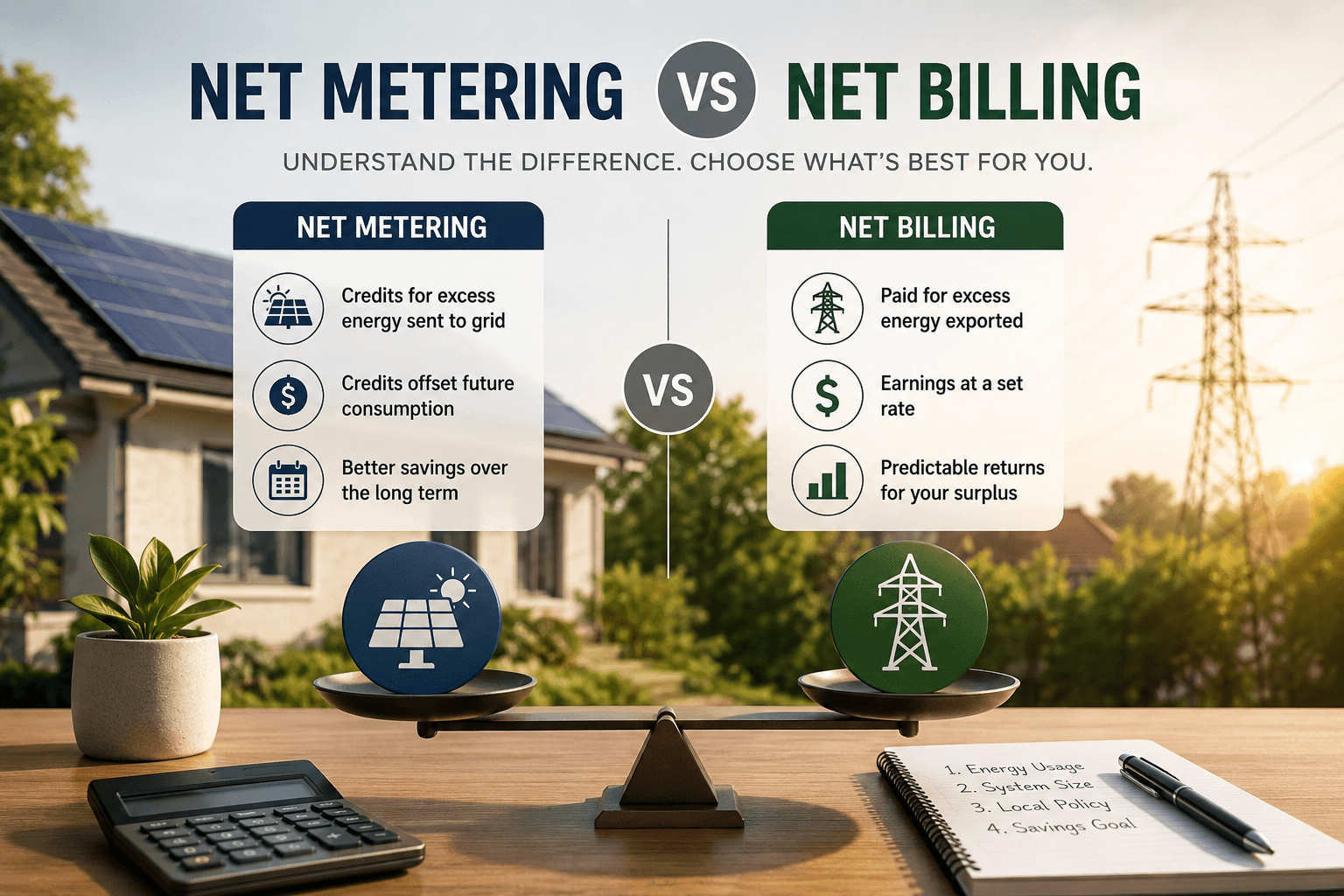
If your utility offers full retail net metering, extra solar sent to the grid may already receive strong credit. In that case, adding a battery may not create much extra bill savings unless you also value backup power.
If your utility offers lower export credits, storing solar for later use may be more valuable.
| Utility Rule | Battery Value |
|---|---|
| Full retail net metering | Battery may be less valuable financially, but backup value may still matter |
| Net billing | Battery may help avoid exporting at lower rates |
| Low buyback rate | Battery may improve value by increasing self-consumption |
| Time-of-use export rates | Battery timing may matter more |
| No meaningful export credit | Battery can help use more solar energy on site |
For more detail, read the net metering explained guide.
Battery Incentives and Tax Credit Caution
Battery incentives can improve solar battery ROI, but they must be verified.
Possible storage incentives may include:
- state battery rebates
- utility battery programs
- virtual power plant incentives
- demand response payments
- local resilience programs
- tax credits, if eligible under current rules
DSIRE is a useful starting point for researching renewable energy and energy efficiency incentives and policies in the United States.
For federal residential tax credit planning, homeowners should be cautious. IRS guidance states that battery storage technology must have a capacity of at least 3 kilowatt-hours to qualify under the Residential Clean Energy Credit rules, but IRS instructions for Form 5695 also state that residential clean energy credits cannot be claimed for expenditures made after December 31, 2025.
This article is educational only and is not tax, legal, or financial advice. Always verify current IRS rules, installation timing, ownership, and eligibility with official sources or a qualified tax professional.
For more detail, read the federal solar tax credit 2026 guide and the solar tax credit calculator guide.
Mini Case Study: Solar-Only vs Solar-Plus-Battery
Here is a simplified example. These numbers are for illustration only and are not guaranteed.
Actual results depend on location, utility rates, outage needs, battery cost, battery size, incentives, system design, net metering rules, financing, and actual energy usage.
| Assumption | Solar-Only | Solar-Plus-Battery |
|---|---|---|
| Solar system cost | $24,000 | $24,000 |
| Battery added cost | $0 | $12,000 |
| Verified incentive | $1,000 | $1,000 solar + $2,000 battery incentive |
| Net cost before financing | $23,000 | $33,000 |
| Annual solar bill savings | $1,800 | $1,800 |
| Additional battery bill savings | $0 | $350 |
| Total estimated annual value | $1,800 | $2,150 plus backup value |
| Simple payback | 12.8 years | 15.3 years before personal backup value |
Simple payback calculations:
$23,000 ÷ $1,800 = 12.8 years
$33,000 ÷ $2,150 = 15.3 years
In this example, the battery increases total annual value but also increases net cost. The solar-plus-battery system has a longer simple payback period, but the homeowner may still choose it if backup power is valuable.
The important question is whether the added battery value is worth the added cost.
How to Estimate Battery Payback
Battery payback is not always simple because batteries may create both direct and indirect value.
A simple battery-only payback formula is:
Battery payback = net battery cost ÷ annual battery-related savings
Example:
| Battery Input | Example Value |
|---|---|
| Installed battery cost | $12,000 |
| Verified battery incentive | $2,000 |
| Net battery cost | $10,000 |
| Annual bill savings from battery | $350 |
| Simple battery payback | 28.6 years |
$10,000 ÷ $350 = 28.6 years
Strictly financially, this would be a long payback. But that calculation does not include the personal value of backup power, avoided generator use, or outage protection.
That is why battery ROI should be separated into:
- bill savings value
- backup power value
- incentive value
- resilience value
- possible utility program value
Backup Power: The Value That Is Hard to Price
Backup power is one of the biggest reasons homeowners add batteries.
A battery can keep selected loads running when the grid is down. Depending on battery size and backup configuration, those loads may include:
- refrigerator
- lights
- internet/router
- medical equipment
- sump pump
- well pump
- garage door opener
- selected outlets
- small appliances
Not every battery backs up the whole home. Some systems are designed for a critical loads panel. Others may support larger loads if sized properly.
| Backup Question | Why It Matters |
|---|---|
| Whole home or critical loads? | Determines how much can run during an outage |
| How many hours of backup? | Depends on battery capacity and load size |
| Can it restart large loads? | Motors and compressors may need surge power |
| Can solar recharge the battery during outage? | Important for extended outages |
| What loads are not backed up? | Prevents unrealistic expectations |
If backup is your main goal, ask for a load analysis rather than just a battery price.
Solar Battery vs Generator
Some homeowners compare batteries with generators.
They solve overlapping problems, but they are not the same.
| Feature | Solar Battery | Generator |
|---|---|---|
| Fuel | Stores electricity, can recharge from solar if designed for it | Uses fuel such as gasoline, diesel, propane, or natural gas |
| Noise | Quiet operation | Usually noisy |
| Emissions at home | No on-site combustion during operation | Produces exhaust and requires safe placement |
| Runtime | Limited by battery capacity and recharge | Limited by fuel supply and maintenance |
| Bill savings | May help with TOU rates or self-consumption | Usually backup only |
| Maintenance | Generally lower, but battery warranty matters | Requires maintenance and fuel management |
A generator may be better for long outages with high loads. A battery may be better for quiet backup, short outages, solar integration, and time-of-use optimization.
Some homes use both.
When a Solar Battery May Be Worth It
A solar battery may be worth it when several of these conditions apply:
- You have frequent outages.
- You have critical loads that need backup.
- Your utility has high evening peak rates.
- Your utility offers low export credits.
- You have a strong battery incentive.
- You can join a battery program or virtual power plant.
- You want to reduce generator reliance.
- You value resilience even if simple payback is longer.
Battery storage is often most compelling when it solves more than one problem at once: backup power, rate shifting, and low export credit management.
When a Solar Battery May Not Be Worth It
A battery may be less attractive when:
- your utility offers full retail net metering
- outages are rare and short
- the battery quote is expensive
- there are no storage incentives
- your rate plan has little time-of-use spread
- your main goal is shortest financial payback
- you plan to move soon
- you do not need backup power
In these cases, solar-only may provide stronger ROI than solar-plus-battery.
For a broader decision framework, read is solar worth it.
Questions to Ask Before Adding a Battery
Before signing a battery contract, ask:
- What is the installed battery cost?
- What is the usable battery capacity?
- What is the battery power rating?
- What loads will be backed up?
- Is this whole-home backup or critical-load backup?
- Can solar recharge the battery during an outage?
- How long will the battery run my selected loads?
- What warranty applies?
- What capacity retention is guaranteed?
- Are incentives included and verified?
- Does the estimate include a critical loads panel?
- Does the battery improve bill savings or mainly backup value?
- How does this change solar payback?
- What happens if I sell the home?
Ask for written answers and a clear load list.
Common Solar Battery ROI Mistakes
| Mistake | Why It Can Mislead You | Better Approach |
|---|---|---|
| Combining solar and battery into one number | Hides whether the battery helps or hurts ROI | Compare solar-only and solar-plus-battery separately |
| Ignoring backup value | Financial payback may miss the main reason for storage | Separate bill savings from resilience value |
| Assuming batteries always pay for themselves | Battery bill savings may be limited | Use actual utility rates and export credits |
| Assuming full-home backup | Many batteries only support selected loads | Ask for a backed-up loads list |
| Ignoring warranty and usable capacity | Nameplate capacity may overstate real usable energy | Compare usable kWh, power rating, warranty, and cycles |
| Using unverified incentives | Net cost may be understated | Verify programs with official sources |
| Forgetting financing cost | Loan interest can lengthen payback | Compare cash and financed battery cost |
Sources and verification
Before relying on a battery savings or ROI estimate, verify assumptions with reputable sources.
- Energy.gov guide to battery storage for solar systems
- NREL ATB residential battery storage data
- IRS Residential Clean Energy Credit guidance
- IRS Form 5695 instructions
- DSIRE incentive and policy database
- Your local utility’s time-of-use, net metering, battery incentive, and virtual power plant program pages
FAQ About Solar Battery ROI
What is solar battery ROI?
Solar battery ROI compares the value created by battery storage with the net cost of adding the battery. Value may include bill savings, time-of-use savings, backup power, incentives, and resilience benefits.
Do solar batteries pay for themselves?
Sometimes, but not always. Batteries are more likely to pay back financially when utility rates reward energy shifting, export credits are low, incentives are strong, or battery programs provide compensation. Backup value may matter even when financial payback is long.
Is a battery worth it with full net metering?
If your utility offers strong full-retail net metering, a battery may provide limited extra bill savings. It may still be worth it if backup power, outage protection, or resilience is important to you.
Is a battery worth it with time-of-use rates?
A battery may be more valuable with time-of-use rates if it can store solar energy and discharge during expensive peak periods. The rate difference must be large enough to justify the added cost.
How do I calculate battery payback?
A simple formula is net battery cost divided by annual battery-related savings. However, this may not capture backup power value, outage protection, generator replacement, or resilience benefits.
Can a battery power my whole house?
Some systems can support whole-home backup, but many are designed for critical loads only. It depends on battery capacity, power rating, inverter design, load size, and backup panel configuration.
Can solar recharge my battery during an outage?
Some solar-plus-storage systems can recharge from solar during an outage, but not all configurations do this automatically. Ask the installer exactly how the system works when the grid is down.
Should I add a battery now or later?
It depends on cost, incentives, compatibility, backup needs, and utility rules. If you may add a battery later, ask whether your solar system will be battery-ready and what future integration may cost.
Conclusion
Solar battery ROI depends on more than simple bill savings.
A battery may be worth it if it provides valuable backup power, helps manage time-of-use rates, improves self-consumption under low export credits, or qualifies for strong incentives.
A battery may be less attractive if your utility offers strong net metering, outages are rare, storage incentives are limited, or your main goal is the shortest financial payback.
The best approach is to compare solar-only and solar-plus-battery scenarios separately.