Trying to figure out whether solar panels are worth it can feel confusing because every quote seems to use different numbers.
One installer may focus on monthly bill savings. Another may highlight incentives. A third may show a long-term savings estimate that looks attractive but does not clearly explain the assumptions behind it.
That is why learning how to calculate solar ROI matters.
Solar return on investment is not just about the price of panels. It depends on your system cost, electricity rate, solar production, incentives, financing, net metering or buyback rules, roof conditions, maintenance assumptions, and how long you stay in the home.
This guide walks through the solar ROI formula step by step so you can compare quotes with clearer numbers and avoid relying only on a sales estimate.
Before you speak with installers or compare multiple quotes, use the MySolarROI solar ROI calculator to test your own assumptions for system cost, bill savings, incentives, payback period, and long-term return.
What Does Solar ROI Mean?
Solar ROI measures how much financial return you may receive from a solar panel system compared with what you invest.
For homeowners, “return” usually means avoided electricity costs over time. Your solar system may reduce how much electricity you buy from the utility. In some areas, exported solar energy may also earn bill credits through net metering, net billing, or a utility solar buyback program.
A simple homeowner-friendly formula is:
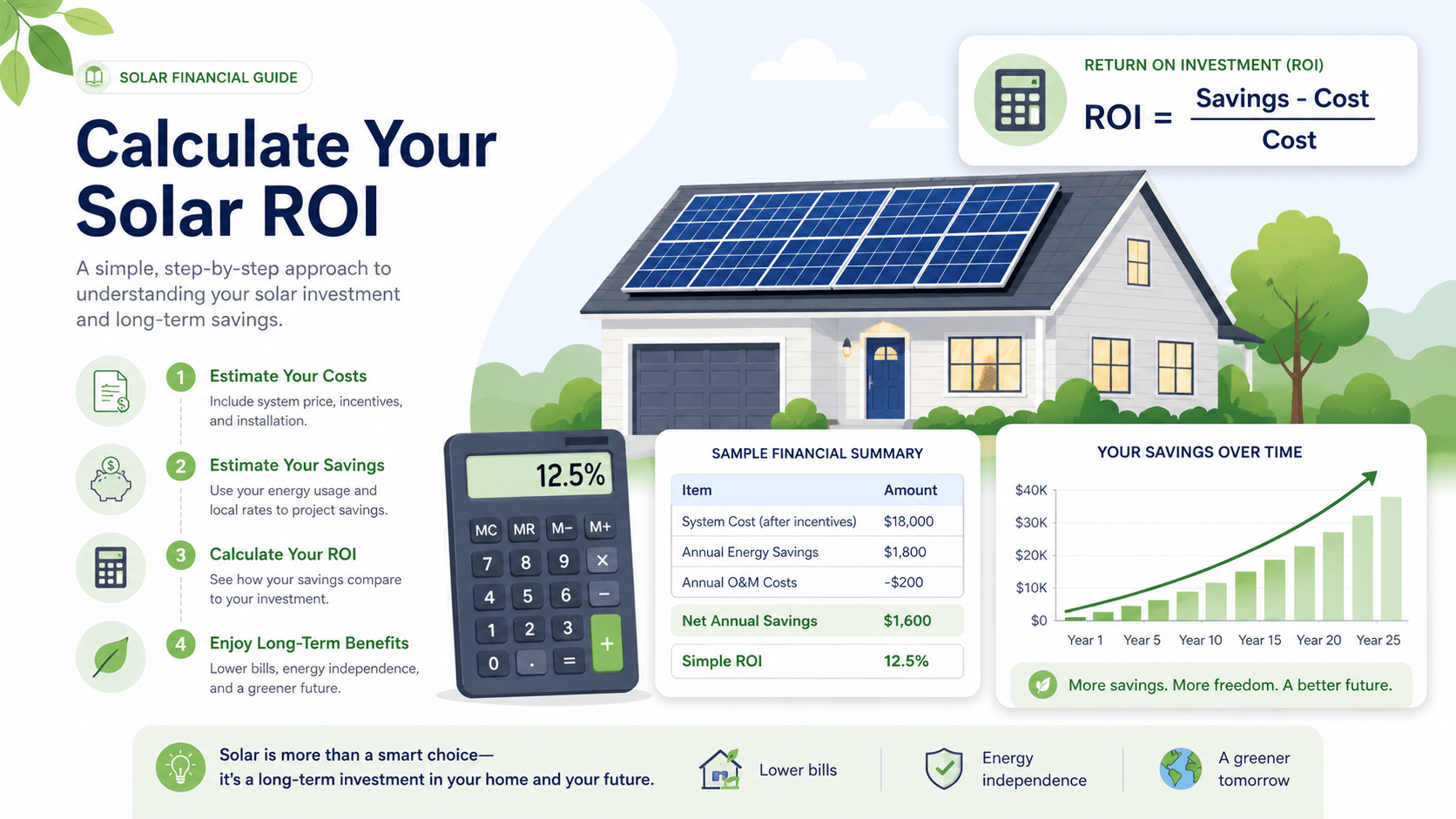
Solar ROI = lifetime net savings ÷ net system cost × 100
A more detailed version is:
Solar ROI = lifetime net savings after costs ÷ net solar investment × 100
Your result is a percentage.
A positive ROI means your estimated lifetime savings are greater than your net system cost. A negative ROI means the system may not recover its cost within the period you are analyzing.
The key word is “estimated.” Solar ROI is not guaranteed. Your result can change based on your actual energy usage, utility rates, roof conditions, incentives, system design, financing terms, and future policy changes.
Solar ROI vs Solar Payback Period
Solar ROI and solar payback period are related, but they are not the same thing.
| Metric | What It Tells You | Simple Example |
|---|---|---|
| Solar payback period | How long it may take to recover your net upfront cost | “This system may pay for itself in about 10 years.” |
| Solar ROI | How much total return you may receive over the analysis period | “This system may generate a positive return over 25 years.” |
Payback period is easier to understand because it answers a simple question:
How many years until my savings equal my cost?
Solar ROI goes further. It looks at the total estimated financial return over time.
For example, two systems may both have a 10-year payback period, but one may produce higher lifetime savings if it lasts longer, has lower financing costs, or offsets more expensive electricity.
That is why it is useful to review both metrics before making a decision. For a deeper explanation, read the solar payback period guide.
What You Need Before Calculating Solar ROI
Before calculating solar ROI, gather the numbers that actually affect your return.
| Input | Why It Matters | Example |
|---|---|---|
| Gross system cost | Starting price before incentives or rebates | $24,000 |
| Eligible incentives | May reduce your net cost if you qualify | Utility rebate, state incentive, or tax credit |
| Annual solar production | Determines how much electricity the system may generate | 9,800 kWh/year |
| Electricity rate | Affects the value of each kWh your system offsets | $0.18/kWh |
| Annual electricity usage | Helps estimate how much of your bill solar can offset | 11,000 kWh/year |
| Net metering or buyback rules | Determines how exported solar energy is credited | Retail credit, avoided cost, or buyback rate |
| Financing terms | Interest, fees, and loan length can change ROI | APR, dealer fee, loan term |
| Battery costs | Adds cost, but may provide backup power or load shifting | Optional battery system |
| Roof condition | Roof work can increase project cost | New roof or repairs |
| Panel degradation | Production may decline gradually over time | Annual production decline assumption |
| Time in home | ROI depends on how long you benefit from the system | 7, 10, 15, or 25 years |
Do not use numbers just because they appear in a quote. Ask where each estimate came from.
A strong quote should clearly explain:
- system size
- panel type
- inverter type
- expected production
- price before and after incentives
- financing terms
- warranty coverage
- assumptions about utility bill savings
- assumptions about net metering or export credits
If those assumptions are unclear, your ROI estimate may be less reliable.
How to Calculate Solar ROI Step by Step
Step 1: Start With Your Gross Solar System Cost
Your gross system cost is the total installed price before incentives.
It may include:
- solar panels
- inverter or microinverters
- racking
- electrical work
- permitting
- installation labor
- monitoring equipment
- sales and overhead costs
If you are adding a battery, roof work, panel upgrade, or EV charger, decide whether to include those costs in the same ROI calculation or analyze them separately.
For a clean solar-only ROI estimate, many homeowners start with the solar system cost first, then run a second scenario with battery or roof-related costs included.
Step 2: Subtract Eligible Incentives and Rebates
Next, estimate your net system cost after incentives you reasonably expect to qualify for.
These may include:
- federal incentives
- state incentives
- local rebates
- utility rebates
- performance-based incentives
- renewable energy credits, if available
Be careful here. Do not assume you qualify for every incentive mentioned in a sales proposal.
Incentive rules can depend on:
- where you live
- when the system is installed
- whether you own the system
- tax liability
- utility territory
- system size
- equipment requirements
- program funding availability
This article is educational and should not be treated as tax, legal, or financial advice. Always verify current incentive rules with official sources or a qualified professional before relying on them in your ROI estimate.
You can also compare incentive assumptions with the solar tax credit calculator before using them in your final ROI estimate.
Step 3: Estimate Annual Solar Production
Solar production is the amount of electricity your system may generate each year.
It is usually measured in kilowatt-hours, or kWh.
Solar production depends on:
- system size
- location
- roof orientation
- roof tilt
- shade
- weather patterns
- panel efficiency
- inverter performance
- system losses
- panel degradation over time
A south-facing, mostly unshaded roof may produce more electricity than a shaded or poorly oriented roof. However, many non-perfect roofs can still work depending on local conditions and system design.
For a stronger estimate, compare the production number in your installer quote with a trusted solar production tool such as NREL PVWatts or another reputable modeling source.
For more detail on how assumptions are handled, review the solar calculator methodology.
Step 4: Estimate Annual Electricity Savings
Once you have estimated annual solar production, calculate how much that electricity may be worth.
A simple first-year savings estimate is:
Annual solar production × electricity rate = estimated first-year bill savings
Example:
9,800 kWh × $0.18/kWh = $1,764 estimated first-year savings
This is a simplified estimate. Your real savings may be different because utility bills often include:
- fixed monthly charges
- minimum bills
- time-of-use rates
- demand charges in some cases
- different rates for imported and exported electricity
- seasonal rate changes
- net metering or net billing rules
That is why electricity rate assumptions matter so much. A homeowner paying $0.30/kWh may see a very different return than a homeowner paying $0.12/kWh, even if both install the same system size.
Step 5: Include Financing Costs
If you pay cash, your solar ROI calculation is usually simpler.
If you finance the system, include the real cost of financing.
Solar loans can affect ROI through:
- interest rate
- loan term
- dealer fees
- origination fees
- monthly payment structure
- whether the loan assumes an incentive paydown
- prepayment penalties, if any
A financed system can still make sense, but the ROI may be lower than the cash scenario if interest and fees are high.
When comparing quotes, ask for both:
- the cash price
- the financed price
- the APR
- the loan term
- any dealer fee or financing-related price increase
Then compare the solar ROI under both scenarios.
Use the solar financing comparison guide to understand how cash, loans, leases, and PPAs can affect long-term savings.
Step 6: Account for Net Metering or Buyback Rules
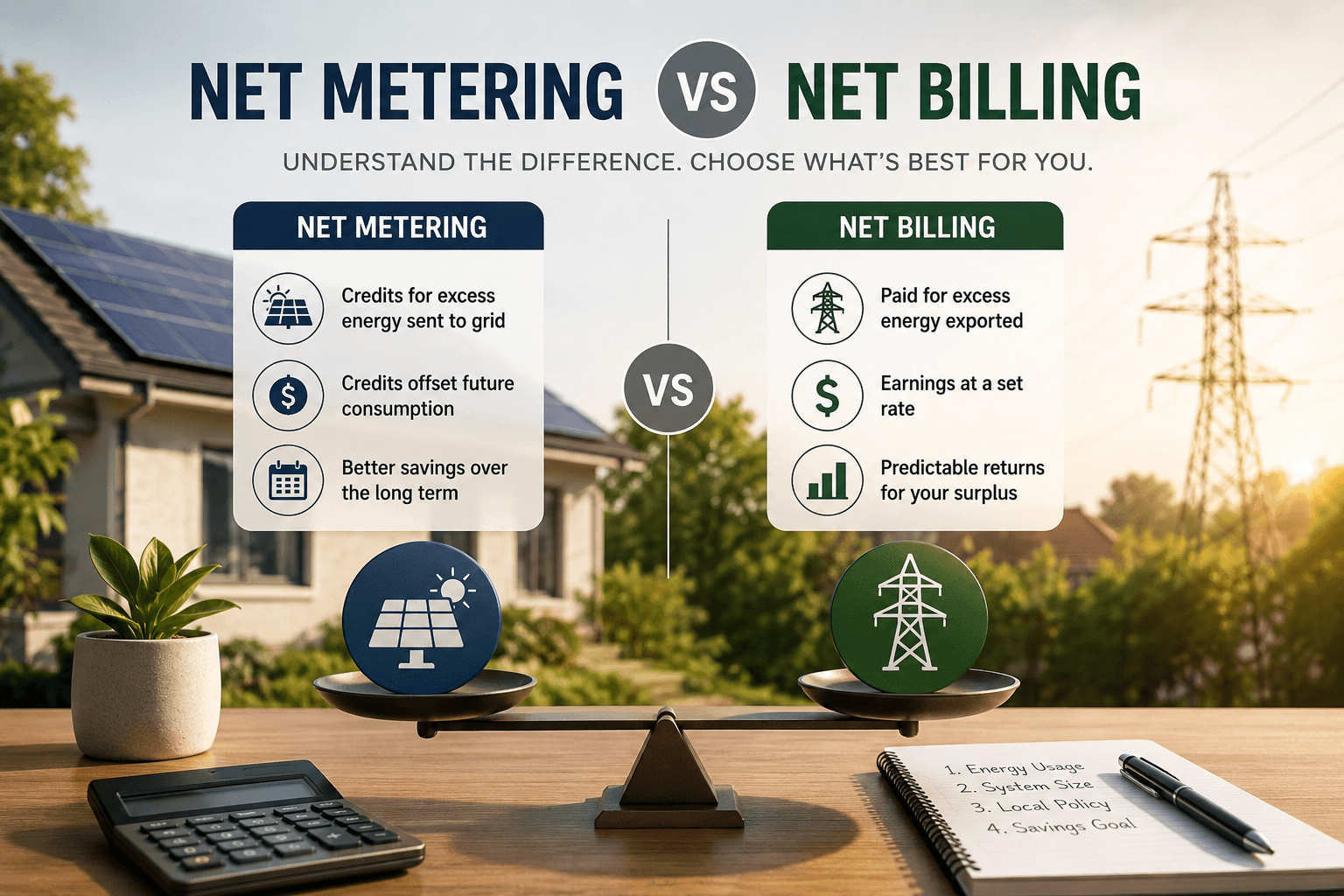
Net metering and solar buyback rules can have a major impact on solar ROI.
If your utility gives full retail credit for exported solar electricity, your savings may be stronger. If exported energy is credited at a lower rate, your savings may be reduced.
| Credit Structure | How It Works | ROI Impact |
|---|---|---|
| Full retail net metering | Exported solar earns credit near the retail electricity rate | Often stronger savings |
| Net billing | Exported solar earns a separate export rate | Savings depend on buyback rate |
| Avoided cost credit | Exported solar is credited at a lower utility cost-based rate | May reduce savings |
| No meaningful export credit | Excess solar earns little or no credit | Self-consumption becomes more important |
This is one reason two homeowners with similar systems can see very different financial results.
If your area has lower export credits, battery storage or load shifting may help use more solar energy at home, but batteries add cost and should be analyzed separately.
Learn more in the net metering explained guide.
Step 7: Estimate Solar Payback Period
Solar payback period estimates how long it may take for your cumulative savings to equal your net system cost.
The simple formula is:
Solar payback period = net system cost ÷ annual savings
Example:
$23,000 ÷ $1,764 = about 13 years
This does not mean your system stops producing value after year 13. It means that, in this simplified example, the homeowner may recover the net cost after about 13 years if assumptions hold.
Payback period can become shorter if:
- electricity rates are high
- system cost is low
- incentives are strong
- solar production is high
- financing costs are low
- net metering credits are favorable
Payback period can become longer if:
- the system is expensive
- electricity rates are low
- roof work is needed
- financing fees are high
- export credits are low
- the system is shaded or underproduces
Step 8: Calculate Lifetime Solar ROI
After estimating annual savings and payback period, calculate long-term ROI.
A simplified lifetime ROI formula is:
Solar ROI = lifetime net savings ÷ net system cost × 100
To estimate lifetime net savings, consider:
- first-year savings
- expected utility rate changes
- panel degradation
- maintenance costs
- inverter replacement assumptions, if relevant
- financing costs
- battery replacement assumptions, if included
- how many years you plan to analyze
Many homeowners use a 20- to 25-year analysis period because solar panels often have long warranties. However, if you plan to move in 7 years, your personal ROI may look different.
The best approach is to run multiple scenarios:
| Scenario | Assumptions | Why It Helps |
|---|---|---|
| Conservative | Lower production, lower utility rate growth, higher costs | Shows downside risk |
| Base case | Reasonable middle-ground estimate | Helps compare quotes |
| Optimistic | Higher savings, better incentives, lower costs | Shows upside potential |
Do not make a solar decision based only on the optimistic case.
Solar ROI Example for a Homeowner
Here is a simplified example. These numbers are for illustration only and are not a guarantee.
Actual results depend on location, electricity rates, roof conditions, incentives, utility rules, financing terms, system design, maintenance, and how long the homeowner stays in the home.
| Assumption | Example Value |
|---|---|
| Gross system cost | $24,000 |
| Verified rebate | $1,000 |
| Net system cost before tax considerations | $23,000 |
| Estimated first-year production | 9,800 kWh |
| Electricity rate | $0.18/kWh |
| Estimated first-year bill savings | $1,764 |
| Estimated simple payback | About 13 years |
Simple payback estimate:
$23,000 ÷ $1,764 = 13.0 years
Now imagine the homeowner analyzes a 25-year period.
If the system continues producing electricity and the homeowner stays in the home long enough, total savings may exceed the original net cost. But the final result will depend on the assumptions used.
What could change this result?
- A higher electricity rate could improve savings.
- A lower export credit could reduce savings.
- A solar loan with high fees could reduce ROI.
- Roof repairs could increase the total project cost.
- A shaded roof could reduce annual production.
- Moving sooner could reduce the homeowner’s personal benefit.
This is why it is helpful to test more than one scenario before comparing installer quotes.
Use the MySolarROI calculator to adjust system cost, annual production, incentives, electricity rates, and financing assumptions before deciding whether a quote makes sense.
What Can Improve Solar ROI?
Solar ROI may be stronger when several favorable factors line up.
| Factor | Why It Can Help |
|---|---|
| High electricity rates | Each kWh of solar production offsets more expensive utility power |
| Good roof exposure | Better production can improve savings |
| Reasonable system cost | Lower upfront cost can shorten payback |
| Strong incentives | Eligible rebates or credits may reduce net cost |
| Favorable net metering | Higher export credit can improve bill savings |
| Low financing cost | Lower interest and fees preserve more savings |
| Long time in the home | More years of savings can improve lifetime ROI |
A homeowner with high electricity rates, a good roof, fair pricing, and strong utility credit rules may see a very different result than a homeowner with low rates, heavy shade, expensive financing, and weak export credits.
What Can Weaken Solar ROI?
Solar may still be useful for some homeowners even when ROI is not ideal, but these factors can reduce the financial return:
| Factor | Why It Can Hurt ROI |
|---|---|
| High installed price | Raises the amount you need to recover |
| Heavy shade | Reduces solar production |
| Low electricity rates | Reduces the value of each kWh saved |
| Weak export credits | Lowers the value of excess solar energy |
| Expensive financing | Interest and fees reduce net savings |
| Roof replacement needs | Adds cost to the project |
| Short time in home | Fewer years to benefit from savings |
| Oversized system | Extra production may have lower value if export credits are weak |
A good solar ROI estimate should not ignore these risks. It should make them visible so you can compare your options clearly.
Common Solar ROI Mistakes
| Mistake | Why It Hurts the Estimate | Better Approach |
|---|---|---|
| Using only the installer’s savings estimate | The quote may use optimistic assumptions | Run your own conservative, base, and optimistic scenarios |
| Ignoring financing costs | Interest and dealer fees can reduce real ROI | Compare cash price and financed price separately |
| Counting incentives without verifying eligibility | Not every homeowner qualifies for every incentive | Confirm rules with official sources or a professional |
| Assuming full net metering everywhere | Export credit rules vary by utility and state | Check your local utility policy |
| Ignoring roof condition | Roof work can increase total project cost | Include roof-related costs before calculating ROI |
| Looking only at payback period | Payback does not show total lifetime return | Review both payback and ROI |
| Using one electricity rate forever | Rates may change over time | Test multiple rate assumptions |
| Forgetting system performance changes | Production can vary and may decline gradually | Use realistic production assumptions |
The goal is not to make the numbers look better. The goal is to make them more useful.
How to Compare Solar Quotes Using ROI
When you receive multiple solar quotes, do not compare only the monthly payment.
Compare each quote using the same assumptions.
Use this checklist:
- What is the gross system cost?
- What is the cash price?
- What is the financed price?
- What is the system size?
- What is the estimated annual production?
- What electricity rate is used?
- What incentives are included?
- Are those incentives guaranteed or only possible?
- What net metering or export credit assumption is used?
- What happens if production is lower than estimated?
- What warranties are included?
- What maintenance or replacement costs should be considered?
Then calculate ROI for each quote using the same method.
| Quote Element | Quote A | Quote B | Quote C |
|---|---|---|---|
| System size | |||
| Gross cost | |||
| Cash price | |||
| Financed price | |||
| Estimated production | |||
| Estimated annual savings | |||
| Incentives included | |||
| Payback period | |||
| Estimated ROI |
This makes it easier to see whether a quote is genuinely better or simply presented more attractively.
For source transparency and assumptions, you can also review the MySolarROI data sources.
External Sources to Check
For stronger assumptions, verify current information with reputable sources before making a decision.
Useful sources include:
- U.S. Department of Energy homeowner solar guidance
- NREL PVWatts solar production estimates
- DSIRE state, local, and utility incentive database
- EIA electricity data
- Your state energy office or local utility for current net metering and buyback rules
These sources can help you avoid relying only on sales materials or outdated incentive information.
FAQ About Calculating Solar ROI
How do you calculate solar ROI?
Solar ROI is usually calculated by comparing lifetime net savings with the net system cost. A simple formula is lifetime net savings divided by net system cost, multiplied by 100. For a better estimate, include incentives, financing costs, utility rates, production assumptions, maintenance, and net metering rules.
What is a good ROI for solar panels?
A good solar ROI depends on your system cost, electricity rate, incentives, net metering or buyback rules, financing, roof conditions, and how long you stay in the home. There is no single universal number that applies to every homeowner.
Is solar ROI the same as solar payback period?
No. Solar payback period estimates how long it may take to recover your net system cost. Solar ROI estimates the broader financial return over the full analysis period. Both are useful, but they answer different questions.
What costs should I include when calculating solar ROI?
Include the installed system cost, financing costs, roof-related work, battery costs if applicable, maintenance assumptions, inverter replacement assumptions if relevant, and any fees that affect the real cost of going solar.
Should I include tax credits in my solar ROI calculation?
Only include tax credits or incentives if you reasonably expect to qualify. Incentive rules can change and eligibility depends on your situation. Verify current rules with official sources or a qualified tax professional before relying on them.
Why do solar ROI estimates vary so much?
Solar ROI estimates vary because homes have different electricity usage, utility rates, roof conditions, shade, sun exposure, system designs, incentives, financing terms, and net metering or buyback rules.
Can financing reduce solar ROI?
Yes. Solar loans, dealer fees, interest rates, and long loan terms can reduce the financial return compared with a cash purchase. Always compare the cash price and financed price separately before choosing a financing option.
What is the easiest way to estimate solar ROI?
The easiest way is to use a solar ROI calculator that lets you test system cost, annual savings, incentives, financing, and payback assumptions. This helps you compare solar quotes with the same basic method.
Conclusion
Learning how to calculate solar ROI helps you look beyond monthly payment claims and long-term savings estimates that may not show all assumptions.
The most important step is using realistic numbers.
Your solar ROI depends on your location, roof, electricity usage, utility rates, incentives, net metering or buyback rules, system design, financing terms, and how long you stay in the home.
Before comparing installer quotes, estimate your solar payback period and long-term return with the MySolarROI solar ROI calculator. It can help you see how system cost, incentives, electricity rates, and annual savings affect your return before you make a decision.