If you are asking, “How much solar power do I need?”, the honest answer is: enough to match your electricity usage, roof conditions, utility rules, budget, and financial goals — not necessarily the biggest system that can fit on your roof.
Solar system size is usually measured in kilowatts, or kW. A larger system can produce more electricity, but it also costs more. A smaller system may cost less, but it may offset less of your electric bill.
The right solar system size depends on your home’s electricity usage, local sun exposure, roof space, shade, panel production, net metering or export credit rules, future energy needs, financing terms, and how long you plan to stay in the home.
This guide explains how homeowners can estimate solar system size step by step, what numbers matter, and how to avoid oversizing or undersizing a system before comparing installer quotes.
Before you speak with installers, use the MySolarROI solar ROI calculator to estimate how system size, solar cost, electricity savings, incentives, financing, and payback period may affect your long-term ROI.
How Much Solar Power Do I Need? The Simple Answer
Most homeowners start by looking at annual electricity usage.
A simple planning formula is:
Solar system size = annual electricity usage ÷ estimated annual solar production per kW
For example, if your home uses 10,000 kWh per year and each 1 kW of solar panels is expected to produce about 1,400 kWh per year in your location, the rough system size would be:
10,000 kWh ÷ 1,400 kWh per kW = 7.1 kW solar system
This is only a first estimate. Real system size depends on roof direction, roof angle, shade, local weather, panel type, inverter design, utility rules, and whether you want to offset all or only part of your electricity use.
| Annual Electricity Use | Estimated Production per 1 kW | Rough System Size |
|---|---|---|
| 6,000 kWh/year | 1,400 kWh/year | About 4.3 kW |
| 8,000 kWh/year | 1,400 kWh/year | About 5.7 kW |
| 10,000 kWh/year | 1,400 kWh/year | About 7.1 kW |
| 12,000 kWh/year | 1,400 kWh/year | About 8.6 kW |
| 15,000 kWh/year | 1,400 kWh/year | About 10.7 kW |
These examples are for planning only. Your actual production per kW may be higher or lower depending on location and system design. NREL’s PVWatts tool estimates energy production for grid-connected photovoltaic systems and can help homeowners compare production assumptions by location. :contentReference[oaicite:3]{index=3}
Step 1: Find Your Annual Electricity Usage
The best starting point is your electric bill.
Look for your total electricity usage over the last 12 months. It may be shown as kilowatt-hours, or kWh.
If your utility bill only shows monthly usage, add the last 12 months together.
Example:
| Month | Electricity Use |
|---|---|
| January | 900 kWh |
| February | 800 kWh |
| March | 750 kWh |
| April | 700 kWh |
| May | 800 kWh |
| June | 1,000 kWh |
| July | 1,250 kWh |
| August | 1,200 kWh |
| September | 950 kWh |
| October | 750 kWh |
| November | 700 kWh |
| December | 800 kWh |
| Total | 10,600 kWh/year |
In this example, the homeowner uses 10,600 kWh per year. That number becomes the starting point for solar sizing.
If your usage changed recently because of a new EV, heat pump, pool pump, home office, or family size change, adjust the estimate before sizing the system.
Step 2: Decide How Much of Your Bill You Want to Offset
You do not always need a system that offsets 100% of your annual usage.
The right offset depends on your goals and utility rules.
| Offset Goal | What It Means | When It May Make Sense |
|---|---|---|
| 50% offset | Solar covers about half your annual usage | Limited roof space, limited budget, or lower export credits |
| 75% offset | Solar covers most usage but not all | Balanced cost and savings goal |
| 100% offset | Solar is sized to match annual usage | Strong net metering or high electricity rates |
| More than 100% offset | Solar is sized for future load growth | EV, heat pump, or expected electricity usage increase |
A 100% offset may sound ideal, but it is not always the best financial choice.
If your utility gives low credit for exported solar electricity, extra production may have less value. In that case, a smaller system focused on self-consumption may produce better ROI.
Read the net metering explained guide before assuming a larger system is always better.
Step 3: Estimate Solar Production in Your Location
The same 7 kW solar system can produce different amounts of electricity in different locations.
Production depends on:
- local solar resource
- roof direction
- roof tilt
- shade
- weather patterns
- panel efficiency
- inverter type
- system losses
- temperature
- snow, dust, or debris
The U.S. Department of Energy notes that roof age, shade, roof size, roof shape, and roof slope are important when assessing solar potential. :contentReference[oaicite:4]{index=4} DOE also notes that solar panels often perform best on south-facing roofs with a slope between 15 and 40 degrees, although other roofs may still be suitable. :contentReference[oaicite:5]{index=5}
That is why you should not copy a system size from a friend in another state. Their production per kW may be different from yours.
| Condition | Likely Effect on System Size |
|---|---|
| Excellent sun exposure | May need fewer panels to produce the same kWh |
| Heavy shade | May need more panels or may not be a good fit |
| South-facing roof | Often favorable in the U.S. |
| East/west roof | May still work, but production timing changes |
| Steep or complex roof | May increase design and installation complexity |
| Limited usable roof space | May cap system size below desired offset |
For a stronger estimate, compare installer production estimates with NREL PVWatts or another reputable solar production tool.
Step 4: Estimate the Number of Solar Panels
Once you know the target system size, you can estimate how many solar panels you may need.
The basic formula is:
Number of panels = system size in watts ÷ panel wattage
Example:
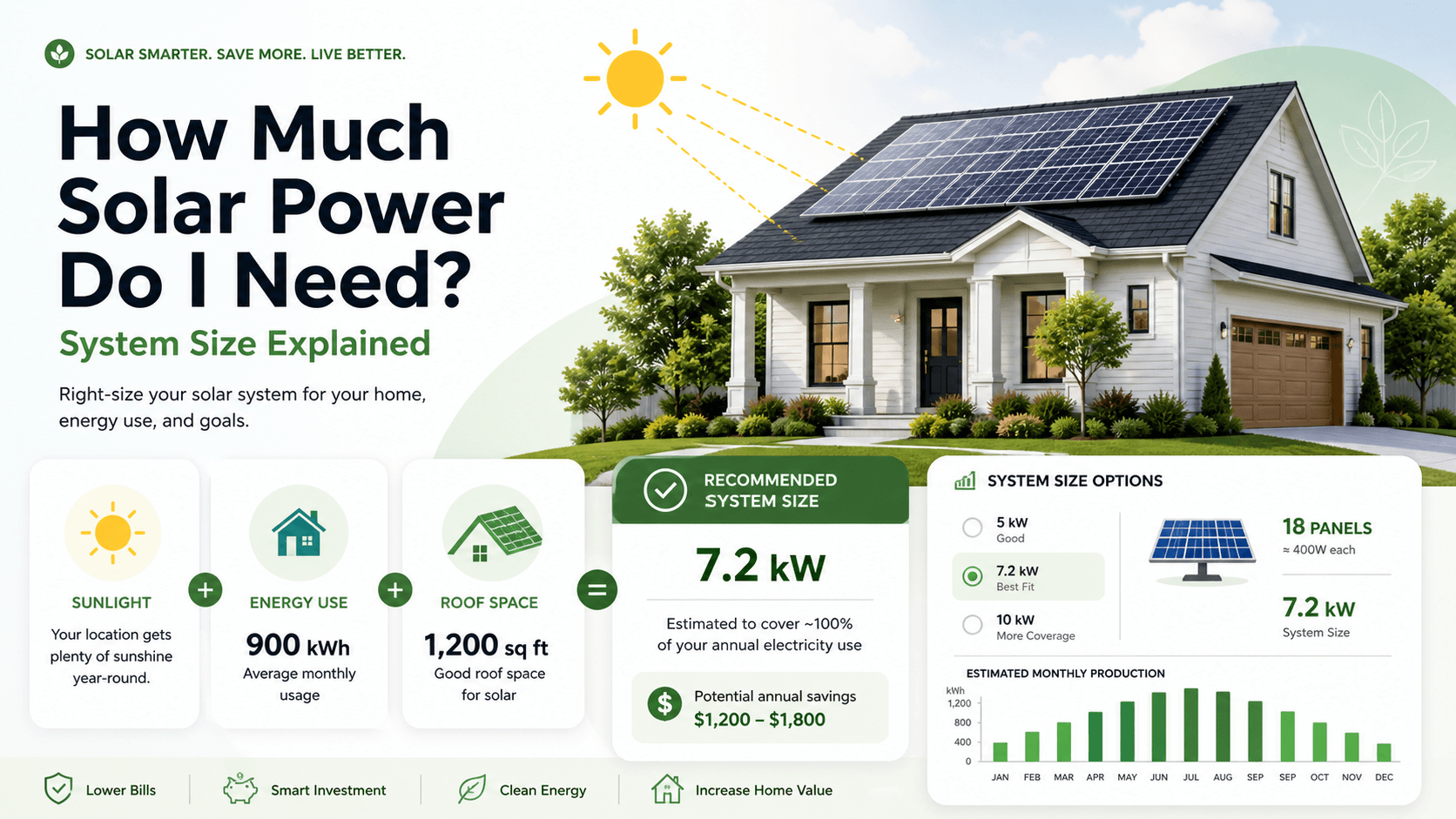
7,200 watts ÷ 400-watt panels = 18 panels
| Target System Size | 350 W Panels | 400 W Panels | 450 W Panels |
|---|---|---|---|
| 5 kW | 15 panels | 13 panels | 12 panels |
| 7 kW | 20 panels | 18 panels | 16 panels |
| 9 kW | 26 panels | 23 panels | 20 panels |
| 11 kW | 32 panels | 28 panels | 25 panels |
Panel count is only a rough estimate. Actual layout depends on panel dimensions, roof space, setbacks, fire code access paths, obstructions, roof planes, shade, and inverter design.
Step 5: Check Roof Space and Layout Limits
Even if your electricity usage suggests a certain system size, your roof may not be able to fit it.
Roof constraints may include:
- limited usable roof area
- vents and skylights
- chimneys
- dormers
- shade from trees or nearby buildings
- roof age or condition
- fire setbacks
- structural limitations
- HOA or local design restrictions
If your roof cannot fit enough panels, you may still have options:
- use higher-wattage panels
- install panels on multiple roof planes
- consider a ground mount if space allows
- reduce the target offset
- improve home efficiency first
- add more solar later if practical
Roof suitability should be evaluated before you rely on any system size estimate.
Step 6: Account for Future Electricity Use
Your current electric bill may not reflect your future usage.
Future loads can change the amount of solar power you need.
| Future Change | How It Affects Solar Sizing |
|---|---|
| EV charger | May significantly increase annual electricity usage |
| Heat pump | May increase electricity use but reduce gas or oil use |
| Heat pump water heater | May add electricity use while lowering fossil fuel use |
| Pool pump | Can increase summer electricity usage |
| Home office | May slightly increase daytime usage |
| Battery storage | May change how much solar energy is used at home |
| Home efficiency upgrades | May reduce the solar system size needed |
If you plan to buy an EV or electrify heating soon, tell your installer. A system sized only for last year’s usage may be too small for your future needs.
But do not oversize based on vague plans. If the future load is uncertain, ask for two scenarios: current usage and future usage.
Step 7: Consider Net Metering and Export Credits
Utility rules can change the ideal system size.
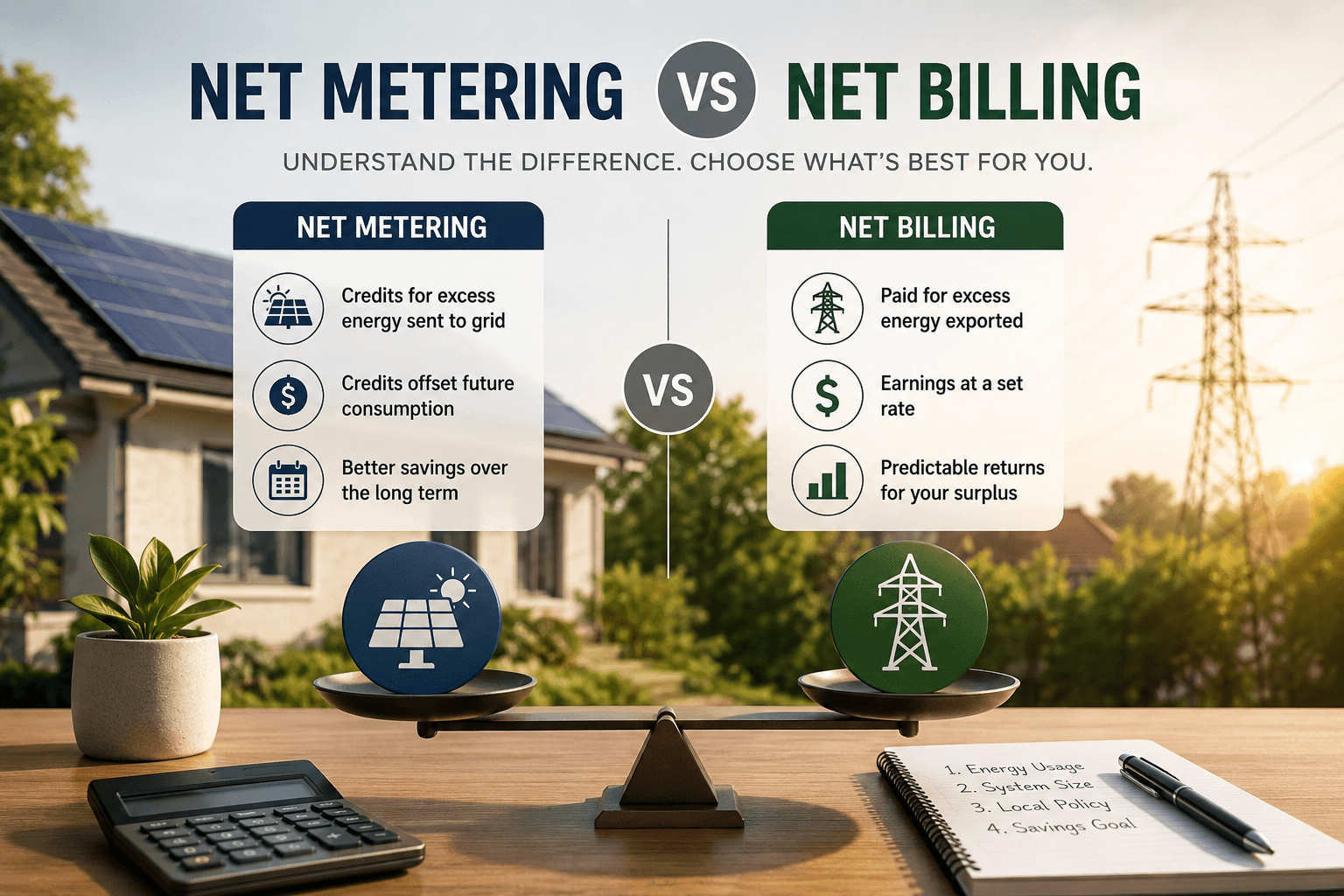
If your utility gives strong credit for exported solar electricity, a larger annual offset may make sense. If export credits are low, a system that produces too much extra electricity may not be financially attractive.
| Utility Rule | Possible Sizing Strategy |
|---|---|
| Full retail net metering | System can often be sized closer to annual usage |
| Lower export credits | System may be sized around daytime self-consumption |
| Time-of-use rates | Production timing and battery options matter more |
| Export limits | System size may be capped by utility rules |
| Minimum bills or fixed charges | Solar may not eliminate the full electric bill |
Ask your installer and utility:
- What happens to excess solar electricity?
- What export credit rate applies?
- Do credits roll over month to month?
- Are there annual true-up rules?
- Are there system size limits?
- Do fixed charges remain after solar?
These rules affect both system size and ROI.
Step 8: Estimate Cost, Payback, and ROI
After you estimate system size, the next question is whether that size makes financial sense.
Larger systems usually cost more, but they may also produce more savings. The best system is not always the biggest system. It is the system that balances cost, savings, utility rules, roof fit, and long-term goals.
| System Size | Estimated Gross Cost at $3.25/W | Estimated Annual Production | Planning Note |
|---|---|---|---|
| 5 kW | $16,250 | Varies by location | May fit smaller homes or partial offset goals |
| 7 kW | $22,750 | Varies by location | Common planning size for moderate usage |
| 9 kW | $29,250 | Varies by location | May fit higher usage homes |
| 11 kW | $35,750 | Varies by location | May support high usage or future loads |
These cost examples are for planning only. Actual solar panel cost depends on location, equipment, roof complexity, installer pricing, batteries, electrical work, financing, and incentives.
For a deeper pricing breakdown, read the solar panel cost 2026 guide.
To understand payback, use this simple formula:
Solar payback period = net system cost ÷ annual electricity bill savings
For a full explanation, read the solar payback period guide.
Mini Case Study: Sizing Solar for a Homeowner
Here is a simplified example. These numbers are for illustration only and are not guaranteed.
Actual results depend on location, roof conditions, electricity usage, utility rules, incentives, financing, system design, installer pricing, and actual solar production.
| Assumption | Example Value |
|---|---|
| Annual electricity usage | 10,600 kWh/year |
| Target offset | 90% |
| Target solar production | 9,540 kWh/year |
| Estimated production per 1 kW | 1,400 kWh/year |
| Estimated system size | 6.8 kW |
| Rounded planning size | 7 kW |
| Panel wattage | 400 W |
| Estimated panel count | 18 panels |
System size calculation:
10,600 kWh × 90% = 9,540 kWh target annual production
9,540 kWh ÷ 1,400 kWh per kW = 6.8 kW
Panel count calculation:
6,800 watts ÷ 400 watts per panel = 17 panels
The homeowner may round to about 17–18 panels depending on roof layout, panel model, inverter design, and installer recommendation.
This example could change if the homeowner adds an EV, has a shaded roof, receives low export credits, has limited roof space, or chooses a different offset goal.
Run this type of scenario in the MySolarROI calculator before comparing installer quotes. Test current usage, future usage, and different offset goals to see how system size affects payback and ROI.
Common Solar System Sizing Mistakes
| Mistake | Why It Can Hurt the Estimate | Better Approach |
|---|---|---|
| Using only one month of electricity usage | Seasonal usage can vary widely | Use 12 months of kWh data |
| Assuming bigger is always better | Extra exported energy may have lower value | Check utility export credit rules |
| Ignoring future loads | EVs or heat pumps can increase usage | Run current and future usage scenarios |
| Ignoring roof shade | Production may be lower than expected | Ask for shade analysis |
| Comparing system size without production | A larger system may not always produce proportionally more | Compare expected annual kWh production |
| Forgetting fixed utility charges | Solar may not eliminate the entire bill | Ask which charges remain after solar |
| Using installer assumptions without checking | Savings may be too optimistic | Compare with PVWatts and your utility bill |
Questions to Ask Before Choosing a Solar System Size
Before signing a solar contract, ask:
- How much electricity did my home use over the last 12 months?
- What offset percentage is this system designed for?
- What annual production is expected?
- What production per kW did you assume?
- How many panels are included?
- What panel wattage is used?
- How much usable roof space do I have?
- How much shade affects the system?
- Does this size account for future EV or heat pump use?
- Does my utility allow this system size?
- How are exported solar credits valued?
- Will fixed charges remain on my bill?
- What happens if the system produces less than estimated?
If an installer cannot explain the system size clearly, ask for the assumptions in writing.
When a Smaller Solar System May Be Better
A smaller system may make more sense when:
- roof space is limited
- export credits are low
- your budget is limited
- your electricity usage is low
- you plan to move soon
- shade reduces production on part of the roof
- you want to start with a partial offset
A smaller system is not a failure if it matches your financial goals. In some utility territories, partial offset can provide better value than oversizing.
When a Larger Solar System May Be Better
A larger system may make sense when:
- your electricity usage is high
- your electricity rates are high
- you have strong net metering
- you plan to add an EV
- you plan to electrify heating
- you have excellent roof exposure
- your utility allows the system size
- the added cost still produces reasonable payback
Do not size larger just because there is extra roof space. Size larger only when the added production has clear value.
External Sources to Check
Before relying on a solar sizing estimate, verify assumptions with reputable sources.
- NREL PVWatts solar production calculator
- U.S. Department of Energy planning a home solar electric system
- U.S. Department of Energy homeowner solar guide
- EIA electricity data
- Your local utility’s net metering, net billing, or solar buyback tariff
FAQ About How Much Solar Power You Need
How much solar power do I need for my home?
Start with your annual electricity usage in kWh, then divide by the estimated annual solar production per kW in your location. Adjust for roof conditions, shade, target bill offset, utility rules, future loads, and budget.
How many solar panels do I need?
Divide your target system size in watts by the wattage of each solar panel. For example, a 7,200-watt system using 400-watt panels would need about 18 panels, depending on roof layout and final design.
Should I size solar for 100% of my electric bill?
Not always. A 100% offset may make sense with strong net metering and good roof conditions. If export credits are low or roof space is limited, a smaller system may produce better financial results.
Can I add more solar panels later?
Sometimes, but it depends on inverter capacity, roof space, utility rules, permitting, equipment compatibility, and installer availability. If you expect future load growth, discuss expansion plans before the first installation.
How does an EV charger affect solar system size?
An EV charger can significantly increase annual electricity use. Estimate expected EV charging kWh and run a separate future usage scenario before deciding how much solar power you need.
Does roof shade change how much solar I need?
Yes. Shade can reduce solar production, which may require more panels or a different design. In some cases, heavy shade can make rooftop solar less attractive.
Is a bigger solar system always better?
No. Bigger systems cost more, and extra exported electricity may have lower value under some utility rules. The best system size balances cost, savings, production, utility credit rules, and ROI.
What is the easiest way to estimate solar system size?
The easiest starting point is your 12-month electricity usage. Then use a solar calculator or production estimate to compare system sizes, annual savings, payback period, and long-term ROI.
Conclusion
So, how much solar power do I need? Start with your annual electricity usage, then adjust for your target offset, local solar production, roof conditions, utility rules, future loads, cost, and ROI goals.
The right system is not automatically the largest one. It is the system size that fits your home, your utility rules, your budget, and your long-term savings expectations.
Before you compare installer quotes, estimate system size and financial return with the MySolarROI solar ROI calculator. It can help you test different system sizes, electricity rates, incentives, financing assumptions, payback periods, and long-term ROI before making a decision.