If you are researching solar panel cost in 2026, you have probably noticed one frustrating thing: every quote, calculator, and solar website seems to give a different number.
One installer may quote one price. Another may offer a lower monthly payment but a higher long-term financing cost. A national average may be useful for context, but it may not reflect your roof, utility, state incentives, local labor market, equipment choice, battery options, or electricity rate.
This guide explains what U.S. homeowners should look at when estimating solar costs in 2026, including system size, cost per watt, batteries, roof conditions, financing, incentives, utility rules, and installer quote differences.
Solar can be worth it for some homeowners, but not for everyone. Your actual cost and return depend on location, electricity usage, roof condition, system design, installer pricing, financing terms, and how your utility values solar energy.
Before comparing installer proposals, run your own estimate with the MySolarROI solar ROI calculator. It can help you see how solar cost, electricity savings, incentives, financing, and payback period may affect your long-term ROI.
Solar Panel Cost 2026: Quick Pricing Snapshot
A national average can help you start, but it should not replace local quotes.
Residential solar panel costs vary widely depending on system size, location, roof complexity, equipment, installer pricing, batteries, electrical upgrades, incentives, and financing terms.
For context, the U.S. Department of Energy’s 2024Q1 PV cost benchmark lists a representative residential PV system at 8 kWdc and shows residential PV benchmark values by dollar per watt. SEIA and Wood Mackenzie also reported residential system pricing in the mid-$3/Wdc range in late 2025. These are useful reference points, but your actual 2026 quote may be higher or lower depending on your market and project details.
| System Size | Example Cost at $2.75/W | Example Cost at $3.25/W | Example Cost at $3.75/W |
|---|---|---|---|
| 5 kW | $13,750 | $16,250 | $18,750 |
| 7 kW | $19,250 | $22,750 | $26,250 |
| 9 kW | $24,750 | $29,250 | $33,750 |
| 11 kW | $30,250 | $35,750 | $41,250 |
These examples are for planning only. They are not a quote, estimate, or promise of what your system will cost. Your price may differ based on equipment, roof design, permitting, labor, battery storage, electrical work, financing, and installer margin.
What Counts as Solar Panel Cost?
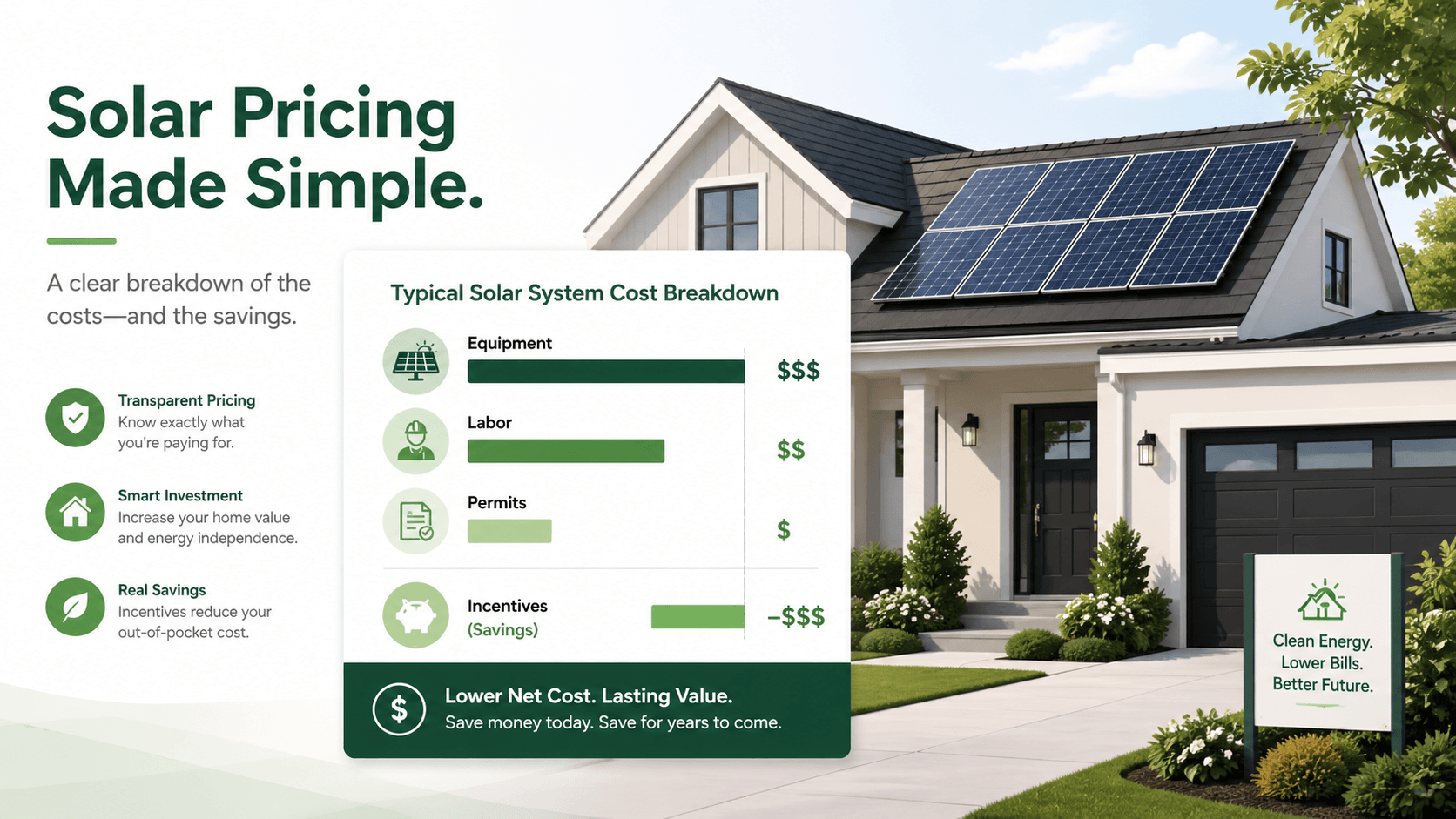
Solar panel cost should include more than the panels themselves.
When homeowners say “solar cost,” they often mean the full installed project price. That may include equipment, labor, design, permits, interconnection, and other project costs.
Your gross solar cost may include:
- solar panels
- inverter or microinverters
- racking and mounting hardware
- labor
- system design
- permitting
- electrical work
- interconnection work
- monitoring equipment
- main panel upgrades, if needed
- roof work directly tied to the installation
- battery storage, if included
- sales, overhead, and installer margin
Do not compare quotes only by total price. A lower quote may exclude important work, use different equipment, or rely on optimistic assumptions. A higher quote may include better warranties, a more complex roof design, electrical upgrades, or battery storage.
Solar Cost Per Watt Explained
Cost per watt is one of the simplest ways to compare solar quotes.
The formula is:
Cost per watt = gross system cost ÷ system size in watts
Example:
$24,000 ÷ 7,000 watts = $3.43 per watt
| Quote Item | Example |
|---|---|
| System size | 7 kW |
| System size in watts | 7,000 watts |
| Gross installed price | $24,000 |
| Cost per watt | $3.43/W |
Cost per watt is helpful, but it does not tell the full story.
When comparing cost per watt, also check:
- whether the quote is cash or financed
- whether a battery is included
- whether roof work is included
- whether a main panel upgrade is included
- panel and inverter type
- warranty terms
- estimated annual production
- installer reputation and service coverage
A quote with a slightly higher cost per watt may still be reasonable if it includes better equipment, a more difficult roof, or additional electrical work. A quote with a lower cost per watt may not be better if production assumptions are weak or important costs are excluded.
Solar Panel Cost by System Size
System size is one of the biggest drivers of solar cost.
A larger system usually costs more in total, but the cost per watt may be lower because some project costs are spread across more panels. However, bigger is not always better.
The right system size depends on:
- your annual electricity usage
- roof space
- shade
- roof orientation
- utility net metering or buyback rules
- whether you plan to add an EV or heat pump
- whether you include battery storage
- local interconnection limits
| Home Situation | Possible System Size | Cost Consideration |
|---|---|---|
| Lower electricity usage | 4–6 kW | Lower total cost, but fewer bill savings |
| Average electricity usage | 6–9 kW | Common range for many homes, but varies widely |
| Higher electricity usage | 9–12+ kW | Higher total cost and more roof space needed |
| EV, heat pump, or future load growth | May need larger system | Future usage should be modeled carefully |
Ask each installer to explain why they recommended a specific system size. If a system is oversized in an area with weak export credits, extra production may not provide strong value.
For production assumptions, review the solar calculator methodology and compare installer production estimates with a reputable tool such as NREL PVWatts.
What Affects Solar Panel Cost in 2026?
Two homeowners with the same system size can receive very different quotes. Solar pricing is affected by both technical and business factors.
| Cost Factor | Why It Matters | What to Ask |
|---|---|---|
| System size | Larger systems usually cost more overall | How did you size the system? |
| Roof complexity | Multiple roof planes, steep roofs, and limited access can increase labor | Does the price include roof complexity? |
| Shade | Shade can reduce production and may require design changes | Did you perform a shade analysis? |
| Equipment | Panels, inverters, and batteries vary in cost and warranty | Which equipment is included? |
| Electrical upgrades | Panel upgrades or wiring work can add cost | Is a main panel upgrade included? |
| Permitting and interconnection | Requirements vary by jurisdiction and utility | Who handles permits and utility approval? |
| Battery storage | Batteries can significantly increase project cost | Is battery cost separated from solar-only cost? |
| Financing | Dealer fees and interest can raise the real cost | What is the cash price vs financed price? |
| Installer pricing | Sales model, overhead, and margin vary | Can you itemize the quote? |
If a quote does not clearly show these assumptions, ask for a more detailed breakdown before signing.
Cash Price vs Financed Solar Cost
One of the most important questions in 2026 is whether the quoted price is a cash price or a financed price.
Some homeowners focus on the monthly payment, but the monthly payment does not always show the real project cost.
Ask every installer for:
- cash price
- financed price
- APR
- loan term
- dealer fee or financing-related markup
- monthly payment
- total repayment amount
- whether the loan assumes an incentive paydown
- whether the payment changes later
| Payment Option | What to Watch | Why It Matters |
|---|---|---|
| Cash purchase | Higher upfront cost | Simpler ROI and payback calculation |
| Solar loan | Interest, term, and fees | Can raise total cost over time |
| Lease | You may not own the system | Savings depend on contract terms |
| PPA | You buy solar energy, not the system | Rate and escalator matter |
A low monthly payment can be useful, but it should not be the only reason you choose a quote.
Use the solar financing comparison guide to compare cash, loans, leases, and PPAs before making a decision.
Solar Battery Cost in 2026
Batteries can add value for backup power, time-of-use rates, lower export credits, or greater energy control. But they also add cost.
Because of that, solar-only cost and solar-plus-battery cost should be evaluated separately.
A battery may be worth considering if:
- you experience frequent outages
- your utility has time-of-use rates
- your export credit is low
- you want backup power for critical loads
- your state or utility offers battery incentives
- you want to use more solar energy at home
A battery may weaken simple financial payback if:
- your utility has strong net metering
- your outage risk is low
- the battery is expensive
- you do not need backup power
- there are no meaningful battery incentives
| Scenario | How to Evaluate It |
|---|---|
| Solar-only | Best for understanding basic panel cost, savings, and payback |
| Solar plus battery | Evaluate backup value, load shifting, added cost, and battery warranty |
| Battery added later | Check whether the system is battery-ready and what future integration may cost |
If your goal is financial ROI, run the numbers both ways: solar-only and solar-plus-battery.
Roof Work, Electrical Work, and Hidden Solar Costs
A solar quote may look affordable until extra project costs are added.
Common additional costs may include:
- roof repair or replacement
- main electrical panel upgrade
- trenching or wiring work
- tree trimming or shade mitigation
- structural work
- permit-related requirements
- utility interconnection upgrades
- battery backup load panel
- solar removal and reinstallation if the roof is replaced later
These costs are not automatically bad. Some are necessary for a safe and durable installation. The problem is when they are missing from the quote or discovered too late.
Before signing, ask:
- Is my roof suitable for solar now?
- Will I need roof work before installation?
- Is a main panel upgrade included?
- Are permit and interconnection fees included?
- What happens if the utility requires additional work?
- What costs are excluded from this contract?
How Incentives Affect Solar Panel Cost in 2026
Incentives can reduce solar cost, but they must be handled carefully.
In 2026, homeowners should be especially cautious with federal tax credit assumptions. The IRS states that the Residential Clean Energy Credit is not available for property placed in service after December 31, 2025. That means a 2026 solar cost estimate should not automatically assume the federal residential solar tax credit applies.
Other incentives may still exist depending on your state, city, utility, and program rules.
Possible incentive types include:
- state rebates
- utility rebates
- local solar incentives
- battery incentives
- renewable energy credit programs
- property tax exemptions
- sales tax exemptions
- special financing programs
Do not include an incentive in your net cost unless you have verified current eligibility.
Use DSIRE, your state energy office, your local utility, and qualified tax guidance to confirm incentive rules. You can also use the solar tax credit calculator to test different assumptions, but do not treat calculator results as tax advice.
How Electricity Rates Affect Solar Value
Solar panel cost is only one side of the decision. The other side is what your solar electricity is worth.
If you pay high electricity rates, each kilowatt-hour of solar production may be more valuable. If your rates are low, the same system may save less money.
| Annual Solar Offset | Electricity Rate | Estimated Annual Value |
|---|---|---|
| 9,000 kWh | $0.12/kWh | $1,080 |
| 9,000 kWh | $0.18/kWh | $1,620 |
| 9,000 kWh | $0.28/kWh | $2,520 |
This is a simplified example. Your actual savings may differ because electricity bills can include fixed charges, minimum bills, delivery charges, time-of-use pricing, demand charges in some cases, and different values for imported and exported energy.
Use your own utility bill whenever possible. State averages are helpful for context, but your actual rate plan is what drives your savings.
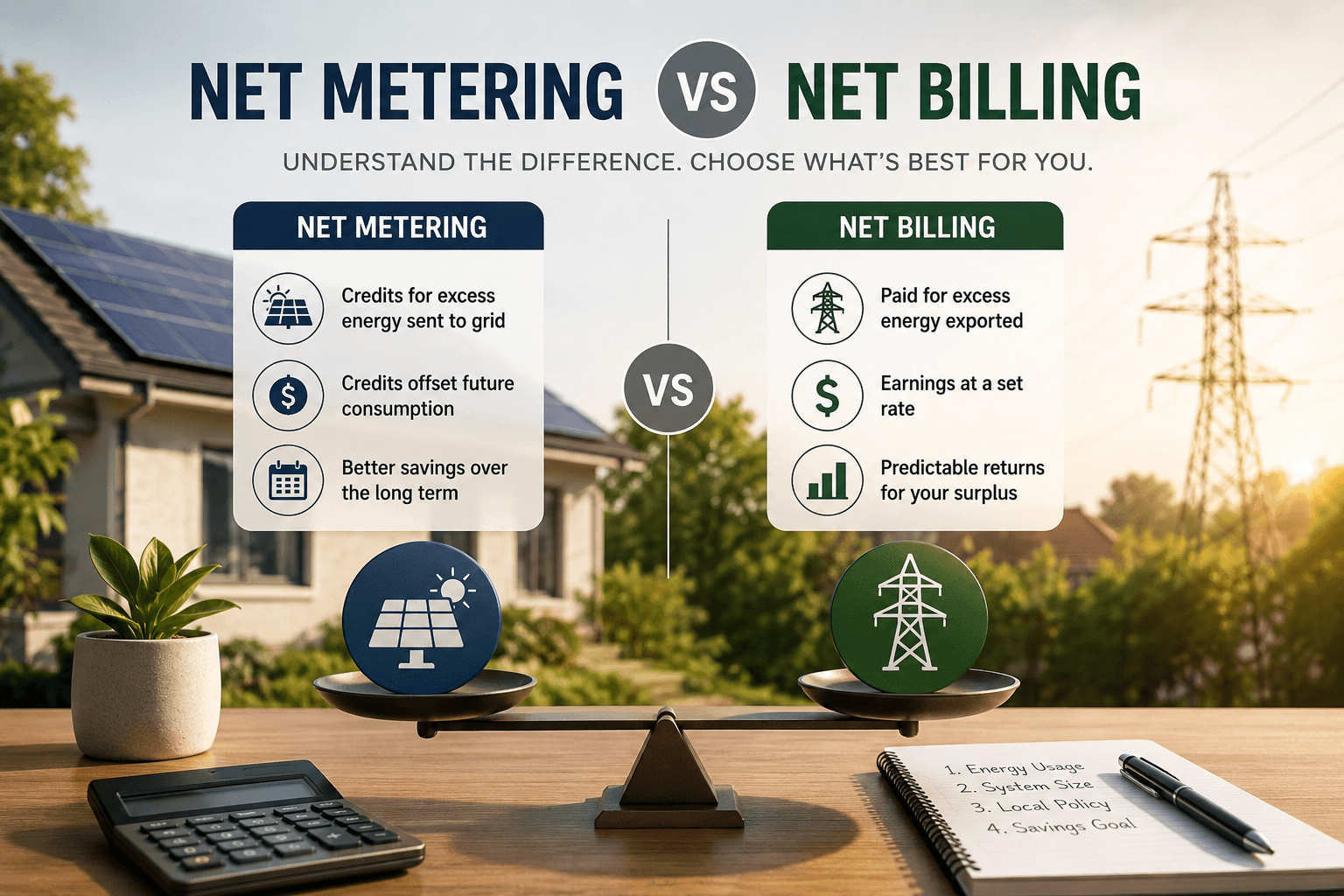
Net Metering and Solar Buyback Rules
Your solar savings depend heavily on how your utility credits excess solar electricity sent to the grid.
Not all utilities credit exported solar energy at the full retail electricity rate.
| Solar Energy Type | Possible Value |
|---|---|
| Solar electricity used directly in the home | Often close to your retail electricity rate |
| Solar electricity exported to the grid | Depends on net metering, net billing, or buyback rules |
| Solar produced during high-rate peak hours | May be worth more under time-of-use rates |
| Solar produced when export credits are low | May be worth less than retail electricity |
If export credits are low, system sizing becomes more important. Oversizing a system may produce extra energy that has limited value.
Read the net metering explained guide before assuming every kilowatt-hour of solar production has the same value.
Mini Case Study: Comparing Solar Cost and Payback
Here is a simplified homeowner example. These numbers are for illustration only and are not guaranteed.
Actual results depend on location, roof conditions, system design, incentives, utility rules, financing, installer pricing, electricity rates, and future energy use.
| Assumption | Example Value |
|---|---|
| System size | 7 kW |
| Gross installed cost | $24,000 |
| Cost per watt | $3.43/W |
| Battery storage | Not included |
| Verified local rebate | $1,000 |
| Net cost before tax considerations | $23,000 |
| Estimated annual production | 9,500 kWh |
| Electricity rate | $0.18/kWh |
| Estimated first-year value | $1,710 |
| Simple payback estimate | About 13.5 years |
Simple payback calculation:
$23,000 ÷ $1,710 = 13.5 years
This estimate could improve if the homeowner has higher electricity rates, stronger local incentives, better production, or lower system cost.
It could weaken if financing costs are high, export credits are low, roof work is required, or the system produces less than expected.
Run your numbers with the MySolarROI calculator before comparing installer quotes. Change the system cost, electricity rate, incentives, production, and financing assumptions to see how sensitive your payback period is.
How to Compare Solar Quotes in 2026
When comparing quotes, use the same assumptions for each installer.
- Do not compare one quote using a cash price against another using a financed monthly payment.
- Do not compare one quote with verified incentives against another with possible incentives.
- Do not compare one quote using retail net metering against another using lower export credits.
| Quote Detail | Quote A | Quote B | Quote C |
|---|---|---|---|
| System size | |||
| Gross system cost | |||
| Cash price | |||
| Financed price | |||
| Cost per watt | |||
| Battery included? | |||
| Roof work included? | |||
| Estimated annual production | |||
| Estimated annual savings | |||
| Incentives included | |||
| Payback period |
Ask each installer to explain the assumptions behind their savings estimate.
Common Solar Cost Mistakes
| Mistake | Why It Can Be a Problem | Better Approach |
|---|---|---|
| Comparing only monthly payment | Can hide higher total cost or long loan terms | Compare cash price, financed price, APR, and total repayment |
| Assuming incentives apply | Eligibility may vary or programs may have expired | Verify current rules with official sources |
| Ignoring roof condition | Roof work can increase project cost | Inspect the roof before signing |
| Comparing different system sizes | Lower total cost may simply mean fewer panels | Compare cost per watt and expected production |
| Ignoring export credits | Savings may be overstated | Check utility net metering or buyback rules |
| Not separating battery cost | Solar-only ROI may be unclear | Run solar-only and solar-plus-battery scenarios |
| Trusting one quote | Pricing and assumptions vary widely | Compare multiple quotes using the same method |
Questions to Ask Before Accepting a Solar Price
Before signing a solar contract, ask:
- Is this the cash price or financed price?
- What is the total system size in kW?
- What is the cost per watt?
- Which panels and inverters are included?
- Is battery storage included or separate?
- Is roof work included?
- Is a main panel upgrade included?
- Which permits and utility fees are included?
- What incentives are included in the quote?
- Are those incentives verified or estimated?
- What annual production estimate did you use?
- What electricity rate did you use?
- Does the savings estimate assume full net metering?
- What happens if the system produces less than estimated?
- What costs are excluded from the contract?
If an installer cannot answer these clearly, slow down before signing.
External Sources to Check
Before relying on a solar cost estimate, verify key assumptions with reputable sources.
- U.S. Department of Energy solar photovoltaic system cost benchmarks
- SEIA Solar Market Insight pricing and market data
- NREL PVWatts solar production calculator
- DSIRE incentive and policy database
- IRS Residential Clean Energy Credit guidance
- EIA electricity data
- Your local utility’s current net metering, net billing, interconnection, or solar buyback tariff
FAQ About Solar Panel Cost in 2026
How much do solar panels cost in 2026?
Solar panel cost in 2026 depends on system size, location, equipment, roof complexity, labor, installer pricing, batteries, electrical work, financing, and incentives. National averages can help with planning, but local quotes and utility rules matter more for your actual decision.
What is the average cost per watt for solar panels?
Cost per watt varies by market, system size, equipment, and project complexity. To calculate it, divide the gross installed system cost by the system size in watts. Always compare cost per watt along with equipment, warranties, production estimates, and financing terms.
Why are solar quotes so different?
Solar quotes can differ because installers use different equipment, financing structures, production assumptions, labor pricing, warranties, battery options, roof assumptions, and sales models. Always ask for cash price, financed price, cost per watt, production estimate, and included work.
Does financing increase solar panel cost?
Financing can increase the total cost through interest, dealer fees, and long repayment terms. A low monthly payment may still result in a higher total repayment amount. Compare the cash price, financed price, APR, loan term, and total repayment before deciding.
Should I include batteries in solar cost?
Include batteries if they are part of the project, but also calculate solar-only and solar-plus-battery scenarios separately. Batteries can add backup value and help with time-of-use rates, but they also increase upfront cost and may change payback.
Do incentives reduce solar panel cost in 2026?
Some state, local, or utility incentives may reduce solar cost, but eligibility depends on current rules. The IRS states that the Residential Clean Energy Credit is not available for property placed in service after December 31, 2025, so do not automatically assume a federal residential credit for 2026 projects.
Is the cheapest solar quote the best?
Not always. A cheaper quote may use different equipment, exclude needed work, rely on weak production assumptions, or offer less service support. Compare total cost, cost per watt, equipment, warranties, production, financing, and installer quality.
How do I know if my solar quote is fair?
Compare multiple quotes using the same assumptions. Review system size, cash price, financed price, cost per watt, annual production, incentives, equipment, warranties, roof work, utility assumptions, and estimated payback period.
Conclusion
Solar panel cost in 2026 depends on much more than the price of panels.
Your total cost can change based on system size, equipment, roof conditions, battery storage, electrical work, installer pricing, financing, incentives, and utility rules.
The best way to evaluate a solar price is to compare quotes using the same assumptions: cash price, financed price, cost per watt, annual production, electricity rate, incentives, net metering rules, and payback period.
Do not rely only on national averages or monthly payment claims. Use your own utility bill, verify incentive eligibility, and ask installers to explain their assumptions clearly.
Before comparing installer proposals, use the MySolarROI solar ROI calculator to estimate how system cost, electricity savings, incentives, financing, and utility rules may affect your payback period and long-term ROI.