Comparing solar quotes can feel harder than it should. One installer may show a low monthly payment. Another may highlight long-term savings. A third may offer premium panels, a battery, or a financing plan that makes the upfront cost look smaller.
The problem is that solar quotes are not always built the same way.
To compare solar quotes fairly, you need to look beyond the headline price. The real value depends on system size, cost per watt, estimated production, equipment, warranties, financing terms, incentives, net metering rules, roof conditions, and installer quality.
The U.S. Department of Energy recommends that homeowners evaluate roof suitability, local installers, consumer protection resources, and quote options before choosing solar. It also notes that some mapping and quote tools can help homeowners evaluate solar potential and connect with pre-screened providers.
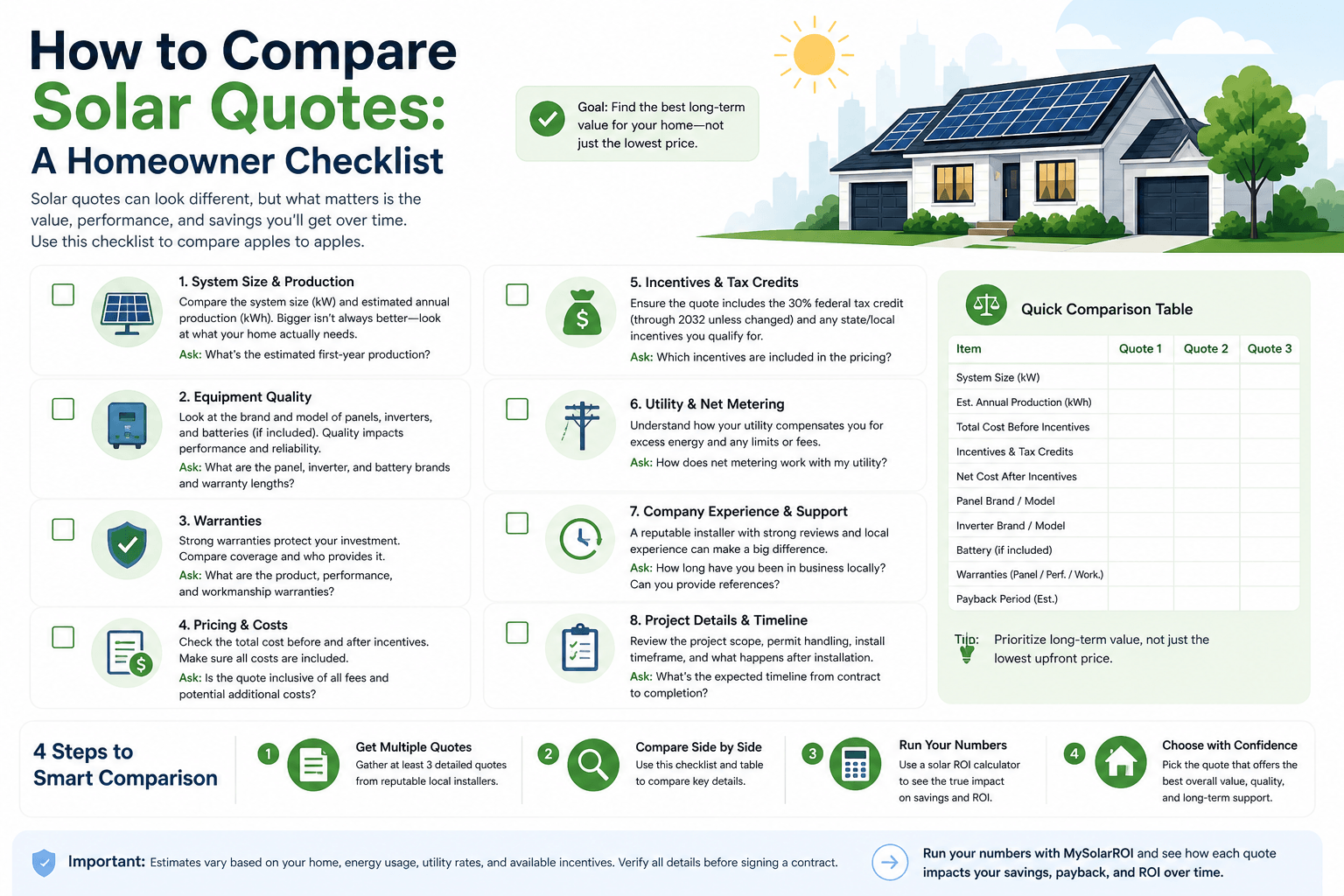
Use this guide to compare solar proposals side by side, spot weak assumptions, and understand which quote may deliver the best long-term value for your home.
Before choosing an installer, you can also use the solar ROI calculator from MySolarROI to test your own cost, savings, incentives, payback period, and financing assumptions.
What a Solar Quote Should Include
A good solar quote should give you enough information to understand what you are buying, what it may produce, what it may cost, and how the installer estimated your savings.
At minimum, a solar quote should include:
- Total system size in kilowatts
- Number and model of solar panels
- Inverter type and model
- Estimated first-year electricity production
- Estimated long-term production degradation
- Total cash price before incentives
- Cost per watt
- Battery details, if included
- Financing terms, if financed
- Warranty details
- Workmanship coverage
- Roof or electrical upgrade assumptions
- Permit, interconnection, and inspection responsibilities
- Estimated incentives and eligibility assumptions
- Net metering or utility credit assumptions
- Project timeline
- Installer license, insurance, and certifications
EnergySage summarizes quote comparison around four major areas: system design, equipment quality, financing options, and installer reputation. That is a useful starting point, but homeowners should also check assumptions behind savings, incentives, and utility bill credits.
Step 1: Compare System Size, Not Just Price
The first mistake many homeowners make is comparing total price without comparing system size.
A $22,000 quote may look better than a $27,000 quote. But if the first quote is for a smaller system, it may produce less electricity and save less money over time.
Look for the system size in kilowatts, often written as kW DC.
Example
| Quote | System Size | Total Price | Cost Per Watt |
|---|---|---|---|
| Quote A | 7.0 kW | $22,400 | $3.20/W |
| Quote B | 8.5 kW | $27,200 | $3.20/W |
| Quote C | 8.5 kW | $24,650 | $2.90/W |
Quote A has the lowest total price, but Quote C may offer better value because it provides the same system size as Quote B at a lower cost per watt.
How to calculate cost per watt
Use this formula:
Total system price ÷ system size in watts = cost per watt
For example:
$24,650 ÷ 8,500 watts = $2.90 per watt
This lets you compare quotes more fairly, even when the systems are different sizes.
Step 2: Check the Estimated Solar Production
System size tells you how large the system is. Production tells you how much electricity it is expected to generate.
A quote should show estimated annual solar production in kilowatt-hours, often written as kWh.
Two 8 kW systems may produce different amounts depending on:
- Roof direction
- Roof tilt
- Shade
- Local sunlight
- Panel placement
- Inverter design
- Weather assumptions
- Panel degradation
- System losses
Ask each installer how they modeled production. A quote based on a detailed shade analysis and roof layout is usually more useful than a quote based only on your monthly electric bill.
Production questions to ask
- What is the estimated first-year production?
- What software or method was used to estimate production?
- Does the estimate account for shade?
- What annual degradation rate is assumed?
- Is the system designed to offset 100% of my usage or a smaller amount?
- What happens if the system produces less than estimated?
A quote with higher projected savings is not automatically better. It may simply be using more optimistic production assumptions.
Step 3: Compare Cash Price Before Incentives
Always compare the price before incentives first.
Some quotes show the net price after incentives more prominently than the gross price. That can make a quote look cheaper than it really is.
For 2026, homeowners should be especially careful with federal incentive assumptions. The IRS says the Residential Clean Energy Credit equaled 30% of qualified clean energy property costs for systems installed from 2022 through December 31, 2025, and that the credit is not available for property placed in service after December 31, 2025.
That means a 2026 quote should not automatically assume the prior federal residential solar tax credit unless a specific eligibility situation applies and a qualified tax professional confirms it.
What to compare
| Cost Item | Why It Matters |
|---|---|
| Gross system price | Shows the true contract price before incentives |
| Net price | May depend on tax eligibility, rebates, or credits |
| Cost per watt | Helps compare different system sizes |
| Battery cost | Can significantly change payback and ROI |
| Roof work | May or may not be included |
| Electrical panel upgrade | Can add cost if required |
| Financing fees | May be hidden in a higher system price |
| Permits and interconnection | Should be clearly included or excluded |
For current market context, EnergySage reported a median solar installation price of $2.48 per watt in the first half of 2025 on its marketplace, unchanged from the second half of 2024. That is marketplace data, not a guaranteed price for every home, but it can help homeowners identify quotes that need closer review.
Step 4: Review Equipment Quality
Solar equipment matters, but the “best” equipment is not always the most expensive option.
Most homeowners should compare:
- Panel brand and model
- Panel efficiency
- Product warranty
- Performance warranty
- Inverter type
- Inverter warranty
- Battery brand and usable capacity, if included
- Monitoring system
- Racking and roof attachment system
Panel comparison basics
Higher-efficiency panels can be helpful when roof space is limited. But if you have plenty of roof space, a slightly lower-efficiency panel may still produce enough power at a lower cost.
Inverter comparison basics
Common inverter options include:
| Inverter Type | Best For | Watch Out For |
|---|---|---|
| String inverter | Simple, lower-shade roofs | One shaded area can affect system performance more |
| Optimized string inverter | Roofs with some shade or multiple angles | More roof-level electronics |
| Microinverters | Complex roofs, panel-level monitoring | Often higher upfront cost |
Do not choose a quote only because it uses a familiar panel brand. Look at the full design, warranties, installer quality, and projected savings.
Step 5: Understand Battery Add-Ons
A solar battery can be valuable for backup power, time-of-use rate management, or lower net metering credits. But batteries often change the financial picture.
A battery may:
- Increase upfront cost
- Lengthen payback period
- Provide backup power during outages
- Help store solar energy for evening use
- Reduce reliance on exported power credits
- Improve value in areas with weak net metering
EnergySage reported that storage prices increased by 4% in the first half of 2025 after two years of declines, partly due to tariffs on Chinese battery components.
If one quote includes a battery and another does not, do not compare them as if they are equal. Create two comparisons:
- Solar-only quotes
- Solar-plus-battery quotes
Then decide whether the battery is primarily a financial investment, a backup power choice, or both.
Step 6: Compare Financing Carefully
Financing can make solar easier to afford, but it can also make quote comparison confusing.
A solar loan with a low monthly payment may include dealer fees or a higher system price. A higher-interest loan may have a lower cash price. A lease or power purchase agreement may have no upfront cost, but you may not own the system or receive certain incentives directly.
Solar financing comparison table
| Option | Ownership | Upfront Cost | Incentives | What to Review |
|---|---|---|---|---|
| Cash purchase | Homeowner owns system | Highest | Homeowner may claim eligible incentives | Net cost, payback, warranties |
| Solar loan | Homeowner owns system | Low to moderate | Homeowner may claim eligible incentives | APR, term, dealer fees, total repayment |
| Lease | Third party owns system | Often low | Usually system owner receives incentives | Escalator, contract length, transfer terms |
| PPA | Third party owns system | Often low | Usually system owner receives incentives | Price per kWh, escalator, buyout terms |
The IRS states that to claim the Residential Clean Energy Credit, the taxpayer must buy and install qualified energy property, keep documentation, and file Form 5695. For 2026 decisions, homeowners should verify current eligibility carefully because the residential credit is not available for property placed in service after December 31, 2025.
This is not tax or financial advice. Before relying on any incentive, ask a qualified tax professional and check official program rules.
Step 7: Check Net Metering and Utility Assumptions
Net metering can have a major effect on solar savings.
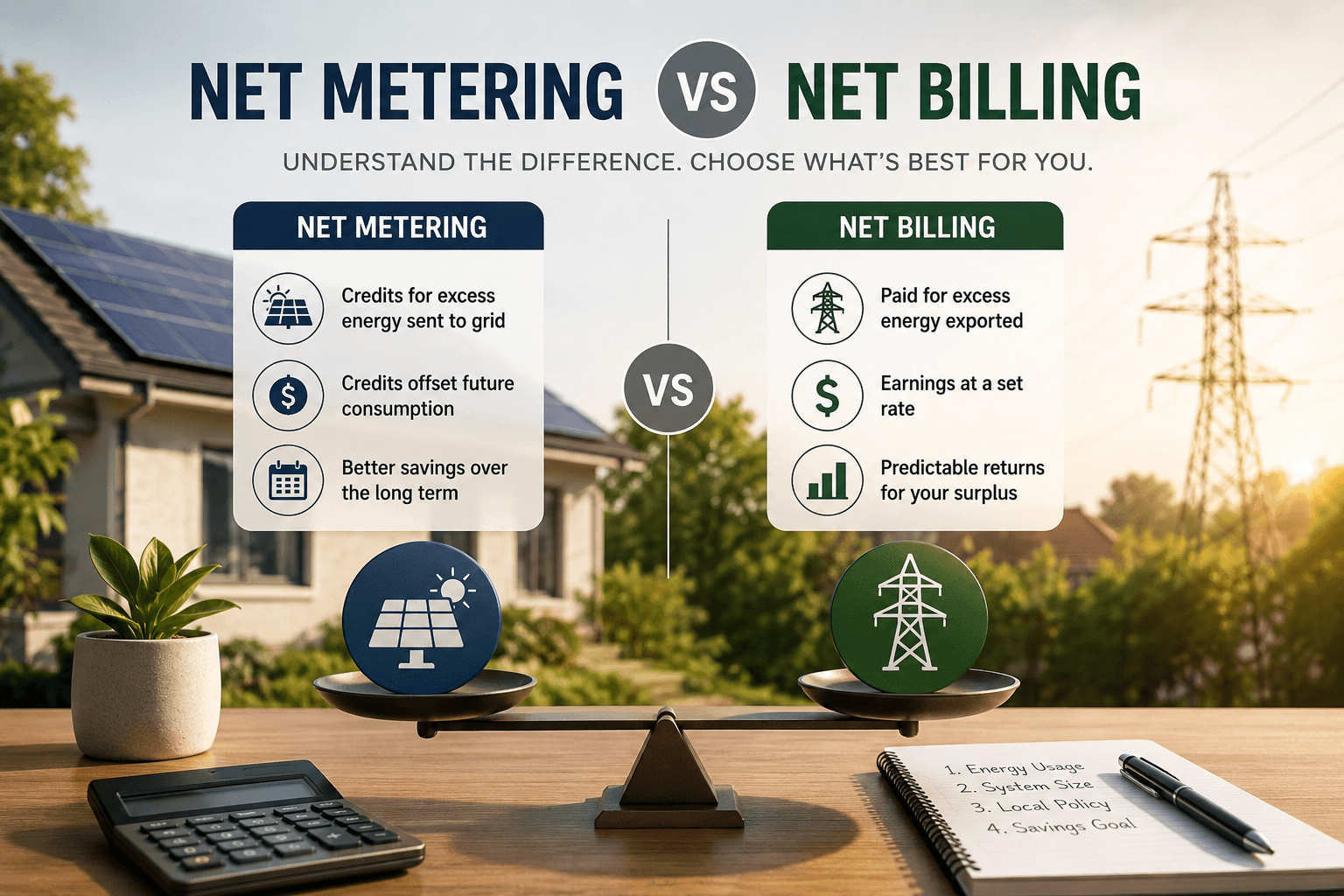
Under strong net metering, excess solar energy exported to the grid may receive a credit close to the retail electricity rate. Under weaker export credit rules, excess solar may be worth less. Some utilities use time-of-use rates, minimum bills, demand charges, or other rules that can change the value of solar.
Ask each installer:
- What utility rate plan is used in the savings estimate?
- How are exported kWh credited?
- Does the estimate assume full retail net metering?
- Are time-of-use rates included?
- Are fixed charges included?
- Will my rate plan change after solar?
- Does the proposal include battery savings assumptions?
A solar quote that ignores utility rules may overstate savings.
To estimate how utility credits may affect your numbers, use the net metering guide and compare scenarios in the MySolarROI calculator.
Step 8: Compare Warranties and Installer Workmanship
Solar warranties are not all the same.
Most homeowners should look for three types of protection:
| Warranty Type | What It Covers | Why It Matters |
|---|---|---|
| Product warranty | Equipment defects | Protects against panel or inverter failure |
| Performance warranty | Long-term output decline | Shows expected panel production over time |
| Workmanship warranty | Installation labor and roof-related workmanship | Helps protect against installation mistakes |
A long panel warranty is helpful, but it does not replace a strong workmanship warranty from a reputable installer.
Ask:
- Who handles warranty claims?
- Is labor included for equipment replacement?
- How long is the workmanship warranty?
- Are roof penetrations covered?
- What happens if the installer goes out of business?
- Are monitoring and service calls included?
Step 9: Review Installer Reputation
The lowest quote is not always the best quote.
Solar is a long-term home improvement project. The installer’s quality affects permitting, roof work, electrical safety, interconnection, inspection, service, and warranty support.
Check:
- State license status
- Insurance
- Years in business
- Local reviews
- Complaint history
- NABCEP certification, if applicable
- Subcontractor use
- Workmanship warranty
- Responsiveness and clarity
- References from nearby homeowners
The Department of Energy points homeowners toward state consumer protection offices, utility consumer advocates, and nonprofit legal resources for support in cases of fraud, abuse, or deception.
Step 10: Compare Payback Period and ROI
Once you understand price, production, incentives, financing, and utility rules, compare the estimated payback period and ROI.
Simple solar payback formula
Net system cost ÷ annual bill savings = payback period
Example:
- Gross system cost: $24,000
- Confirmed upfront incentives or rebates: $2,000
- Net system cost: $22,000
- Estimated first-year bill savings: $1,900
$22,000 ÷ $1,900 = 11.6 years
This is a simplified example. Actual results may change based on electricity rate increases, system degradation, maintenance, financing interest, utility rules, shade, roof conditions, and how long you stay in the home.
For a faster comparison, run each proposal through the solar payback estimate or solar ROI calculator using the same assumptions.
Mini Case Study: Comparing Three Solar Quotes
Here is a realistic example of how a homeowner might compare quotes.
Homeowner assumptions
- Location: U.S. home with good roof exposure
- Annual electricity use: 10,500 kWh
- Current electricity rate: $0.18/kWh
- No battery included
- Cash purchase comparison
- Incentives: Only confirmed local rebate included
- Federal residential tax credit not assumed for 2026
- Actual results depend on location, utility rules, roof conditions, incentives, financing, and system design
| Quote | System Size | Gross Price | Cost/Watt | Est. Annual Production | Est. First-Year Savings |
|---|---|---|---|---|---|
| A | 7.5 kW | $22,500 | $3.00/W | 9,600 kWh | $1,550 |
| B | 8.2 kW | $25,830 | $3.15/W | 10,700 kWh | $1,780 |
| C | 8.0 kW | $23,600 | $2.95/W | 10,300 kWh | $1,720 |
Simple comparison
Quote A has the lowest price, but it also produces less electricity. Quote B produces the most energy, but it has the highest cost per watt. Quote C has a lower cost per watt than Quote B and nearly the same estimated production.
If Quote C comes from a reputable installer with solid warranties and realistic production assumptions, it may be the strongest financial option. But if Quote B includes better workmanship coverage, better equipment, or more accurate shade modeling, it may still be worth considering.
The best quote is not always the cheapest. It is the quote with the best balance of cost, production, risk, warranty support, financing terms, and expected long-term value.
Common Mistakes When Comparing Solar Quotes
| Mistake | Why It Can Hurt You | Better Approach |
|---|---|---|
| Comparing only monthly payment | Financing can hide total cost | Compare cash price and total repayment |
| Ignoring system size | Smaller systems cost less but save less | Compare cost per watt and production |
| Assuming all incentives apply | Eligibility rules vary | Confirm with official sources |
| Comparing battery and non-battery quotes together | Battery changes cost and value | Separate solar-only and battery quotes |
| Trusting savings estimates without checking assumptions | Estimates may be optimistic | Review rate, production, and net metering assumptions |
| Choosing only the lowest price | Installer quality matters | Check warranties, reviews, license, and service |
| Ignoring roof or electrical upgrades | Extra work may change final cost | Ask what is included and excluded |
Questions to Ask Every Solar Installer
Before signing, ask each installer the same questions:
- What is the total cash price before incentives?
- What is the system size in kW DC?
- What is the cost per watt?
- What is the estimated first-year production?
- How did you model shade and roof conditions?
- What utility rate and net metering assumptions are used?
- What incentives are included, and who qualifies?
- What warranties cover panels, inverters, batteries, and workmanship?
- Are roof repairs, main panel upgrades, permits, and interconnection included?
- What is the total cost if I finance the system?
- Who handles service after installation?
- What happens if actual production is lower than estimated?
Expert Tips for a Better Solar Quote Comparison
- Ask for at least three quotes.
- Compare cash price first, even if you plan to finance.
- Use the same electricity rate assumptions for every quote.
- Do not assume a tax credit, rebate, or incentive unless eligibility is clear.
- Ask installers to explain any major difference in production estimates.
- Separate “nice to have” upgrades from financial must-haves.
- Keep copies of proposals, warranties, equipment spec sheets, and incentive documents.
- Run each quote through the same calculator so the comparison is consistent.
FAQ: How to Compare Solar Quotes
How many solar quotes should I get?
Most homeowners should get at least three solar quotes. This gives you a better sense of fair pricing, equipment options, installer quality, and production assumptions in your area.
What is the most important number in a solar quote?
There is no single number that tells the whole story. Start with system size, gross price, cost per watt, estimated annual production, incentives, financing terms, and warranty coverage.
Is the cheapest solar quote always the best?
Not always. A cheaper quote may use a smaller system, weaker warranties, lower production assumptions, or less experienced labor. Compare total value, not just price.
How do I know if a solar savings estimate is realistic?
Check the assumptions behind it. Look at electricity rate, solar production, net metering credits, annual utility bill increase assumptions, panel degradation, and financing costs.
Should I compare solar quotes before or after incentives?
Compare both, but start with the gross price before incentives. Then compare the net cost only after confirming which incentives you may actually qualify for.
Why do solar quotes show different system sizes?
Installers may use different assumptions about your energy usage, roof space, offset target, shade, utility rules, or budget. Ask each installer why they recommended that specific system size.
Should I include a battery in my solar quote comparison?
Only if you need backup power, have time-of-use rates, or live in an area where storing energy improves value. Compare solar-only quotes separately from solar-plus-battery quotes.
Can MySolarROI help me compare quotes?
Yes. You can enter cost, savings, incentives, financing details, and payback assumptions into the MySolarROI calculator to compare quotes using a consistent method.
Conclusion: Compare Solar Quotes With the Same Assumptions
Learning how to compare solar quotes helps you avoid choosing based on the wrong number.
The best proposal is not simply the one with the lowest monthly payment or the biggest savings claim. It is the one with a fair price, realistic production estimate, strong warranties, clear financing terms, accurate incentive assumptions, and an installer you trust to support the system long after installation.
Before signing a contract, compare each quote using the same assumptions. Review cost per watt, estimated annual production, net cost, utility credit rules, financing costs, and payback period.
Then use the MySolarROI solar ROI calculator to run your numbers before comparing installer quotes. It can help you see how system cost, electricity rates, incentives, and financing affect your estimated savings, payback period, and long-term return.