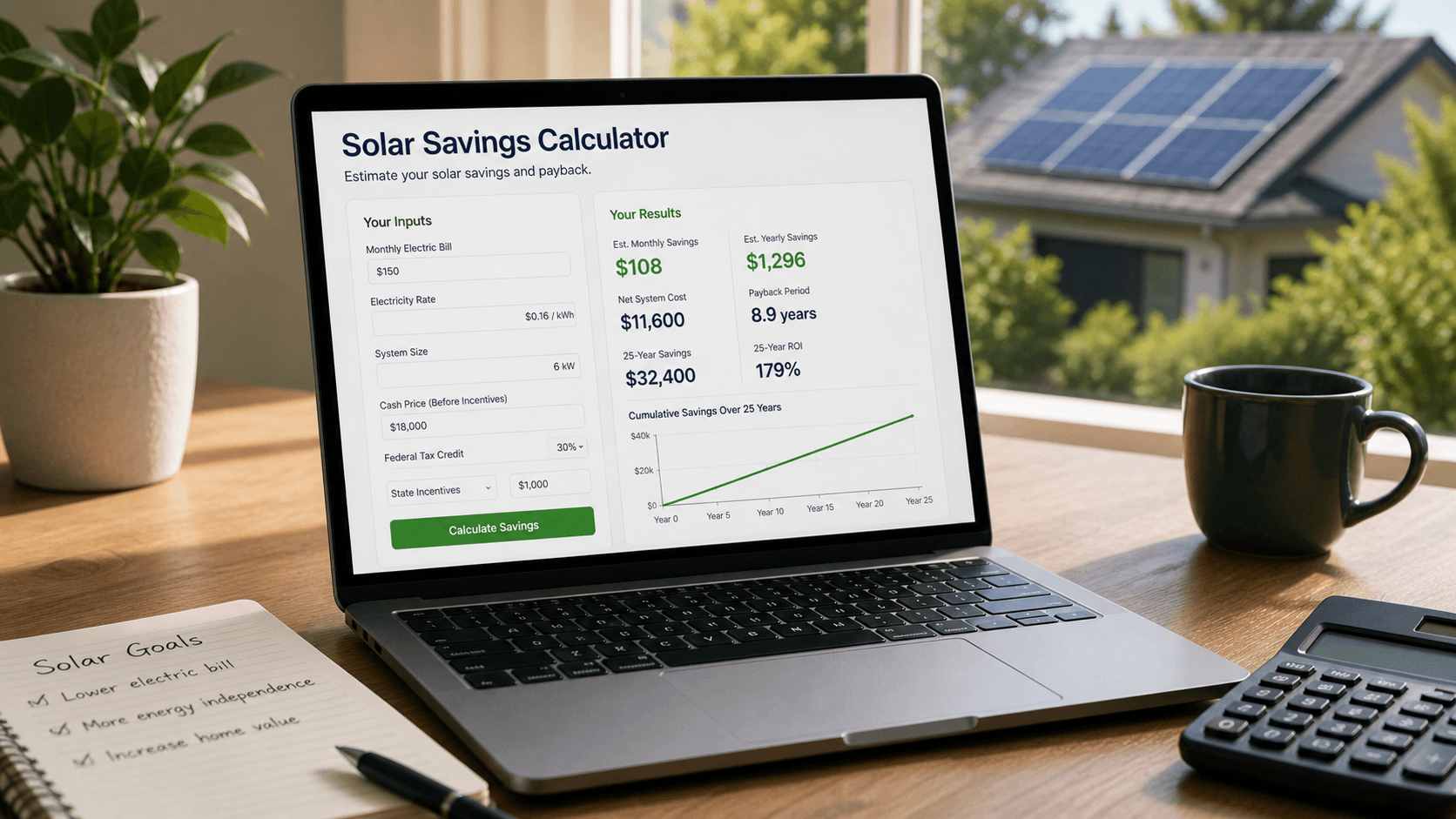
A solar savings calculator helps estimate how much money solar panels may save on your electric bill.
But solar savings are not as simple as multiplying panel production by your electricity rate.
Your real savings depend on how much electricity your system produces, how much of that power you use at home, how your utility credits exported solar energy, what fixed charges remain on your bill, whether you have time-of-use rates, what incentives apply, and how your system is financed.
That means a good solar savings estimate should answer more than one question:
How much of my electric bill can solar realistically reduce, and what assumptions are behind that estimate?
This guide explains how a solar savings calculator works, what inputs matter, which mistakes to avoid, and how to turn a savings estimate into a solar payback and ROI calculation.
Before comparing installer quotes, use the MySolarROI solar ROI calculator to estimate solar savings, payback period, incentives, financing impact, and long-term ROI using realistic assumptions.
What Is a Solar Savings Calculator?
A solar savings calculator estimates how much your utility bill may decrease after installing solar panels.
It usually combines several inputs:
- your electricity usage
- your electricity rate
- solar system size
- estimated solar production
- net metering or export credit rules
- fixed utility charges
- time-of-use rates
- incentives
- system cost
- financing terms
The basic idea is simple:
Solar bill savings = value of solar electricity used at home + value of exported solar credits − remaining utility charges
But the details vary by home and utility.
Solar Savings vs Solar Production
Solar production and solar savings are related, but they are not the same thing.
| Term | What It Means | Why It Matters |
|---|---|---|
| Solar production | How much electricity your panels generate in kWh | Starts the savings calculation |
| Solar savings | How much your electric bill decreases | Depends on rates, credits, and utility rules |
| Solar payback | How long it may take savings to recover net cost | Uses annual savings and net system cost |
| Solar ROI | Long-term return compared with cost | Uses lifetime savings, cost, incentives, and financing |
PVWatts can estimate solar production for grid-connected photovoltaic systems, but production alone does not fully determine your bill savings. :contentReference[oaicite:1]{index=1}
For a deeper production estimate, read the PVWatts calculator guide.
How a Solar Savings Calculator Works
A solar savings calculator usually follows this basic process:
- Estimate your annual electricity usage.
- Estimate solar system size.
- Estimate annual solar production.
- Estimate how much solar is used directly at home.
- Estimate how much solar is exported to the grid.
- Apply your utility’s net metering or export credit rules.
- Subtract remaining fixed charges or minimum bills.
- Estimate annual bill savings.
- Compare savings with net system cost.
A simple first-pass formula is:
Annual solar production × effective electricity value = estimated annual savings
Example:
9,500 kWh × $0.18/kWh = $1,710 estimated annual value
This simplified estimate is only a starting point. Your real savings may be different because exported solar may be credited at a different rate than electricity you use directly at home.
Inputs You Need for a Better Solar Savings Estimate
The better your inputs, the more useful your savings estimate will be.
| Input | Where to Find It | Why It Matters |
|---|---|---|
| 12 months of electricity usage | Utility bill or online utility account | Shows how much electricity solar may offset |
| Electricity rate | Utility bill | Determines value of electricity avoided |
| Rate plan | Utility account or tariff | Flat, tiered, or time-of-use rates affect savings |
| System size | Installer quote or sizing estimate | Determines production potential |
| Annual solar production | Installer model or PVWatts | Shows expected kWh output |
| Direct use vs exported energy | Installer model or load profile estimate | Credits may differ from retail rates |
| Net metering rules | Utility tariff | Determines export credit value |
| Fixed charges | Utility bill | Some charges may remain after solar |
| Incentives | IRS, DSIRE, state, utility | May reduce net cost, not monthly usage directly |
| Financing terms | Installer or lender proposal | Monthly loan payments affect cash flow |
EIA publishes electricity price and consumption data, but your own utility bill is usually the best input for your personal savings calculation. :contentReference[oaicite:2]{index=2}
Electricity Rates: Why They Matter So Much
Electricity rate is one of the biggest drivers of solar savings.
If you pay a higher price per kWh, each kWh of solar electricity may be more valuable. If your rate is low, the same solar system may save less money.
| Annual Solar Value | Electricity Value | Estimated Annual Savings |
|---|---|---|
| 9,000 kWh | $0.12/kWh | $1,080 |
| 9,000 kWh | $0.18/kWh | $1,620 |
| 9,000 kWh | $0.28/kWh | $2,520 |
This example is simplified. Real bills may include fixed charges, delivery charges, minimum bills, tiered rates, and time-of-use prices.
Do not use a generic national electricity rate if you have your own utility bill available.
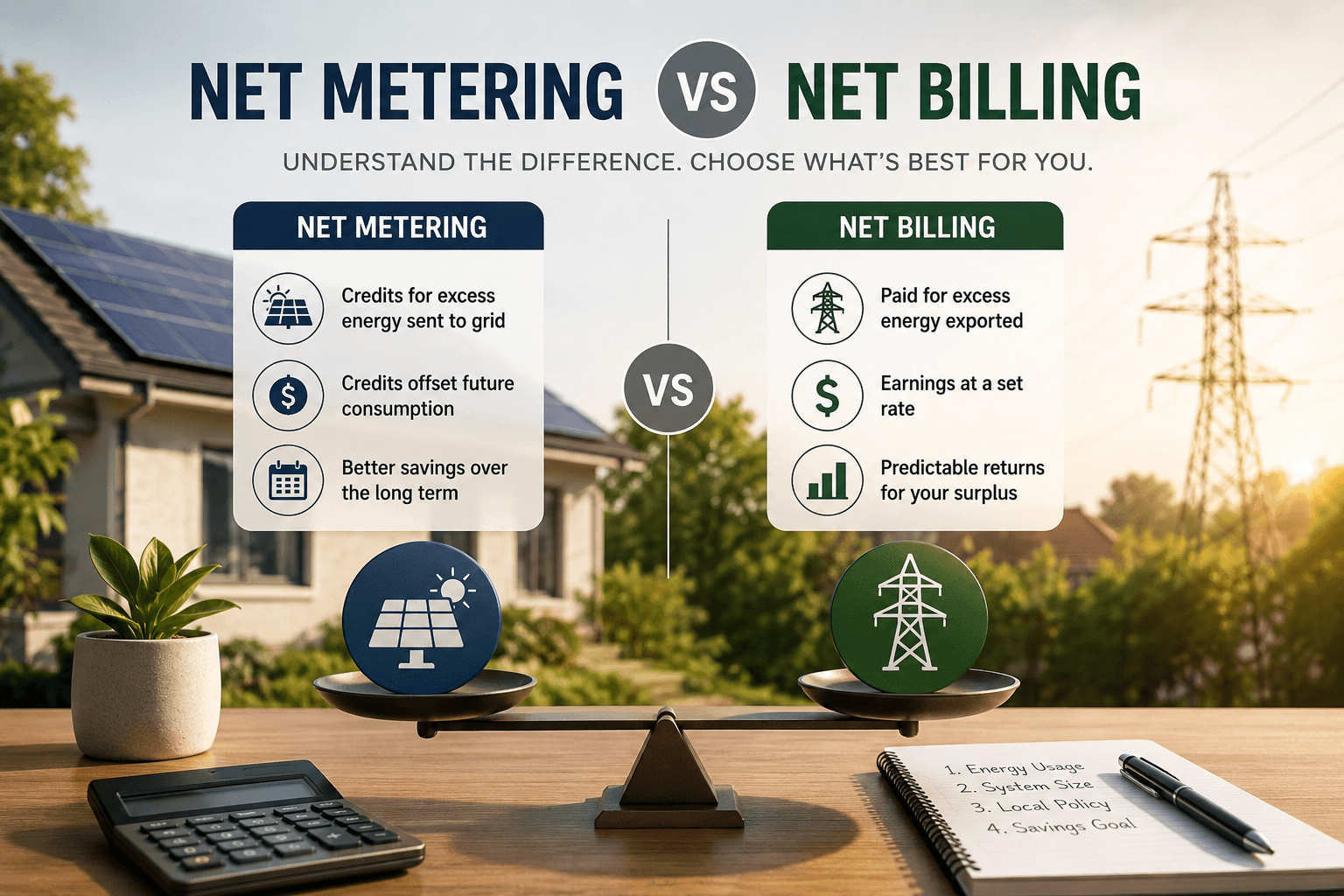
Net Metering and Export Credits
Net metering and export credit rules can dramatically change solar savings.
Energy.gov explains that net metering compensates solar system owners for solar generation exported to the grid, but whether a system qualifies and how it is compensated depends on state and utility policies. :contentReference[oaicite:3]{index=3}
That means every kWh of solar electricity may not have the same value.
| Solar Electricity Type | Possible Value | Why It Matters |
|---|---|---|
| Solar used directly at home | Often close to your retail electricity rate | Reduces electricity bought from the utility |
| Solar exported to the grid | Depends on net metering or buyback rules | May be credited at retail, avoided cost, or another rate |
| Solar stored in a battery | Depends on when it is used | May help with time-of-use rates or low export credits |
Read the net metering explained guide before trusting a savings estimate that assumes every exported kWh gets full retail credit.
Example: Same Solar Production, Different Savings
Here is a simplified example. These numbers are for illustration only and are not guaranteed.
Actual results depend on your utility rate plan, net metering rules, solar production, home usage patterns, fixed charges, incentives, financing, and system design.
| Assumption | Scenario A | Scenario B |
|---|---|---|
| Annual solar production | 9,500 kWh | 9,500 kWh |
| Solar used directly at home | 6,000 kWh | 6,000 kWh |
| Solar exported to grid | 3,500 kWh | 3,500 kWh |
| Retail electricity rate | $0.20/kWh | $0.20/kWh |
| Export credit rate | $0.18/kWh | $0.06/kWh |
Now compare the estimated annual value:
| Scenario | Direct Solar Value | Export Credit Value | Estimated Annual Savings |
|---|---|---|---|
| Scenario A | 6,000 × $0.20 = $1,200 | 3,500 × $0.18 = $630 | $1,830 |
| Scenario B | 6,000 × $0.20 = $1,200 | 3,500 × $0.06 = $210 | $1,410 |
The solar production is the same in both scenarios, but the savings are different because exported solar is credited differently.
Run both scenarios in the MySolarROI calculator so you can see how export credits affect payback and ROI.
Time-of-Use Rates and Solar Savings
Some utilities use time-of-use rates. That means electricity costs more during certain hours and less during others.
Time-of-use rates can change solar savings because the value of electricity depends on when it is used or exported.
| Rate Situation | Why It Matters |
|---|---|
| High evening peak rates | Solar may produce less during expensive evening periods unless paired with storage |
| Low midday export value | Excess solar may be worth less if exported during low-value periods |
| Battery storage | May shift solar energy to more valuable hours |
| Load shifting | Using appliances during sunny hours may improve savings |
If you have time-of-use rates, ask the installer whether the savings estimate models your actual rate schedule or uses a simple average rate.
What Charges May Remain After Solar?
Solar can reduce your electric bill, but it may not eliminate every charge.
Your bill may still include:
- fixed monthly customer charges
- minimum bills
- grid connection charges
- delivery or distribution charges
- taxes and public purpose charges
- non-bypassable charges
- demand charges in some rate plans
- fees not offset by solar credits
This is why a “100% offset” system does not always mean a $0 utility bill.
Ask your utility or installer which charges remain after solar and whether solar credits apply to all bill components or only energy charges.
How Incentives Affect Solar Savings Calculations
Incentives do not usually change how much electricity your system produces. Instead, they may reduce your net system cost.
That affects payback and ROI more directly than monthly bill savings.
| Incentive Type | Effect on Savings Calculation |
|---|---|
| State rebate | May reduce net system cost |
| Utility rebate | May reduce upfront or net cost |
| Tax credit | May reduce tax liability if eligible under current rules |
| Property tax exemption | May affect long-term ownership costs |
| Battery incentive | May reduce storage cost if eligible |
For new 2026 residential solar installations, do not automatically apply the old 30% federal residential credit without verifying current IRS rules. Read the federal solar tax credit 2026 guide and the solar tax credit calculator guide.
How Financing Changes Solar Savings
There are two types of savings to compare:
- bill savings
- cash-flow savings after solar payments
For example, solar may reduce your utility bill by $150 per month. But if your solar loan payment is $130 per month, your first-year cash-flow savings may be closer to $20 per month before considering other charges.
| Monthly Item | Example |
|---|---|
| Estimated electric bill reduction | $150/month |
| Solar loan payment | $130/month |
| Estimated monthly cash-flow difference | $20/month |
This simplified example does not include rate changes, financing fees, incentives, fixed utility charges, or seasonal variation.
Before choosing financing, compare cash price, financed price, APR, loan term, dealer fee, total repayment amount, and whether the payment assumes an incentive paydown.
Use the solar financing comparison guide before relying on monthly savings claims.
Solar Savings vs Solar Payback
Solar savings and solar payback answer different questions.
| Metric | Question It Answers | Example |
|---|---|---|
| Annual savings | How much might solar reduce my bill each year? | $1,800/year |
| Monthly cash flow | How does bill reduction compare with loan payment? | $150 saved minus $130 payment |
| Payback period | How long until savings recover net cost? | 12.8 years |
| ROI | What is the long-term return? | Depends on lifetime savings and net cost |
The basic payback formula is:
Solar payback period = net system cost ÷ annual electricity bill savings
For example:
$23,000 ÷ $1,800 = 12.8 years
For more detail, read the solar payback period guide.
Mini Case Study: Estimating Real Solar Savings
Here is a simplified homeowner example. These numbers are for illustration only and are not guaranteed.
Actual results depend on location, utility rates, solar production, export credits, fixed charges, incentives, system cost, financing, and actual energy usage.
| Assumption | Example Value |
|---|---|
| Annual electricity usage | 10,500 kWh |
| Solar system production | 9,500 kWh/year |
| Solar used directly at home | 6,000 kWh/year |
| Solar exported to grid | 3,500 kWh/year |
| Retail electricity rate | $0.20/kWh |
| Export credit rate | $0.10/kWh |
| Remaining fixed charges | Not included in this simple example |
Estimated savings:
Direct use value: 6,000 × $0.20 = $1,200
Export credit value: 3,500 × $0.10 = $350
Total estimated annual savings: $1,550
If the same homeowner incorrectly valued all 9,500 kWh at $0.20/kWh, the estimate would be:
9,500 × $0.20 = $1,900
That would overstate savings by $350 in this example.
This is why a solar savings calculator should separate direct solar usage from exported solar credits whenever possible.
Common Solar Savings Calculator Mistakes
| Mistake | Why It Misleads You | Better Approach |
|---|---|---|
| Using solar production as savings | Production does not always equal bill value | Apply utility rates and export credits |
| Assuming full retail net metering | Many utilities use different export credit rules | Check your utility tariff |
| Ignoring fixed charges | Some bill charges remain after solar | Review your utility bill structure |
| Using national average rates | Your utility rate may differ significantly | Use your actual bill |
| Ignoring financing payments | Bill savings are not the same as monthly cash flow | Compare savings with loan or lease payments |
| Applying unverified incentives | May make payback look too short | Use only verified incentives in base case |
| Using only optimistic assumptions | Can make solar look better than reality | Run conservative and base-case scenarios |
Questions to Ask Before Trusting a Solar Savings Estimate
Before accepting a savings estimate from an installer or calculator, ask:
- What annual electricity usage was used?
- What electricity rate was used?
- Does the estimate use my actual utility rate plan?
- What annual solar production is assumed?
- How much solar is used directly at home?
- How much solar is exported to the grid?
- What export credit rate is used?
- Which fixed charges remain?
- Are time-of-use rates included?
- Are incentives included in savings or net cost?
- Does the estimate include financing payments?
- What happens if the system produces less than expected?
If the answers are unclear, the savings estimate may not be reliable enough for a buying decision.
How to Use a Solar Savings Calculator Safely
Use this process:
- Enter your actual 12-month electricity usage.
- Use your current electricity rate or effective rate.
- Estimate system size and annual production.
- Separate direct solar use from exported solar if possible.
- Apply your utility’s export credit rules.
- Subtract fixed charges that remain after solar.
- Estimate annual bill savings.
- Compare bill savings with system cost.
- Add financing terms separately.
- Calculate payback and ROI.
For a full tool comparison, read the solar calculator comparison guide.
External Sources to Check
Before relying on a solar savings estimate, verify assumptions with reputable sources.
- NREL PVWatts solar production calculator
- Energy.gov homeowner solar guide and net metering overview
- EIA electricity prices and consumption data
- OpenEI Utility Rate Database
- DSIRE incentive and policy database
- Your local utility’s current net metering, net billing, or solar buyback tariff
FAQ About Solar Savings Calculators
What does a solar savings calculator do?
A solar savings calculator estimates how much solar panels may reduce your electric bill. It usually uses electricity usage, electricity rates, solar production, net metering rules, fixed charges, incentives, and sometimes financing assumptions.
Are solar savings calculators accurate?
They can be useful, but accuracy depends on the inputs. A calculator using your actual utility bill, rate plan, production estimate, and export credit rules will usually be more useful than one using broad averages.
Is solar production the same as solar savings?
No. Solar production is the amount of electricity your panels generate. Solar savings are the dollar value of that electricity under your utility bill rules. Exported solar may be credited differently than solar used directly at home.
How do I calculate solar savings?
Estimate the value of solar used directly at home, add the value of exported solar credits, and subtract any charges that remain after solar. Then compare annual savings with system cost to estimate payback.
Does net metering affect solar savings?
Yes. Net metering or export credit rules can strongly affect savings. If exported solar receives a lower credit, your annual bill savings may be lower than a simple production-times-rate estimate.
Can solar eliminate my electric bill?
Sometimes solar can greatly reduce a bill, but it may not eliminate every charge. Fixed charges, minimum bills, delivery fees, taxes, or non-bypassable charges may remain after solar.
Should I include financing in solar savings?
Yes, but separate bill savings from cash flow. Bill savings show how much your utility bill may drop. Cash flow compares that bill reduction with your solar loan, lease, or PPA payment.
What is the best way to estimate solar savings?
Use your actual utility bill, a realistic solar production estimate, your utility’s export credit rules, verified incentives, and clear financing terms. Then compare conservative, base-case, and optimistic scenarios.
Conclusion
A solar savings calculator is useful only when it uses realistic assumptions.
Solar savings depend on production, electricity rates, net metering or export credits, fixed charges, time-of-use rates, incentives, system cost, and financing.
The most common mistake is assuming every kWh of solar production has the same dollar value. In reality, solar used directly at home and solar exported to the grid may be credited differently.
Before comparing installer quotes, use the MySolarROI solar ROI calculator to estimate bill savings, payback period, and long-term ROI with your own utility and cost assumptions.