A solar panel calculator helps estimate how many solar panels you may need, how large your solar system should be, how much it may cost, and how much electricity it may produce.
But the best solar panel estimate is not based only on roof space or panel count.
To size solar properly, you need to understand your electricity usage, location, roof conditions, panel wattage, solar production, utility rules, incentives, financing, and ROI goals.
A system that is too small may not reduce your bill enough. A system that is too large may cost more than necessary, especially if your utility gives low credit for extra solar electricity sent to the grid.
This guide explains how a solar panel calculator works, what inputs matter, how to estimate panel count, and how to connect system size with cost, savings, payback period, and long-term ROI.
Before comparing installer quotes, use the MySolarROI solar ROI calculator to estimate how system size, solar cost, electricity savings, incentives, financing, and utility rules affect your payback period and long-term return.
What Is a Solar Panel Calculator?
A solar panel calculator estimates the solar system size and number of panels needed for a home.
Depending on the tool, it may estimate:
- number of solar panels
- solar system size in kW
- annual solar production in kWh
- roof space needed
- gross system cost
- cost per watt
- electric bill savings
- payback period
- long-term solar ROI
A simple calculator may only estimate panel count. A better calculator connects panel count to production, savings, cost, utility rules, and ROI.
Solar Panel Calculator: The Basic Formula
The basic solar panel calculation starts with electricity usage.
A simple system sizing formula is:
Solar system size = annual electricity usage ÷ estimated annual production per kW
Example:
10,000 kWh/year ÷ 1,400 kWh per kW = 7.1 kW system
Then estimate panel count:
Number of panels = system size in watts ÷ panel wattage
Example:
7,200 watts ÷ 400-watt panels = 18 panels
| Annual Usage | Estimated Production per kW | Estimated System Size | Approx. Panels at 400 W |
|---|---|---|---|
| 6,000 kWh/year | 1,400 kWh/year | 4.3 kW | 11 panels |
| 8,000 kWh/year | 1,400 kWh/year | 5.7 kW | 15 panels |
| 10,000 kWh/year | 1,400 kWh/year | 7.1 kW | 18 panels |
| 12,000 kWh/year | 1,400 kWh/year | 8.6 kW | 22 panels |
| 15,000 kWh/year | 1,400 kWh/year | 10.7 kW | 27 panels |
These are planning examples only. Actual production per kW depends on your location, roof direction, roof tilt, shade, weather, system losses, and equipment.
Step 1: Find Your Annual Electricity Usage
The best starting point is your electric bill.
Look for your total electricity usage over the last 12 months. It is usually measured in kilowatt-hours, or kWh.
If you do not have annual usage, add up the last 12 monthly bills.
| Electricity Usage Level | Planning Note |
|---|---|
| Low usage | May need a smaller system or partial offset |
| Average usage | May need a mid-sized residential system |
| High usage | May need a larger system, more roof space, or future-load planning |
| Seasonal usage | Summer cooling, winter heating, or pool pumps may affect sizing |
Usage can vary significantly by home. Your actual utility bill is better than a national average because climate, appliances, heating fuel, cooling needs, household size, and lifestyle all affect electricity use.
Step 2: Choose Your Target Bill Offset
You do not always need a solar system that offsets 100% of your annual usage.
Your target offset depends on your budget, roof space, utility rules, and ROI goals.
| Target Offset | What It Means | When It May Make Sense |
|---|---|---|
| 50% | Solar offsets about half your annual usage | Limited roof space, lower budget, or weak export credits |
| 75% | Solar offsets most of your usage | Balanced cost and savings strategy |
| 100% | Solar is sized to match annual usage | Strong net metering or high electricity rates |
| 100%+ | Solar is sized for future growth | EV charging, heat pump, or planned electrification |
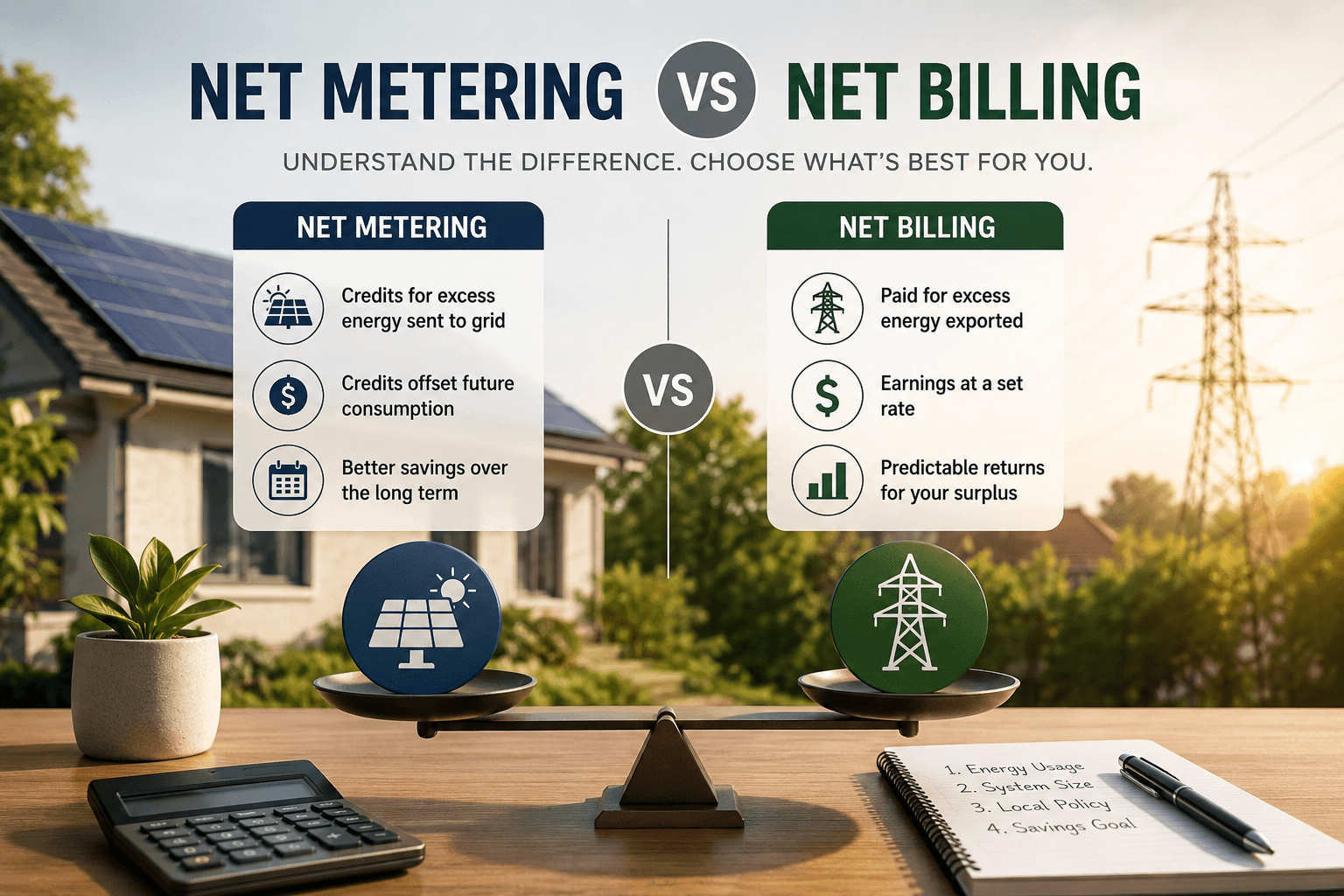
A larger system can produce more savings, but bigger is not always better. If your utility gives low credit for exported solar, a system that overproduces may weaken ROI.
Read the net metering explained guide before choosing a 100% or oversized system.
Step 3: Estimate Solar Production in Your Location
The same solar panel system can produce different amounts of electricity in different locations.
Solar production depends on:
- local sunlight
- weather patterns
- roof direction
- roof tilt
- shade
- panel type
- inverter type
- system losses
- temperature
- snow or soiling
PVWatts estimates the energy production of grid-connected photovoltaic systems around the world and allows homeowners, small building owners, installers, and manufacturers to develop performance estimates for potential PV installations. :contentReference[oaicite:2]{index=2}
Use PVWatts or an installer production model to estimate how much electricity your system may produce in your location.
For a walkthrough, read the PVWatts calculator guide.
Step 4: Estimate the Number of Solar Panels
Once you know your target system size, calculate panel count.
The formula is:
Number of panels = system size in watts ÷ panel wattage
| Target System Size | 350 W Panels | 400 W Panels | 450 W Panels |
|---|---|---|---|
| 5 kW | 15 panels | 13 panels | 12 panels |
| 7 kW | 20 panels | 18 panels | 16 panels |
| 9 kW | 26 panels | 23 panels | 20 panels |
| 11 kW | 32 panels | 28 panels | 25 panels |
Panel count is only an estimate. Final layout depends on roof space, panel dimensions, fire setbacks, vents, chimneys, shade, roof planes, and local code requirements.
Step 5: Check Roof Space, Direction, and Shade
A solar panel calculator can estimate system size, but your roof determines what is actually possible.
Energy.gov notes that the size, shape, and slope of your roof are important, and that panels often perform best on south-facing roofs with a slope between 15 and 40 degrees, although other roofs may also be suitable. :contentReference[oaicite:3]{index=3}
Important roof factors include:
- usable roof area
- roof age
- roof condition
- roof orientation
- roof pitch
- shade from trees or buildings
- chimneys, vents, and skylights
- fire code setbacks
- structural suitability
| Roof Condition | Effect on Solar Panel Calculation |
|---|---|
| Large unshaded roof | May allow the target system size |
| Limited usable roof space | May reduce panel count |
| Heavy shade | May reduce production or make solar less attractive |
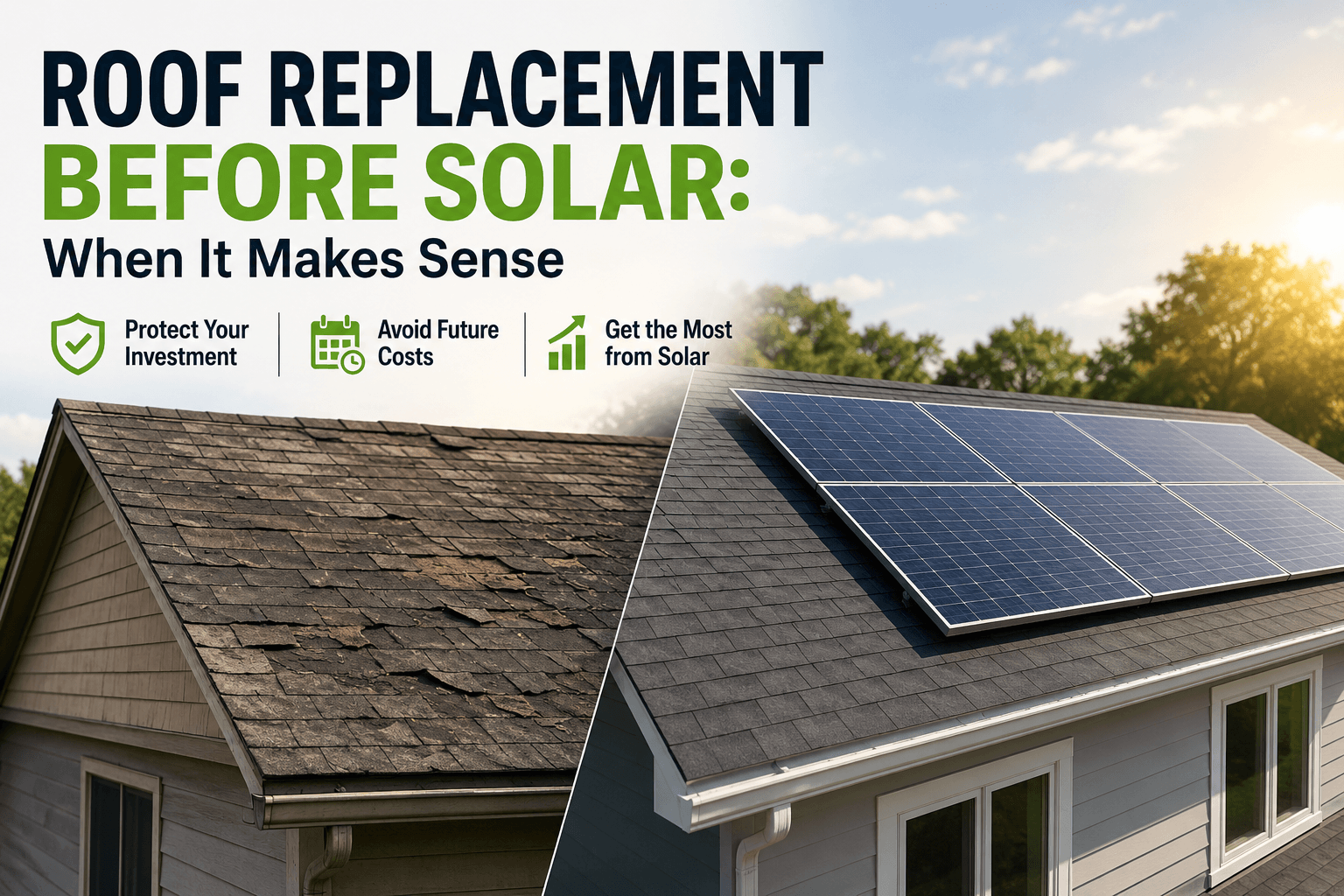
| Old roof | May need replacement before solar |
| Multiple roof planes | May require more complex design |
| East/west roof | May still work, but production timing differs |
If your roof cannot fit enough panels for your target offset, you may still have options: higher-wattage panels, ground mount, partial offset, efficiency upgrades, or future expansion.
Step 6: Estimate Solar Panel Cost
After estimating system size and panel count, estimate cost.
A simple cost formula is:
System size in watts × cost per watt = gross installed cost
Example:
7,000 watts × $3.25/W = $22,750 gross installed cost
| System Size | Example Cost at $2.75/W | Example Cost at $3.25/W | Example Cost at $3.75/W |
|---|---|---|---|
| 5 kW | $13,750 | $16,250 | $18,750 |
| 7 kW | $19,250 | $22,750 | $26,250 |
| 9 kW | $24,750 | $29,250 | $33,750 |
| 11 kW | $30,250 | $35,750 | $41,250 |
These examples are not quotes. Actual cost depends on your location, equipment, roof, electrical work, installer pricing, incentives, financing, and whether a battery is included.
For a full pricing process, read the solar cost calculator guide.
Step 7: Estimate Solar Savings
Solar savings depend on how much your panels produce and how your utility values that electricity.
A simple first estimate is:
Annual solar production × effective electricity value = estimated annual savings
Example:
9,500 kWh × $0.18/kWh = $1,710 estimated annual value
This is only a starting point because utility bills can include fixed charges, minimum bills, time-of-use rates, and different values for exported solar electricity.
| Savings Factor | Why It Matters |
|---|---|
| Electricity rate | Determines value of solar used directly at home |
| Export credit rate | Determines value of excess solar sent to grid |
| Fixed charges | May remain after solar |
| Time-of-use rates | Production timing can affect value |
| Self-consumption | Using solar at home may be more valuable than exporting it |
For detailed savings math, read the solar savings calculator guide.
Step 8: Calculate Payback and ROI
After estimating cost and savings, calculate payback period.
The basic formula is:
Solar payback period = net system cost ÷ annual electricity bill savings
Example:
| Input | Example |
|---|---|
| Gross system cost | $24,000 |
| Verified rebate | $1,000 |
| Net cost before financing | $23,000 |
| Estimated annual savings | $1,710 |
| Simple payback | 13.5 years |
Calculation:
$23,000 ÷ $1,710 = 13.5 years
Payback is not the same as ROI. Solar ROI looks at the broader return over the analysis period.
For the full formula, read the how to calculate solar ROI guide.
Mini Case Study: Using a Solar Panel Calculator
Here is a simplified homeowner example. These numbers are for illustration only and are not guaranteed.
Actual results depend on location, roof conditions, utility rates, system design, incentives, financing, net metering rules, installer pricing, and actual production.
| Input | Example Value |
|---|---|
| Annual electricity usage | 10,500 kWh/year |
| Target offset | 90% |
| Target solar production | 9,450 kWh/year |
| Estimated production per kW | 1,350 kWh/year |
| Estimated system size | 7.0 kW |
| Panel wattage | 400 W |
| Estimated panel count | 18 panels |
| Example cost per watt | $3.25/W |
| Estimated gross cost | $22,750 |
System size calculation:
10,500 kWh × 90% = 9,450 kWh target production
9,450 kWh ÷ 1,350 kWh per kW = 7.0 kW system
Panel count calculation:
7,000 watts ÷ 400 watts per panel = 17.5 panels
Cost estimate:
7,000 watts × $3.25/W = $22,750
The homeowner may round to 18 panels depending on roof layout, inverter design, and installer recommendation.
Run this type of scenario in the MySolarROI calculator to estimate savings, payback, and ROI before comparing quotes.
Solar Panel Calculator Mistakes to Avoid
| Mistake | Why It Can Mislead You | Better Approach |
|---|---|---|
| Using only one month of usage | Seasonal usage can vary | Use 12 months of kWh data |
| Ignoring roof shade | Production may be overstated | Ask for shade analysis |
| Assuming 100% offset is always best | Exported solar may have lower value | Check net metering rules |
| Comparing panel count only | Panel wattage and production differ | Compare system size and annual kWh |
| Ignoring future loads | EVs or heat pumps may increase usage | Run current and future scenarios |
| Ignoring financing | Loan costs can reduce ROI | Compare cash and financed prices |
| Forgetting fixed utility charges | Solar may not eliminate the entire bill | Review your utility bill structure |
Questions to Ask Before Trusting a Solar Panel Estimate
Before accepting a panel count or system size recommendation, ask:
- What annual electricity usage was used?
- What target offset was assumed?
- What system size is recommended?
- How many panels are included?
- What panel wattage is used?
- What annual production is estimated?
- What roof planes are used?
- What shade assumptions are included?
- What tilt and azimuth were modeled?
- What utility export credit is assumed?
- What gross cost and cost per watt are used?
- What financing assumptions are included?
- What happens if future electricity usage changes?
If the estimate does not explain these assumptions, it is not complete enough for a final decision.
How to Use a Solar Panel Calculator Safely
Use this process:
- Gather 12 months of electricity usage.
- Choose a target offset percentage.
- Estimate production per kW for your location.
- Calculate target system size.
- Estimate panel count using panel wattage.
- Check roof space and shade.
- Estimate gross system cost.
- Apply only verified incentives.
- Estimate annual bill savings.
- Calculate payback period and ROI.
- Compare the result with real installer quotes.
For a broader tool comparison, read the solar calculator comparison guide.
External Sources to Check
Before relying on a solar panel calculator estimate, verify assumptions with reputable sources.
- NREL PVWatts Calculator
- Energy.gov homeowner solar guide
- Energy.gov solar rooftop potential overview
- EIA electricity use in homes FAQ
- DSIRE incentive and policy database
- Your local utility’s current net metering, net billing, or solar buyback tariff
FAQ About Solar Panel Calculators
What does a solar panel calculator do?
A solar panel calculator estimates the number of panels, system size, production, cost, savings, payback period, and ROI for a home solar system based on electricity usage, location, panel wattage, roof conditions, and utility assumptions.
How many solar panels do I need?
Divide your target system size in watts by panel wattage. For example, a 7,200-watt system using 400-watt panels needs about 18 panels. Final panel count depends on roof layout and system design.
How do I calculate solar system size?
Divide your annual electricity usage by estimated annual solar production per kW in your location. Then adjust for roof conditions, target offset, future loads, utility rules, and budget.
Is a 100% solar offset always best?
Not always. A 100% offset may make sense with strong net metering, but a smaller system may be better if export credits are low, roof space is limited, or cost is a concern.
How much roof space do I need for solar panels?
Roof space depends on panel count, panel dimensions, setbacks, roof obstructions, and layout. A qualified installer can determine how many panels can fit safely and legally on your roof.
Can I calculate solar panels without an electric bill?
You can make a rough estimate, but it will be less accurate. A 12-month utility usage history is the best starting point for solar sizing.
Does panel wattage change how many panels I need?
Yes. Higher-wattage panels can reduce panel count for the same system size. However, final design also depends on panel dimensions, roof layout, inverter design, and cost.
Should I use a solar panel calculator before getting quotes?
Yes. A calculator can help you understand likely system size, panel count, cost, and savings before speaking with installers. Then compare calculator assumptions with real quotes.
Conclusion
A solar panel calculator is useful because it turns electricity usage into a practical estimate of system size, panel count, cost, savings, payback, and ROI.
The best estimate starts with your actual 12-month electricity usage, then adjusts for location, production, roof conditions, panel wattage, utility rules, incentives, and financing.
Do not choose a system based only on panel count or roof space. The right system should match your usage, budget, utility rules, and long-term savings goals.
Before comparing installer quotes, use the MySolarROI solar ROI calculator to estimate solar savings, payback period, and long-term ROI using realistic assumptions.