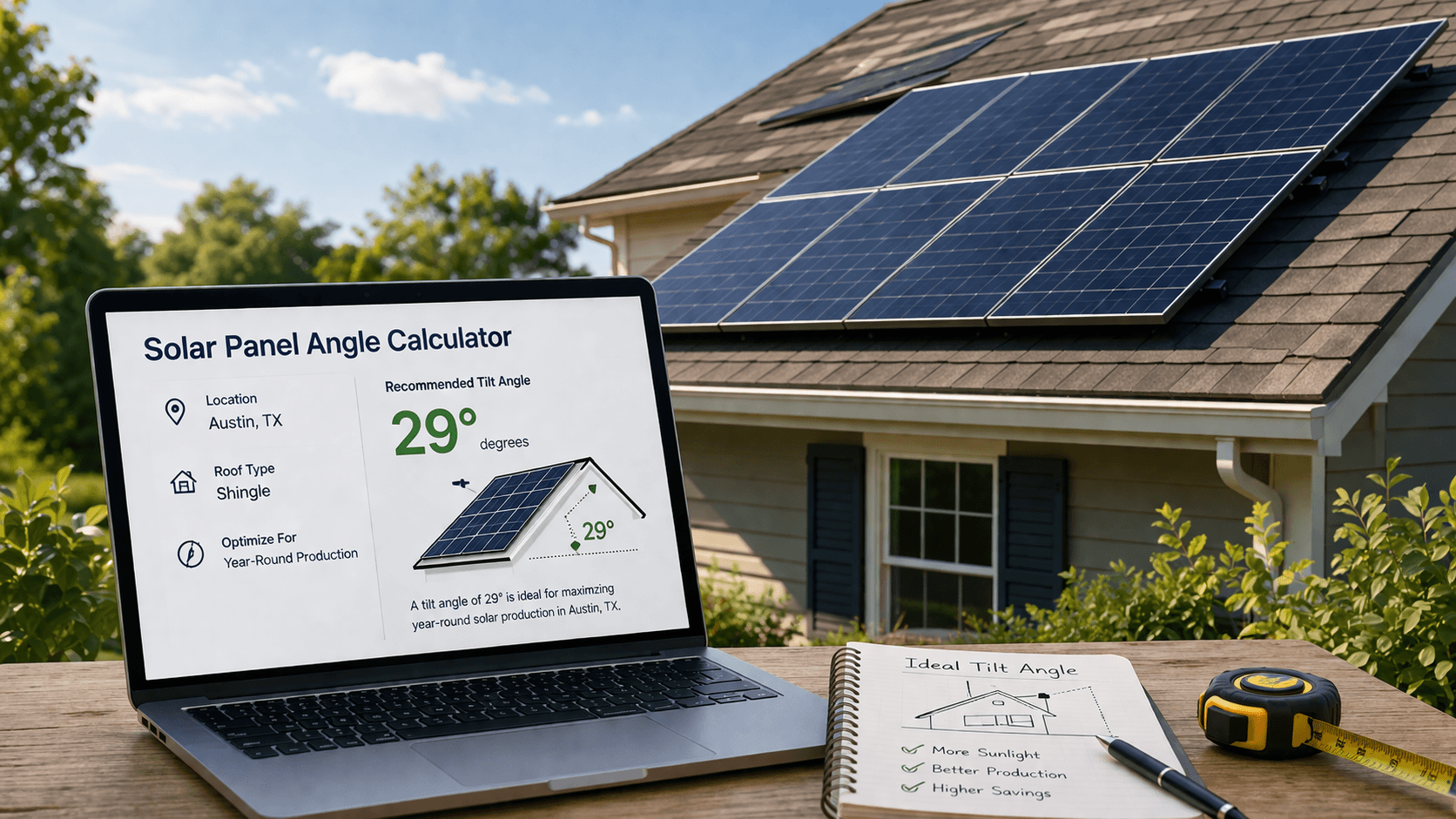
A solar panel angle calculator helps estimate the best tilt and direction for solar panels based on your location, roof, and energy goals.
Panel angle matters because solar panels produce more electricity when they receive stronger sunlight throughout the year. But the “best” angle is not always the same for every home.
Your ideal solar panel tilt depends on your latitude, roof pitch, roof direction, shade, local weather, seasonal energy needs, utility rules, system design, and whether panels are mounted on a roof or ground rack.
This guide explains how solar panel angle works, how to estimate tilt, what azimuth means, when roof pitch matters, and how to use PVWatts or a solar ROI calculator to compare production and savings.
Before choosing a final design, use the MySolarROI solar ROI calculator to see how solar production, system cost, savings, incentives, financing, and payback may change your long-term ROI.
What Is a Solar Panel Angle Calculator?
A solar panel angle calculator estimates the tilt and direction that may help a solar panel system produce more electricity.
It may use inputs such as:
- ZIP code or address
- latitude
- roof pitch
- roof direction
- azimuth
- system size
- seasonal production goal
- mounting type
- shade conditions
Some calculators focus only on the best annual tilt. Others let you compare different roof planes, seasonal tilt settings, or production estimates using tools like PVWatts.
The goal is not to find a perfect theoretical angle. The goal is to understand whether your roof or ground-mounted design can produce enough electricity to support your savings and ROI goals.
Solar Panel Tilt vs Azimuth: What Is the Difference?
Solar panel angle usually refers to two related concepts: tilt and azimuth.
| Term | Meaning | Example |
|---|---|---|
| Tilt | The angle of the panel from horizontal | 25°, 30°, 35° |
| Azimuth | The compass direction the panel faces | 180° for south-facing in many PV tools |
| Roof pitch | The slope of your roof | 6/12 pitch is about 26.6° |
| Orientation | General direction of the roof plane | South, east, west, southeast |
Tilt affects how directly panels face the sun. Azimuth affects what time of day panels produce more electricity.
In many U.S. locations, south-facing panels often produce strong annual output. East-facing panels may produce more in the morning. West-facing panels may produce more in the afternoon. The best direction depends on your roof, utility rate plan, and energy usage pattern.
What Is the Best Angle for Solar Panels?
There is no single best solar panel angle for every home.
A common rule of thumb is to start with a tilt near your latitude for year-round production. However, that is only a starting point. Roof pitch, mounting type, snow, seasonal needs, and utility rates can change the best practical design.
Energy.gov notes that solar panels typically perform best on south-facing roofs with a slope between 15 and 40 degrees, though other roofs may also be suitable. :contentReference[oaicite:2]{index=2}
| Situation | Angle Consideration |
|---|---|
| Year-round production | Tilt near latitude is often used as a planning baseline |
| Summer-heavy usage | Lower tilt may favor higher summer sun |
| Winter-heavy usage | Steeper tilt may help capture lower winter sun |
| Roof-mounted system | Panels are often installed parallel to the roof |
| Ground-mounted system | Tilt may be more adjustable or optimized |
| Snowy climate | Steeper tilt may help snow shed more easily |
The most practical answer is usually the angle that balances production, installation cost, roof fit, wind loading, aesthetics, permitting, and ROI.
How to Estimate Solar Panel Tilt by Latitude
If you are doing early planning, you can use latitude as a starting point.
Simple planning rule:
Year-round solar panel tilt ≈ your latitude
Example:
| Approximate Latitude | Planning Tilt Starting Point |
|---|---|
| 25° | About 25° |
| 30° | About 30° |
| 35° | About 35° |
| 40° | About 40° |
| 45° | About 45° |
This does not mean the system must be installed at exactly that angle. Many rooftop systems use the existing roof pitch because changing the tilt with racks can add cost, increase wind considerations, and reduce how many panels fit on the roof.
For financial planning, a slightly less-than-perfect angle may still be perfectly reasonable if the system cost is lower and production remains strong.
Roof Pitch and Solar Panel Angle
For most residential rooftop solar systems, panels are installed flush or nearly flush with the roof.
That means your roof pitch often becomes the panel tilt.
| Roof Pitch | Approximate Angle | Solar Planning Note |
|---|---|---|
| 3/12 | 14° | Low slope; may work well in many cases |
| 4/12 | 18° | Common residential roof pitch |
| 6/12 | 27° | Often within a strong practical range |
| 8/12 | 34° | Steeper but still common |
| 10/12 | 40° | Steep; installation complexity may increase |
| 12/12 | 45° | Very steep; safety and labor may affect cost |
On sloped roofs, panels are usually mounted parallel to the roof. On flat or lightly sloped roofs, panels may be rack-mounted with tilt frames, but that can require spacing between rows so panels do not shade each other and may reduce how many panels fit. :contentReference[oaicite:3]{index=3}
Azimuth: Why Direction Matters
Azimuth describes the direction your solar panels face.
In many solar tools, azimuth is measured clockwise from true north:
| Direction | Azimuth |
|---|---|
| North | 0° |
| East | 90° |
| South | 180° |
| West | 270° |
In the Northern Hemisphere, south-facing panels often maximize annual production. But east-facing and west-facing roofs can still be useful.
| Panel Direction | Production Pattern | When It May Help |
|---|---|---|
| South | Often strong year-round production | Maximizing annual output |
| East | More morning production | Morning household usage |
| West | More afternoon production | Afternoon or evening rate plans |
| Southeast / southwest | Balanced production | Common practical roof orientations |
| North | Usually weaker in many U.S. rooftop cases | May be less attractive unless roof slope/location still works |
If your utility has time-of-use rates, west-facing production may sometimes be useful even if annual output is lower than south-facing production, because afternoon energy may be more valuable under some rate plans.
Does the Best Solar Angle Change by Season?
Yes. The sun is higher in the sky during summer and lower during winter.
That means a lower tilt may favor summer production, while a steeper tilt may favor winter production.
| Seasonal Goal | Possible Tilt Strategy |
|---|---|
| Maximize annual production | Use a year-round fixed tilt |
| More summer production | Use a lower tilt where practical |
| More winter production | Use a steeper tilt where practical |
| Off-grid winter reliability | Winter tilt may matter more |
| Grid-tied bill savings | Annual value and utility rate timing may matter more than seasonal maximum |
Most residential rooftop systems are fixed. Homeowners usually do not adjust panel angle seasonally because the added labor, mounting complexity, safety risk, and cost may not be worth it.
For ground-mounted or off-grid systems, seasonal adjustability may be more practical.
How Solar Panel Angle Affects Production
Panel angle affects production because it changes how directly sunlight strikes the solar modules.
However, the difference between a “perfect” angle and a practical roof angle may be smaller than homeowners expect, especially if the roof is already within a reasonable tilt and direction range.
Production can also be affected by:
- shade
- roof direction
- panel type
- inverter design
- temperature
- snow
- dust and soiling
- system losses
- local weather
Do not evaluate solar panel angle in isolation. A perfect angle with heavy shade may perform worse than a less-than-perfect angle with full sun.
Mini Case Study: Comparing Two Roof Angles
Here is a simplified example. These numbers are for illustration only and are not guaranteed.
Actual results depend on location, roof orientation, shade, weather, system size, equipment, utility rates, net metering rules, and installation quality.
| Assumption | Roof A | Roof B |
|---|---|---|
| System size | 7 kW | 7 kW |
| Direction | South-facing | Southwest-facing |
| Tilt | 30° | 18° |
| Shade | Minimal | Minimal |
| Estimated annual production | Use PVWatts result | Use PVWatts result |
| Financial comparison | Compare annual kWh × effective electricity value | Compare annual kWh × effective electricity value |
If Roof A produces slightly more electricity but costs more to install because of complexity, Roof B may still be financially competitive.
The best solar design is not always the one with the highest theoretical production. It is the one that provides a strong balance of production, cost, safety, aesthetics, code compliance, and ROI.
Use PVWatts to compare production, then use the MySolarROI calculator to compare savings, payback, and ROI.
Using PVWatts as a Solar Panel Angle Calculator
PVWatts can be used to compare different tilt and azimuth assumptions.
PVWatts estimates the energy production of grid-connected photovoltaic systems and allows homeowners and installers to develop performance estimates for potential PV installations. :contentReference[oaicite:4]{index=4}
To compare angles in PVWatts:
- Enter your location.
- Enter the same system size for each scenario.
- Choose the same module type and array type.
- Run one scenario with your actual roof tilt.
- Run another scenario with a different tilt.
- Run one scenario with your actual roof direction.
- Compare annual and monthly kWh output.
- Use the production difference in an ROI calculation.
For a full walkthrough, read the PVWatts calculator guide.
Solar Panel Angle and Net Metering
Panel angle and direction affect when your system produces electricity. Utility rules determine how valuable that production is.
Under full retail net metering, annual production may be the main focus. Under time-of-use rates or lower export credits, the timing of production may matter more.
| Utility Situation | Design Consideration |
|---|---|
| Full retail net metering | Annual production may matter most |
| Low export credits | Self-consumption may matter more |
| Time-of-use rates | Afternoon or peak-period production may be valuable |
| Battery included | Storage can shift solar energy to later hours |
| No export value | System should be sized and oriented around on-site usage |
Read the net metering explained guide before assuming the highest annual production always gives the best financial return.
Solar Panel Angle and ROI
Solar panel angle affects ROI through production.
More production can create more savings if that electricity has value under your utility rules. But increasing production by changing tilt may not always improve ROI if it also increases installation cost or reduces the number of panels that fit.
Use this framework:
| Question | Why It Matters |
|---|---|
| How much more production does the better angle create? | Shows the benefit |
| Does the new mounting design cost more? | Shows the added cost |
| Does the tilt reduce usable roof space? | May reduce total system size |
| Is extra production exported at a low credit? | May reduce financial value |
| Does the roof design add maintenance or wind concerns? | May affect long-term value |
For ROI math, read the how to calculate solar ROI guide.
Flat Roofs and Solar Panel Angle
Flat roofs can work for solar, but they require careful design.
Panels may be installed on racking systems that tilt them toward the sun. However, tilted rows need spacing to avoid shading each other. That can reduce how many panels fit on the roof.
Flat roof solar design should consider:
- tilt angle
- row spacing
- wind loading
- roof membrane protection
- ballasted vs attached racking
- drainage
- maintenance access
- fire setbacks
- structural capacity
A higher tilt may produce more per panel, but it may also require more spacing. A lower tilt may fit more panels. The best design depends on total system production, cost, and roof constraints.
Ground-Mounted Solar and Adjustable Tilt
Ground-mounted systems often allow more flexibility than roof-mounted systems.
They may allow:
- better azimuth
- optimized tilt
- seasonal tilt adjustment
- less roof limitation
- easier maintenance access
- larger system size
However, ground mounts can add cost for racking, trenching, foundations, permitting, and land use.
Ground-mounted solar may be worth considering if the roof is shaded, poorly oriented, too small, old, or structurally unsuitable.
Common Solar Panel Angle Mistakes
| Mistake | Why It Can Mislead You | Better Approach |
|---|---|---|
| Assuming one angle is best everywhere | Location, roof, and utility rules vary | Use location-specific modeling |
| Ignoring azimuth | Direction affects production timing and output | Compare tilt and direction together |
| Optimizing angle but ignoring shade | Shade can reduce output more than tilt differences | Ask for shade analysis |
| Using latitude as a final answer | Latitude is only a planning baseline | Compare actual roof conditions in PVWatts |
| Racking roof panels at a steeper angle without checking cost | May increase cost or reduce panel count | Compare production gain against added cost |
| Ignoring time-of-use rates | Production timing can affect savings | Check utility rate plan and export credits |
| Treating production gain as guaranteed savings | Exported solar may be credited differently | Convert production to value using utility rules |
Questions to Ask Your Solar Installer
Before approving a solar design, ask:
- What tilt angle is used in the design?
- What azimuth is used for each roof plane?
- How much annual production is expected?
- Did you model shade?
- What system losses were assumed?
- How does this design compare with another roof plane?
- Would changing tilt increase production?
- Would changing tilt increase cost?
- Would tilt racking reduce how many panels fit?
- Does this design account for my utility rate plan?
- How does the production estimate affect payback?
- What happens if actual production is lower?
Ask for the production estimate in writing and compare it with PVWatts when possible.
External Sources to Check
Before relying on a solar angle estimate, verify assumptions with reputable sources.
- Energy.gov homeowner solar guide
- NREL PVWatts Calculator
- Australian Government solar design considerations
- Energy.gov solar energy guide for homebuilders
- Your installer’s shade and production model
- Your local utility rate plan and net metering tariff
FAQ About Solar Panel Angle Calculators
What is the best angle for solar panels?
The best angle depends on your location, roof pitch, roof direction, shade, seasonal needs, and utility rules. A common starting point is a tilt near your latitude, but actual rooftop systems often use the existing roof pitch.
What is the best roof direction for solar panels?
In many U.S. locations, south-facing roofs often produce strong annual output. Southeast and southwest can also work well. East and west roofs may be useful depending on usage patterns and utility rates.
What does azimuth mean for solar panels?
Azimuth is the compass direction your panels face. In many solar tools, south is 180 degrees, east is 90 degrees, west is 270 degrees, and north is 0 degrees.
Should solar panels be tilted at my latitude?
Tilt near latitude is a common year-round planning rule, but it is not always the best practical choice. Roof pitch, installation cost, shade, utility rates, and system design can make another angle more reasonable.
Do solar panels work on east- or west-facing roofs?
Yes, east- and west-facing roofs can still work. They may produce less annual energy than ideal south-facing roofs, but they can still provide useful savings depending on your location, rate plan, and system cost.
Can changing solar panel angle improve ROI?
It can if the production gain is valuable and the added cost is low. However, if tilt racking increases cost, reduces panel count, or adds complexity, the ROI improvement may be limited.
Is PVWatts a solar panel angle calculator?
PVWatts is a solar production calculator that lets you compare different tilt and azimuth inputs. It can help estimate how panel angle affects annual and monthly production.
Should I adjust solar panel angle seasonally?
Most residential rooftop systems are fixed and not adjusted seasonally. Seasonal adjustment may be more practical for some ground-mounted or off-grid systems, but it should be compared against cost, safety, and convenience.
Conclusion
A solar panel angle calculator can help you understand how tilt, azimuth, roof pitch, and location affect solar production.
But the best solar angle is not only the angle that produces the most electricity. It is the angle and design that make sense for your roof, system cost, utility rules, savings, and ROI.
Use PVWatts to compare production scenarios. Then use the MySolarROI solar ROI calculator to see how production differences affect savings, payback period, and long-term return before approving a solar design.