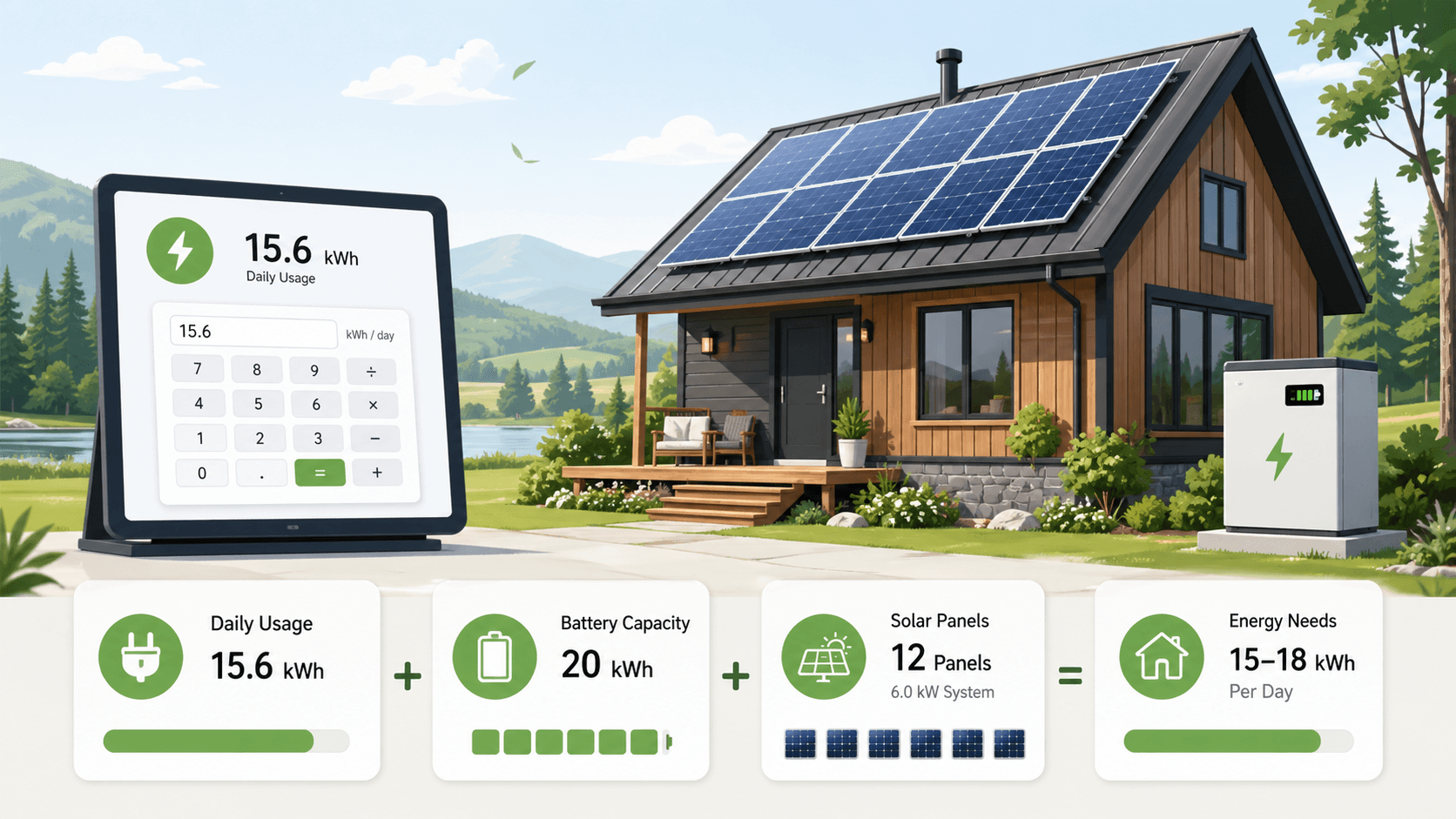
An off-grid solar calculator helps answer one of the most important questions homeowners, cabin owners, and rural property owners ask before building a stand-alone solar system:
How many solar panels, batteries, and inverter capacity do I actually need?
Off-grid solar is different from a regular grid-tied rooftop system. There is no utility grid waiting in the background when solar production drops. Your system has to cover daily electricity use, nighttime loads, cloudy weather, battery limits, inverter surge, seasonal changes, and backup power planning.
That makes sizing more important than guessing.
This guide explains how an off-grid solar calculator works, what inputs matter, and how to estimate your system size step by step. Results depend on your location, electricity usage, sun hours, weather patterns, roof or ground-mount conditions, battery type, inverter design, backup generator plans, and system losses.
For a small RV-style energy budget, use the RV solar calculator with supported daily demand, design sun hours and battery assumptions. It does not design a home off-grid electrical installation or calculate equipment prices. An off-grid home requires a separate seasonal production, power and reliability design; the cash ROI tool is not an off-grid system simulator.
What Is an Off-Grid Solar Calculator?
An off-grid solar calculator estimates the major components needed for a stand-alone solar power system.
A good calculator helps size:
- solar panel array capacity
- battery storage capacity
- inverter size
- charge controller capacity
- backup generator needs
- safety margin
- approximate system cost
- replacement and maintenance assumptions
Off-grid systems usually include more equipment than grid-tied systems. A grid-tied system can rely on the utility grid when solar production is low. An off-grid system cannot.
That means the design needs to answer practical questions:
- How much electricity do you use each day?
- Which loads are essential?
- How many cloudy days do you want to cover?
- How much battery capacity is needed?
- How many solar panels are needed to recharge the batteries?
- Can the inverter handle starting loads from appliances?
- Do you need a backup generator?
- What happens during winter or low-sun months?
An off-grid solar calculator is useful for planning, but final system design should be reviewed by a qualified solar professional or electrical professional, especially for permanent homes, code-compliant installations, and critical backup loads.
Off-Grid Solar vs. Grid-Tied Solar
Before sizing an off-grid system, it helps to understand how it differs from a grid-tied solar system.
| Feature | Grid-Tied Solar | Off-Grid Solar |
|---|---|---|
| Utility connection | Yes | No, or not relied on |
| Battery requirement | Optional | Usually required |
| Backup during outages | Usually no unless battery or special equipment is included | Designed for independent power |
| System sizing goal | Offset electricity bills | Power loads reliably without the grid |
| Cost structure | Panels, inverter, installation, optional battery | Panels, batteries, inverter, charge controller, backup, safety margin |
| Design risk | Lower, because the grid fills gaps | Higher, because undersizing can cause outages |
| ROI calculation | Usually based on bill savings and net metering | Often based on avoided grid extension, fuel cost, resilience, and energy access |
For most suburban homes with reliable utility access, grid-tied solar is usually simpler and less expensive than full off-grid solar. Off-grid solar is more common for remote homes, cabins, farms, RVs, workshops, telecom sites, and properties where grid extension is expensive or unavailable.
If your home is connected to the grid and your main goal is bill savings, read the how to calculate solar ROI guide before assuming off-grid is the best financial option.
What You Need Before Using an Off-Grid Solar Calculator
The most important input is not the number of panels. It is your electricity usage.
Start with your loads.
| Input | Why It Matters | Example |
|---|---|---|
| Daily energy use | Determines how much electricity the system must supply | 8 kWh/day |
| Essential loads | Helps separate must-have power from optional loads | Fridge, lights, water pump, internet |
| Peak load | Determines inverter running capacity | 3,000 watts |
| Surge load | Determines whether the inverter can start motors or pumps | 6,000 watts surge |
| Days of autonomy | Shows how many days the batteries should cover without solar | 2 days |
| Peak sun hours | Helps size the solar array | 4.5 sun hours/day |
| Battery type | Affects usable capacity and depth of discharge | Lithium or lead-acid |
| System losses | Accounts for real-world inefficiencies | 10%–25% planning margin |
| Backup generator | May reduce battery size but adds fuel and maintenance | Optional generator |
If you guess these numbers, the result will be weak. A good off-grid design starts with a real load list.
Step 1: Calculate Your Daily Electricity Loads
Daily electricity use is usually measured in kilowatt-hours, or kWh.
The basic formula is:
Watts × hours used per day ÷ 1,000 = kWh per day
Example:
100-watt appliance × 5 hours ÷ 1,000 = 0.5 kWh/day
Make a list of every appliance, device, and load you want to power.
| Load | Watts | Hours/Day | Daily Energy |
|---|---|---|---|
| Refrigerator | 150 W average | 10 equivalent hours | 1.5 kWh |
| LED lights | 60 W total | 5 hours | 0.3 kWh |
| Internet/router | 20 W | 24 hours | 0.48 kWh |
| Laptop | 60 W | 4 hours | 0.24 kWh |
| Water pump | 800 W | 0.5 hours | 0.4 kWh |
| Small appliances | 500 W | 1 hour | 0.5 kWh |
In this simplified example, the listed loads total about 3.42 kWh/day. A real home, cabin, or farm building may use much more, especially if it includes electric heating, air conditioning, electric water heating, well pumps, power tools, cooking appliances, or EV charging.
Off-grid systems become much larger and more expensive when they need to power heating, cooling, water heating, or large motors. If possible, separate essential loads from optional loads.
Step 2: Separate Essential and Optional Loads
Off-grid sizing is easier when you separate must-have loads from nice-to-have loads.
| Essential Loads | Optional or Flexible Loads |
|---|---|
| Refrigerator or freezer | Laundry |
| Lighting | Dishwasher |
| Water pump | Power tools |
| Medical equipment | Entertainment systems |
| Internet or communications | EV charging |
| Critical heating controls | Air conditioning |
This matters because every load you add increases the size and cost of the system.
For a cabin or backup-focused system, you may only need critical loads. For a full-time off-grid home, you may need a larger system that supports normal daily living.
Be realistic. An off-grid system designed for weekend lights and a small fridge is very different from a full home system with air conditioning, well pump, electric cooking, and laundry.
Step 3: Choose Days of Autonomy
Days of autonomy means how many days your battery bank should power your loads without meaningful solar production.
For example:
- 1 day of autonomy may work for a small, non-critical cabin with generator backup.
- 2 days of autonomy may be a more balanced planning assumption for many small systems.
- 3 or more days may be useful for remote homes, critical loads, harsh weather areas, or limited generator access.
| Days of Autonomy | What It Means | Cost Impact |
|---|---|---|
| 1 day | Batteries cover one day of loads without solar | Lower battery cost, less backup margin |
| 2 days | Batteries cover two days of loads | More balanced for many planning cases |
| 3+ days | Batteries cover extended low-sun periods | Higher battery cost and larger system design |
More autonomy improves resilience, but it can significantly increase cost. Many off-grid systems use a backup generator to avoid oversizing batteries for rare worst-case periods.
Step 4: Size the Battery Bank
Battery capacity is one of the most important parts of an off-grid solar calculation.
A simple planning formula is:
Battery capacity needed = daily kWh use × days of autonomy ÷ usable battery percentage
Usable battery percentage depends on battery chemistry, system settings, and how deeply the battery should be discharged.
Example:
- Daily energy use: 8 kWh/day
- Days of autonomy: 2 days
- Usable battery capacity: 80%
8 kWh/day × 2 days ÷ 0.80 = 20 kWh of nominal battery capacity
| Daily Load | Autonomy | Usable Battery % | Approx. Nominal Battery Capacity |
|---|---|---|---|
| 5 kWh/day | 2 days | 80% | 12.5 kWh |
| 8 kWh/day | 2 days | 80% | 20 kWh |
| 12 kWh/day | 2 days | 80% | 30 kWh |
| 20 kWh/day | 2 days | 80% | 50 kWh |
This is a planning estimate, not a final design. Battery sizing should consider temperature, charge/discharge limits, inverter compatibility, battery warranty, system voltage, and code requirements.
Step 5: Estimate Solar Array Size
After estimating daily energy use and battery capacity, size the solar array.
A simplified formula is:
Solar array size = daily kWh use ÷ peak sun hours ÷ system efficiency factor
The system efficiency factor accounts for real-world losses such as inverter losses, wiring losses, battery charging losses, dust, temperature, and imperfect conditions.
Example:
- Daily energy use: 8 kWh/day
- Peak sun hours: 4.5 hours/day
- Efficiency factor: 0.75
8 ÷ 4.5 ÷ 0.75 = 2.37 kW solar array
In practice, you might round up for seasonal variation, cloudy weather, battery recharge needs, and future load growth.
| Daily Use | Peak Sun Hours | Efficiency Factor | Estimated Solar Array |
|---|---|---|---|
| 5 kWh/day | 4.5 | 0.75 | 1.5 kW |
| 8 kWh/day | 4.5 | 0.75 | 2.4 kW |
| 12 kWh/day | 4.5 | 0.75 | 3.6 kW |
| 20 kWh/day | 4.5 | 0.75 | 5.9 kW |
Peak sun hours vary by location and season. A system that works well in summer may struggle in winter if winter sun is much lower. For year-round off-grid living, winter conditions often drive the design.
For solar production modeling, use reputable tools such as NREL PVWatts and compare results with installer assumptions.
Step 6: Size the Inverter
The inverter converts DC power from batteries or panels into AC power used by most household appliances.
Inverter sizing is not based only on daily kWh. It also depends on how much power your appliances need at the same time.
There are two key numbers:
- running watts: power needed while equipment operates normally
- surge watts: extra power needed to start motors, pumps, compressors, or tools
| Load Type | Why It Matters |
|---|---|
| Refrigerator | May have compressor surge when starting |
| Well pump | Can have high startup surge |
| Power tools | May draw short bursts of high power |
| Microwave | High running wattage |
| Air conditioner | High running and surge load |
Example:
- Expected simultaneous running load: 2,500 watts
- Largest startup surge: 4,000 additional watts
- Suggested inverter planning range: large enough to support both running and surge needs
Do not undersize the inverter. A system may have enough battery capacity but still fail to start a pump or appliance if the inverter cannot handle surge power.
Step 7: Include Charge Controller and System Losses
Off-grid systems need equipment that safely manages charging and power flow.
A typical off-grid system may include:
- solar panels
- batteries
- inverter
- charge controller
- disconnects and overcurrent protection
- wiring and combiner boxes
- monitoring equipment
- grounding and safety equipment
- backup generator connection, if included
System losses are normal. They can come from:
- inverter conversion
- battery charging and discharging
- wiring
- temperature
- dust and soiling
- snow coverage
- panel mismatch
- charge controller efficiency
This is why off-grid calculations should include a safety margin. A system sized exactly to average loads may underperform during bad weather, winter, or unexpected usage spikes.
Mini Case Study: Small Off-Grid Cabin Example
Here is a simplified example for planning only. These numbers are not a final system design and are not guaranteed.
Actual results depend on location, weather, sun hours, equipment, battery chemistry, inverter design, local code, installation quality, and real appliance usage.
| Assumption | Example Value |
|---|---|
| Use case | Small off-grid cabin |
| Daily electricity use | 6 kWh/day |
| Days of autonomy | 2 days |
| Usable battery percentage | 80% |
| Peak sun hours | 4.5/day |
| System efficiency factor | 0.75 |
| Estimated running load | 2,000 watts |
| Estimated surge load | 4,000–6,000 watts |
Battery estimate:
6 kWh/day × 2 days ÷ 0.80 = 15 kWh nominal battery capacity
Solar array estimate:
6 kWh/day ÷ 4.5 sun hours ÷ 0.75 = 1.78 kW solar array
In practice, the system designer may round up the solar array to improve recharge speed and account for seasonal variation. The inverter would need to support both normal running loads and startup surge from appliances such as a pump, refrigerator, or power tools.
This example could change if the cabin adds air conditioning, electric cooking, a larger water pump, laundry, EV charging, or year-round winter use.
Off-Grid Solar Cost Factors
Off-grid solar often costs more than a simple grid-tied system because it requires batteries, controls, backup planning, and a larger design margin.
Major cost factors include:
| Cost Factor | Why It Matters |
|---|---|
| Daily energy use | Higher loads require more panels and batteries |
| Battery capacity | Batteries are often one of the largest cost drivers |
| Days of autonomy | More backup days require more storage |
| Winter performance | Low-sun seasons may require larger arrays or generator backup |
| Inverter size | Larger loads and surge requirements need larger equipment |
| Installation type | Remote sites, trenching, ground mounts, and difficult access can raise cost |
| Generator integration | Can improve resilience but adds fuel and maintenance costs |
| Code and safety requirements | Permanent homes may need more formal design and inspection |
For cost comparison, review the solar panel cost 2026 guide, but remember that off-grid systems include additional equipment and design requirements.
Battery Type Matters
Battery chemistry affects usable capacity, maintenance, lifespan, temperature behavior, cost, and installation requirements.
| Battery Type | Planning Considerations |
|---|---|
| Lithium batteries | Often higher usable capacity, lower maintenance, and higher upfront cost |
| Lead-acid batteries | Lower upfront cost in some cases, but lower usable depth and more maintenance |
| Saltwater or other chemistries | Less common and should be evaluated by specs, warranty, and availability |
Do not compare batteries only by sticker price. Compare usable kWh, warranty, cycle life, temperature limits, charge/discharge rating, safety requirements, and compatibility with your inverter and charge controller.
Do You Need a Backup Generator?
Many off-grid systems include a backup generator.
A generator can reduce the need for a very large battery bank designed for rare worst-case weather. It can also provide resilience during long cloudy periods, winter storms, or unexpected load increases.
However, a generator adds:
- fuel cost
- maintenance
- noise
- emissions
- storage considerations
- startup and transfer equipment
- another system that can fail
| Approach | Benefit | Tradeoff |
|---|---|---|
| Larger battery bank | More silent backup capacity | Higher upfront cost |
| Smaller battery with generator | Lower battery cost and more backup flexibility | Fuel and maintenance required |
| Large solar array | Faster battery recharge | More panels, space, and installation cost |
The right answer depends on how critical your loads are, how remote the site is, and how much downtime you can tolerate.
Common Off-Grid Solar Sizing Mistakes
| Mistake | Why It Causes Problems | Better Approach |
|---|---|---|
| Guessing energy usage | Can undersize panels and batteries | Build a real appliance load list |
| Ignoring surge loads | Inverter may fail to start pumps or compressors | Check running and startup watts |
| Using summer sun for year-round design | Winter production may be much lower | Model low-sun months separately |
| Oversizing optional loads | Can make the system unnecessarily expensive | Separate essential and optional loads |
| Undersizing batteries | May cause outages during cloudy periods | Choose realistic days of autonomy |
| Ignoring system losses | Real output may be lower than expected | Add a safety margin |
| Skipping professional review | Safety and code issues may be missed | Use qualified design help for permanent systems |
Questions to Ask Before Buying Off-Grid Solar Equipment
Before buying panels, batteries, or an inverter, ask:
- What is my realistic daily kWh use?
- Which loads are essential?
- Which loads can be shifted or avoided?
- What are my winter peak sun hours?
- How many days of autonomy do I need?
- What battery chemistry is appropriate?
- What usable battery capacity do I need?
- What inverter running wattage do I need?
- What surge capacity do I need?
- Do I need a backup generator?
- What system losses should I include?
- Will the system meet local code requirements?
- Who will install, inspect, and maintain the system?
- What happens if my energy use increases later?
If you cannot answer these questions, do more planning before purchasing equipment.
When Off-Grid Solar Makes Sense
Off-grid solar may make sense when:
- grid extension is very expensive
- the property is remote
- electricity needs are modest and well understood
- backup power is a high priority
- the owner accepts more system responsibility
- generator fuel delivery is difficult or expensive
- the site has good solar access
- loads can be managed carefully
Off-grid solar may be less attractive when:
- the property already has reliable grid access
- electricity usage is high
- large heating or cooling loads are required
- the site has poor sun exposure
- battery costs make the system too expensive
- the owner does not want maintenance responsibility
- professional installation or inspection is difficult
For grid-connected homes, solar with battery backup may be more practical than going fully off-grid.
Off-Grid Solar and ROI
Off-grid solar ROI is different from grid-tied solar ROI.
Grid-tied ROI is often based on electricity bill savings, incentives, net metering, and payback period.
Off-grid ROI may include:
- avoided utility grid extension cost
- avoided generator fuel cost
- backup power value
- resilience value
- energy access for remote property
- reduced dependence on fuel delivery
- property usability
That makes off-grid ROI more personal and harder to compare with a standard rooftop solar system.
If your home is grid-connected, make sure you compare full off-grid solar against other options:
- grid-tied solar
- grid-tied solar with battery backup
- portable generator
- standby generator
- efficiency upgrades
- critical-load backup panel
For broader financial planning, use the solar financing comparison guide and the solar payback period guide.
Sources and verification
Before relying on an off-grid solar estimate, verify assumptions with reputable sources and qualified professionals.
- U.S. Department of Energy guide to planning home renewable energy systems
- U.S. Department of Energy balance-of-system equipment guidance
- NREL PVWatts solar production calculator
- Your local building department for code and permitting requirements
- A qualified solar installer or licensed electrician for final system design
FAQ About Off-Grid Solar Calculators
What does an off-grid solar calculator do?
An off-grid solar calculator estimates the solar panels, battery capacity, inverter size, and backup planning needed for a stand-alone power system. It uses inputs such as daily kWh usage, peak sun hours, days of autonomy, battery type, and system losses.
How do I calculate battery size for off-grid solar?
A simple planning formula is daily kWh use multiplied by days of autonomy, divided by usable battery percentage. For example, 8 kWh per day for 2 days with 80% usable battery capacity requires about 20 kWh of nominal battery capacity.
How many solar panels do I need for off-grid power?
The number of panels depends on daily energy use, peak sun hours, system losses, battery recharge needs, and seasonal conditions. First calculate the required solar array size in kilowatts, then divide by the wattage of the panels you are considering.
Is off-grid solar cheaper than grid-tied solar?
Usually not. Off-grid solar often costs more because it requires batteries, charge controllers, backup planning, larger safety margins, and more careful design. It may make sense when grid extension is expensive or unavailable.
Can I run a whole house on off-grid solar?
Yes, but the system must be carefully designed around real loads, seasonal conditions, battery capacity, inverter surge, and backup needs. Whole-home off-grid systems can become large and expensive, especially with heating, cooling, pumps, or EV charging.
Do I need a generator with off-grid solar?
Not always, but many off-grid systems include a generator for long cloudy periods, winter conditions, high temporary loads, or emergency backup. A generator can reduce battery oversizing but adds fuel, maintenance, and noise.
What is days of autonomy in off-grid solar?
Days of autonomy is the number of days your batteries can power your loads without meaningful solar production. More autonomy improves resilience but increases battery cost.
Is an off-grid solar calculator accurate?
It can provide a useful planning estimate, but accuracy depends on your inputs. Final system design should use site-specific solar data, real appliance loads, equipment specs, local codes, and professional review.
Conclusion
An off-grid solar calculator is useful because it forces you to design around real electricity use instead of guessing how many panels you need.
The most important steps are simple:
- Calculate daily kWh loads.
- Separate essential and optional loads.
- Choose days of autonomy.
- Size the battery bank.
- Estimate solar array capacity.
- Check inverter running and surge power.
- Add realistic losses and backup planning.
Off-grid solar can provide reliable power for cabins, rural homes, remote buildings, and resilience-focused homeowners, but it requires more careful sizing than a normal grid-tied system.