Solar can lower electric bills for some homeowners, but it is also surrounded by confusing claims, outdated incentive information, and sales pitches that make the decision harder than it should be.
This guide breaks down solar myths debunked in plain English so you can understand what solar can do, what it cannot do, and which numbers matter before you request quotes.
Your actual result depends on your location, roof condition, electricity rate, utility rules, system size, financing, incentives, shading, and how much of your solar production you can use or credit.
Before comparing installer proposals, use the solar ROI calculator to estimate your payback period, savings, and long-term return with your own assumptions.
Solar Myths Debunked: Quick Facts
| Myth | Fact homeowners should know |
|---|---|
| Solar only works in sunny states | Solar works in many climates, but production varies by sunlight, shade, and roof design. |
| Solar panels do not work on cloudy days | They can still generate electricity, but output is lower than on clear days. |
| Solar makes your home fully independent | Most homes remain grid-connected unless they add batteries and backup equipment. |
| Batteries are required | Batteries are optional for many homes, though useful for backup and time-of-use rates. |
| Solar is always worth it | Solar depends on electric rates, system cost, roof fit, incentives, and net metering rules. |
| The biggest system is always best | Oversizing can reduce ROI if excess power is poorly credited. |
| All solar quotes are equal | Equipment, warranties, financing terms, production estimates, and installer quality vary. |
| Solar panels ruin roofs | Properly installed systems should protect penetrations, but roof age matters. |
| Solar needs constant maintenance | Most systems need limited maintenance, but monitoring and occasional service still matter. |
| Federal solar tax credits still work the same | For residential systems, the 25D credit ended after 2025 under current IRS guidance. |
25 Solar Myths Debunked for Homeowners
Myth 1: Solar only makes sense in hot, sunny states
Fact: Solar panels use sunlight, not heat. A sunny roof in Arizona may produce more electricity than a roof in New York or Massachusetts, but solar can still work in cooler or cloudier areas.
The Department of Energy notes that solar panels are built to work in all climates, though roof age, tree cover, roof slope, and roof direction affect suitability. South-facing roofs with slopes between 15 and 40 degrees often perform well, but other roof layouts can still be viable.
Myth 2: Solar panels stop working on cloudy days
Fact: Clouds reduce output, but they do not usually stop production completely. Your panels can still capture diffuse sunlight. The key is annual production, not one cloudy afternoon.
A good solar estimate should show expected monthly and annual production, not just ideal summer output.
Myth 3: Solar panels work at night
Fact: Solar panels do not generate electricity at night. At night, your home uses grid power, battery power, or both.
This is why net metering, battery storage, and your daily energy-use pattern matter.
Myth 4: Solar means you can disconnect from the grid
Fact: Most residential solar homes remain connected to the utility grid. Going fully off-grid usually requires a larger system, battery storage, backup planning, and careful load management.
For many homeowners, grid-tied solar is simpler and more cost-effective than full energy independence.
Myth 5: You must buy a battery with solar
Fact: Batteries are not required for solar panels to work. A battery can help with backup power, time-of-use rates, or low export credits, but it also increases upfront cost.
Use the solar payback estimate to compare solar-only vs. solar-plus-battery scenarios.
Myth 6: Solar always eliminates your electric bill
Fact: Solar can reduce your bill, but many homeowners still pay fixed utility charges, minimum bills, taxes, or fees. Your bill also depends on how your utility credits excess solar production.
A better goal is not “zero bill at all costs.” It is finding the system size that gives you the strongest financial outcome.
Myth 7: Solar is always worth it for every home
Fact: Solar is not automatically a good fit. It tends to work best when you have:
- High electricity rates
- A sunny roof with limited shade
- A roof with useful remaining life
- Fair net metering or export-credit rules
- Reasonable installation pricing
- Plans to stay in the home long enough to benefit
If those conditions are weak, solar may still work, but the payback period can be longer.
Myth 8: The federal solar tax credit is still available like before
Fact: This is one of the biggest outdated solar claims. Under current IRS guidance, the Residential Clean Energy Credit equaled 30% for eligible property installed from 2022 through December 31, 2025, and is not available for property placed in service after December 31, 2025. IRS OBBB guidance also says the Section 25D residential clean energy credit is not allowed for expenditures made after December 31, 2025.
Homeowners should verify federal, state, local, and utility incentives before signing a contract.
Myth 9: State incentives are the same everywhere
Fact: Solar incentives vary widely by state, utility, and program. Rebates, property tax exemptions, sales tax exemptions, renewable energy credits, and net metering rules can change.
Check state solar incentives and confirm details with official program sources before assuming any incentive applies.
Myth 10: Net metering is guaranteed
Fact: Net metering is not the same everywhere. Some utilities credit excess solar at retail rates, while others use lower export rates, avoided-cost rates, or time-based credits.
This can materially affect ROI. Learn the basics in our guide to net metering.
Myth 11: Bigger solar systems always save more money
Fact: Bigger systems produce more electricity, but that does not always mean better ROI. If your utility pays little for exported electricity, oversizing your system may stretch your payback period.
The right system size should match your annual usage, roof space, budget, and utility rules.
Myth 12: Solar ROI is too complicated to estimate
Fact: Solar ROI can be estimated with a few core inputs:
- Total installed cost
- Incentives and rebates
- Expected annual production
- Electricity rate
- Net metering or export-credit value
- Financing cost
- Maintenance and inverter assumptions
- Expected time in the home
That is exactly why using a solar ROI calculator is better than relying on a sales estimate alone.
Myth 13: Solar panels are too expensive for most homeowners
Fact: Solar is still a major purchase, but pricing has become more transparent. DOE’s 2024 Q1 benchmark lists an 8 kW residential PV modeled market price of $3.15/Wdc, while EnergySage reported median quoted solar pricing of $2.48/W in H1 2025. Actual quotes vary by market, roof complexity, equipment, installer, and financing.
Do not judge affordability from one quote. Compare at least three.
Myth 14: The cheapest solar quote is always best
Fact: A low price can be good, but only if the assumptions are realistic. Compare:
| Quote item | Why it matters |
|---|---|
| Cost per watt | Helps compare pricing across different system sizes |
| Annual production estimate | Drives projected savings |
| Panel and inverter brands | Affects performance and warranty terms |
| Workmanship warranty | Protects against installation issues |
| Roof work included? | Avoids surprise costs |
| Financing APR and fees | Can change ROI dramatically |
| Battery included? | Makes quote comparisons harder if mixed |
Myth 15: Solar financing is basically free money
Fact: Financing can make solar more accessible, but interest rates, dealer fees, loan terms, and escalators can change the true cost.
A low monthly payment is not the same as a good ROI. Always compare the cash price, financed price, APR, fees, and total payments.
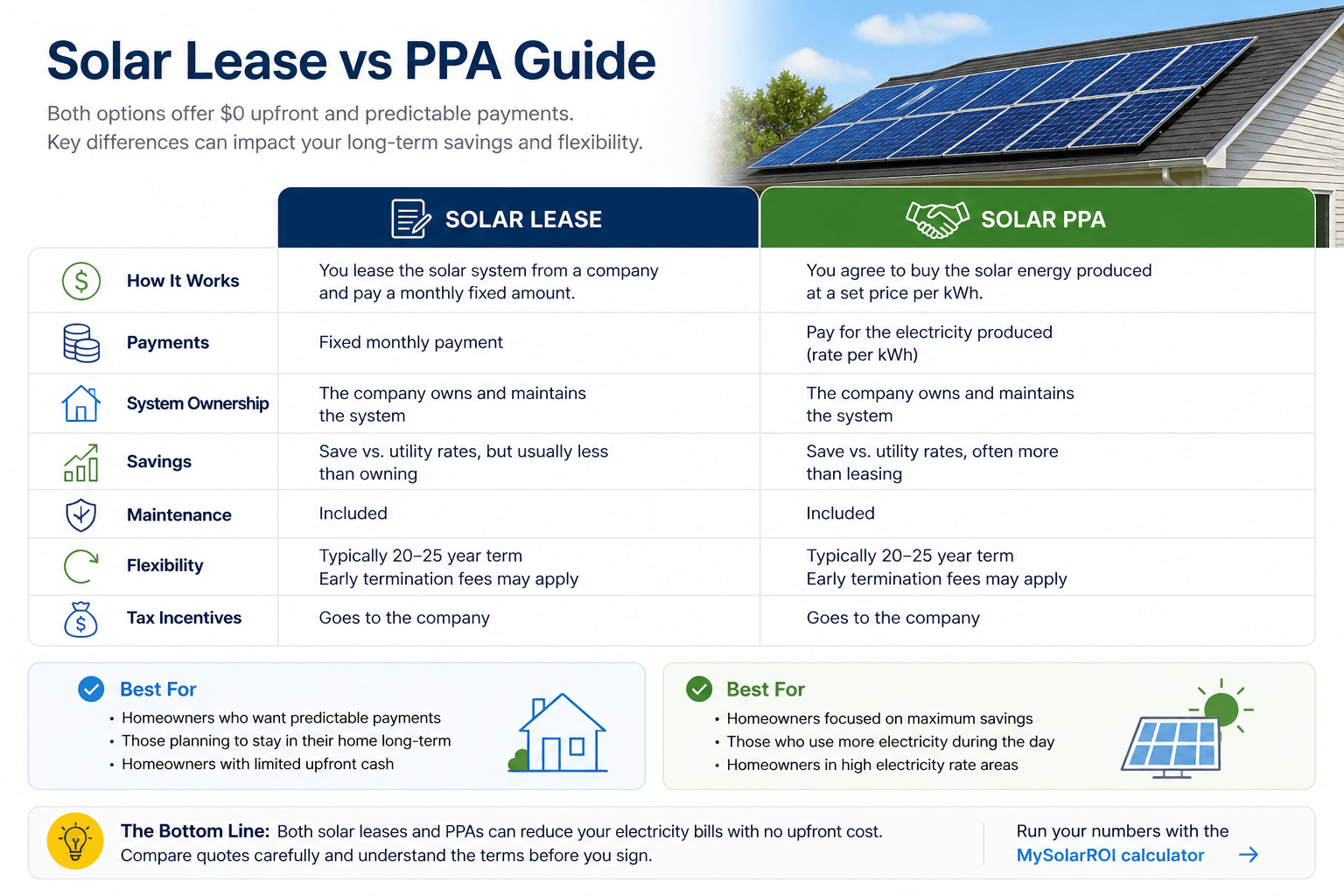
Myth 16: Leasing solar is always bad
Fact: A lease or power purchase agreement may work for some homeowners, especially if they want lower upfront cost. But third-party ownership can affect long-term savings, home sale complexity, contract flexibility, and who receives incentives.
Compare ownership, lease, and PPA options using solar financing options.
Myth 17: Solar panels destroy roof value
Fact: Properly installed solar should not destroy your roof. But roof age is important. If your roof needs replacement soon, installing solar first can create extra removal and reinstallation costs later.
The Department of Energy recommends considering the age of your roof and how long until replacement before installing solar.
Myth 18: Every roof is good for solar
Fact: Not every roof is ideal. Watch for:
- Heavy shading
- Old roofing material
- Limited usable roof area
- Complex roof planes
- Poor orientation
- Structural concerns
- Local code limitations
If rooftop solar is not a good fit, community solar may be an alternative in some markets.
Myth 19: Solar panels require constant maintenance
Fact: Solar systems generally have low maintenance needs, but they are not “install and forget forever.” Homeowners should monitor production, keep an eye on inverter alerts, and address unusual drops in output.
Rain may help clean panels in many areas, but dust, pollen, wildfire ash, or bird debris can reduce production in some locations.
Myth 20: Solar panels are unsafe
Fact: Solar systems must meet electrical, building, and fire codes. DOE states that solar panels meet international inspection and testing standards, and qualified installers must install systems according to local building, fire, and electrical codes.
Homeowners should still choose a licensed, experienced installer and confirm permitting and inspection steps.
Myth 21: Solar panels are impossible to recycle
Fact: Solar panel recycling is a real and developing field. The EPA says end-of-life solar panels present opportunities to recover valuable materials and create jobs through recycling, and recommends using responsible recyclers that follow recognized standards.
Recycling access varies by location, so ask installers and manufacturers about end-of-life options.
Myth 22: Solar panels will automatically increase home value
Fact: Owned solar can be attractive to buyers, but value depends on local market conditions, system age, documentation, utility savings, and whether the system is owned or leased.
A Berkeley Lab study found that buyers were willing to pay more for homes with host-owned PV systems, averaging about $4 per watt across its study sample, but that does not guarantee the same premium for every home or market.
Myth 23: Solar savings are guaranteed
Fact: No one can guarantee your exact lifetime savings. Solar savings depend on weather, system performance, utility rates, rate design, equipment reliability, export credits, and your energy use.
Be cautious with proposals that promise exact savings decades into the future without explaining assumptions.
Myth 24: Rising electricity rates make solar automatically profitable
Fact: Higher electric rates can improve solar economics, but they are only one factor. EIA reported that U.S. residential average revenue per kWh was 17.65 cents in February 2026, up 7.4% from February 2025, but local rates vary widely.
Solar may look stronger in high-rate areas, but quote price and utility policy still matter.
Myth 25: You should trust the first solar estimate you receive
Fact: A solar proposal is only as good as its assumptions. Before signing, compare multiple quotes and run your own numbers.
Ask every installer:
- What annual production are you assuming?
- What utility rate and escalation are you using?
- How are export credits calculated?
- Is battery storage included?
- What happens if production is lower than estimated?
- What warranties apply to panels, inverters, roof penetrations, and labor?
- What is the cash price vs. financed price?
Mini Case Study: How One Solar Myth Changes Payback
Scenario: A homeowner believes, “Solar will erase my bill and pay for itself in five years.”
Here is a more realistic estimate.
| Assumption | Example |
|---|---|
| System size | 8 kW |
| Installed cost | $24,000 |
| Expected annual production | 10,500 kWh |
| Electricity value | $0.1765/kWh |
| Estimated first-year value | $1,853 |
| Federal residential credit | $0 for post-2025 residential installation under current IRS guidance |
| Simple payback before other incentives | About 13 years |
Simple math:
10,500 kWh × $0.1765 = $1,853 in first-year electricity value
$24,000 ÷ $1,853 = about 13 years
This is not a universal result. A homeowner with a lower quote, higher electric rate, strong state incentive, or better net metering could see a shorter payback. A shaded roof, high financing cost, low export credit, or planned move could make payback longer.
Use the solar ROI calculator to replace these sample numbers with your actual utility rate, quote, incentives, and system size.
Common Solar Mistakes and How to Avoid Them
| Mistake | Why it hurts | Better approach |
|---|---|---|
| Comparing monthly payments only | Hides fees and total loan cost | Compare cash price, APR, fees, and total payments |
| Ignoring roof age | Can cause removal/reinstall costs later | Replace an aging roof before solar if needed |
| Assuming old tax credit rules | Overstates ROI | Verify current IRS and state incentive rules |
| Oversizing the system | May reduce ROI under weak export credits | Size solar around usage and utility policy |
| Skipping net metering research | Savings estimate may be wrong | Confirm your utility’s export-credit rules |
| Accepting one quote | May overpay | Get at least three comparable quotes |
| Ignoring battery economics | Can add cost without enough value | Model solar-only and solar-plus-storage separately |
Expert Tips Before You Sign a Solar Contract
- Ask for both cash and financed pricing.
- Confirm whether production estimates include shade analysis.
- Check whether the proposal includes main panel upgrades, trenching, roof work, or permitting.
- Read the workmanship warranty, not just the panel warranty.
- Confirm who handles interconnection paperwork.
- Ask what happens if your system underperforms.
- Keep copies of utility bills, proposals, warranties, permits, and interconnection approvals.
A practical solar decision is not about believing the best or worst solar myths. It is about checking your numbers.
Suggested Visuals for This Article
| Placement | Image description | File name | SEO alt text | Caption |
|---|---|---|---|---|
| After introduction | Home with rooftop solar panels in a typical neighborhood | solar-myths-debunked-home-rooftop.jpg | Solar myths debunked for homeowners considering rooftop panels | Solar can be a smart upgrade, but the numbers depend on your home and utility rules. |
| Near myth table | Simple myth vs. fact graphic | solar-myths-vs-facts-chart.png | Solar myths debunked myth versus fact chart | The best solar decisions start with clear assumptions, not sales claims. |
| Near case study | Bar chart showing cost, annual savings, and payback | solar-payback-example-chart.png | Solar payback example for homeowners | A payback estimate should be based on real quote, rate, and production assumptions. |
| Near roof section | Roof with shade and sun exposure zones | solar-roof-shade-example.jpg | Solar roof shade example for homeowners | Shade, roof age, and orientation can affect solar production. |
External Source Suggestions
Before publishing or updating this article, verify incentive and policy claims with:
- IRS Residential Clean Energy Credit guidance for current federal tax credit rules.
- U.S. Department of Energy homeowner solar guidance for roof suitability, safety, and basic solar explanations.
- U.S. Energy Information Administration electricity data for current rate context.
- DOE/NREL solar cost benchmarks for modeled cost assumptions.
- EPA solar panel recycling guidance for end-of-life information.
FAQ: Solar Myths Debunked
Do solar panels work when it is cloudy?
Yes, solar panels can still generate electricity on cloudy days, but production is lower than on sunny days. The more useful number is expected annual production for your specific roof.
Do solar panels work during a power outage?
Not always. Most grid-tied systems shut down during outages for safety unless they include battery storage and backup-capable equipment.
Is solar worth it without the federal tax credit?
Sometimes. Solar may still be worth it if your electric rates are high, your quote is competitive, your roof is suitable, and your state or utility incentives are strong. The payback calculation needs to be updated using current rules.
How long does solar payback take?
Solar payback varies by location, system cost, electricity rate, incentives, net metering, and financing. Many homeowners should model several scenarios rather than relying on one sales estimate.
Should I get a battery with solar panels?
A battery may be useful if you want backup power, have time-of-use rates, or receive low credit for exported solar. It may not be necessary if your utility offers favorable net metering.
Can solar panels damage my roof?
A quality installation should be designed to protect the roof, but roof age matters. If your roof is near replacement, address that before installing solar.
How many solar quotes should I get?
Try to get at least three quotes. Compare system size, cost per watt, annual production, equipment, warranties, financing terms, and installer reputation.
What is the biggest solar myth homeowners should avoid?
The biggest myth is that solar savings are automatic. Solar can be valuable, but ROI depends on your own roof, utility rate, incentives, financing, and system design.
Conclusion
The most important lesson from these solar myths debunked is simple: solar is not magic, but it is not hype either. It is a home energy investment that needs clear assumptions.
For some homeowners, solar can reduce bills, improve long-term energy cost control, and deliver a reasonable payback. For others, shade, roof age, financing, or utility rules may weaken the return.
Before you believe a claim from either side, run your numbers. Use the MySolarROI solar ROI calculator to estimate your solar savings, payback period, and ROI before comparing installer quotes.