If you are comparing solar quotes in New York, incentives can change the math quickly. But in 2026, homeowners need to be especially careful because some older solar articles still mention federal tax credit rules that no longer apply to new residential installations.
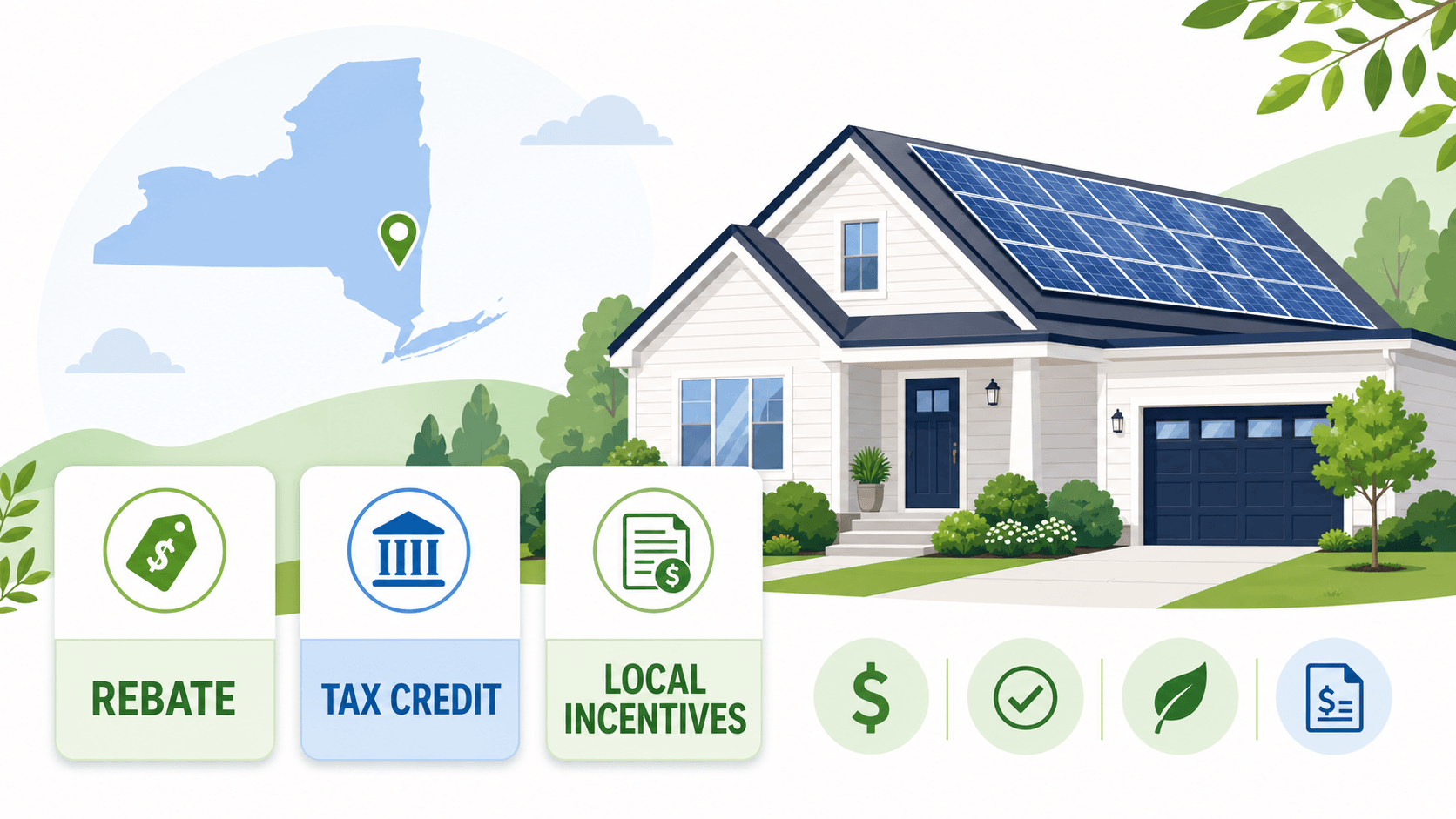
This guide explains the main New York solar incentives 2026 homeowners should understand, including the New York State solar tax credit, NY-Sun rebates, sales tax exemptions, property tax benefits, New York City’s solar abatement, battery incentives, and community solar options.
Your actual savings will depend on your location, utility, electricity rate, roof condition, system size, financing, tax liability, contractor pricing, net metering or export-credit rules, and whether you qualify for income-based programs.
First establish annual bill reduction in the self-consumption and export savings calculator. Then enter supported bill reduction, net cash cost, annual upkeep and your chosen horizon in the cash ROI calculator. It does not retrieve tariffs, model roof production or simulate battery operation. For borrowing, use the separate fixed-rate loan calculator; cash ROI does not model a loan.
New York Solar Incentives 2026: What Changed?
The biggest 2026 change is federal. The IRS says the Residential Clean Energy Credit applied to qualified clean energy property installed from 2022 through December 31, 2025, and is not available for property placed in service after December 31, 2025. IRS guidance also says a Section 25D credit cannot be claimed if installation is completed after December 31, 2025, even if a homeowner paid before that date.
That means many New York homeowners planning a new 2026 solar installation should focus more heavily on state, local, utility, and NYSERDA incentives.
Here is the practical takeaway:
| Incentive | 2026 homeowner status | What it may do |
|---|---|---|
| Federal Residential Clean Energy Credit | Generally unavailable for new 2026 residential installations | Previously reduced federal tax liability, but ended for new post-2025 installations |
| New York State Solar Energy System Equipment Credit | Still important | Can reduce New York State income tax liability |
| NY-Sun incentives | Available by region, block, and eligibility | May reduce contract price through participating contractors |
| Affordable Solar incentive | Available for eligible households | Larger NY-Sun incentive for qualifying income-eligible homeowners |
| Sales tax exemption | Statewide state-tax benefit, local rules vary | Can reduce sales tax on eligible solar equipment and installation |
| Property tax exemption | Available where not disallowed locally | Helps avoid higher property taxes from added solar value |
| NYC solar tax abatement | For eligible NYC properties | Can reduce NYC property taxes over four years |
| Battery storage incentives | Available through NYSERDA-approved contractors | Can reduce eligible residential storage costs |
The New York State Solar Tax Credit
New York offers the Solar Energy System Equipment Credit for qualifying residential solar energy systems installed and used at a principal residence in New York State. The credit is equal to 25% of qualified solar energy system equipment expenditures, limited to $5,000. The credit is nonrefundable, but unused credit can be carried forward for up to five years.
Who may qualify?
According to the New York State Department of Taxation and Finance, homeowners may be eligible if they:
- Purchase solar energy system equipment
- Enter into a written agreement to lease solar equipment
- Enter into a qualifying long-term power purchase agreement for power generated by solar equipment they do not own
- Install and use the system at their principal residence in New York State
The system must use solar radiation to produce energy for residential heating, cooling, hot water, or electricity.
Why this credit matters in 2026
Because the federal residential solar credit is no longer generally available for new 2026 installations, the New York State solar tax credit may be one of the most valuable remaining tax benefits for homeowners.
Example:
| Qualified solar cost | 25% calculation | NY credit limit | Estimated credit |
|---|---|---|---|
| $12,000 | $3,000 | $5,000 | $3,000 |
| $18,000 | $4,500 | $5,000 | $4,500 |
| $24,000 | $6,000 | $5,000 | $5,000 |
This is not tax advice. Your eligibility, qualified expenses, carryforward, and tax liability should be reviewed with a qualified tax professional.
NY-Sun Rebates and Incentives
NY-Sun is New York’s major solar incentive program, administered by NYSERDA. NYSERDA says NY-Sun incentives are divided by region and MW block, with real-time incentive levels shown on regional dashboards. Incentives remain available until blocks are fully subscribed, and they phase down over time as markets mature.
For homeowners, the most important detail is how the incentive is applied. NYSERDA explains that the NY-Sun incentive usually goes through the contractor and is taken “right off the top” of the bill, so the homeowner does not usually need to pay the full price and apply later. The incentive amount must be disclosed in the customer contract.
NY-Sun regions
NY-Sun incentives are organized around three broad regions:
- Con Edison
- Long Island
- Upstate New York
Standard residential incentive availability can change quickly because MW blocks close as applications are submitted. For example, NYSERDA’s Con Edison dashboard shows prior residential incentive blocks and indicates Con Edison residential incentive rates from January 1, 2014 to May 29, 2025, with Block 10 closing May 29, 2025.
Affordable Solar incentives
Income-eligible homeowners may qualify for additional incentives through Affordable Solar. NYSERDA states that households earning less than 80% of area median income may qualify, subject to an income eligibility application.
Current NYSERDA dashboard pages list these Affordable Solar residential incentive levels:
| Region | Affordable Solar incentive |
|---|---|
| Con Edison | $0.80/W of nameplate capacity |
| Upstate | $0.80/W of nameplate capacity |
| Long Island | $0.40/W of nameplate capacity |
NYSERDA lists the Con Edison Affordable Solar Residential Incentive at $0.80/W, the Upstate Affordable Solar Residential Incentive at $0.80/W, and the Long Island Affordable Solar Residential Incentive at $0.40/W.
For a 7 kW system, $0.80/W would equal:
7,000 watts × $0.80 = $5,600
That does not mean every homeowner receives it. You must qualify, use a participating contractor, and meet program requirements.
New York Solar Sales Tax Exemption
New York also provides a sales tax benefit for eligible residential solar equipment and installation.
The New York Department of Taxation and Finance says retail sales and installations of residential solar energy systems equipment are exempt from the 4% New York State sales and use tax and the 3/8% Metropolitan Commuter Transportation District tax. Local sales tax treatment depends on whether the local jurisdiction has enacted the exemption.
This matters because solar quotes often include equipment, labor, permitting, electrical work, and other eligible project costs. Ask each installer to show whether sales tax is included, excluded, or partially applied based on your local rules.
New York Property Tax Exemption for Solar
Solar panels may increase home value, but New York’s RPTL Section 487 can help prevent that added solar value from increasing property taxes for a period of 15 years, where the exemption applies.
The New York State Department of Taxation and Finance explains that eligible real property with solar energy systems is exempt from taxation for 15 years to the extent of the increase in assessed value due to the system. However, the exemption is subject to local option, and local taxing jurisdictions may disallow it or require payment-in-lieu-of-taxes agreements in certain cases.
For homeowners, this means:
- Do not assume your property tax treatment automatically.
- Check with your local assessor before installation.
- Ask your installer whether they help with Form RP-487.
- Keep documentation showing system cost, installation date, and equipment details.
NYC Solar Electric Generating Systems Tax Abatement
Homeowners in New York City may have another incentive: the Solar Electric Generating Systems Tax Abatement.
NYC Business says the program provides a property tax abatement for four years, equal to 5% of eligible system expenditures per year. The maximum benefit is $62,500 per year for four years, or the building’s annual tax liability, whichever is less.
For many NYC homeowners, this can be more valuable than statewide property tax protection because it directly reduces property taxes owed, subject to eligibility and approval.
NYC example
If an eligible NYC solar project has $30,000 in qualifying expenditures:
| Item | Calculation |
|---|---|
| Eligible project cost | $30,000 |
| Annual abatement rate | 5% |
| Annual abatement estimate | $1,500 |
| Four-year total before limits | $6,000 |
Actual results depend on eligibility, filing requirements, project approval, and property tax liability.
Net Metering, Value Stack, and Bill Credits
Incentives lower the upfront cost. Net metering and export-credit rules affect ongoing savings.
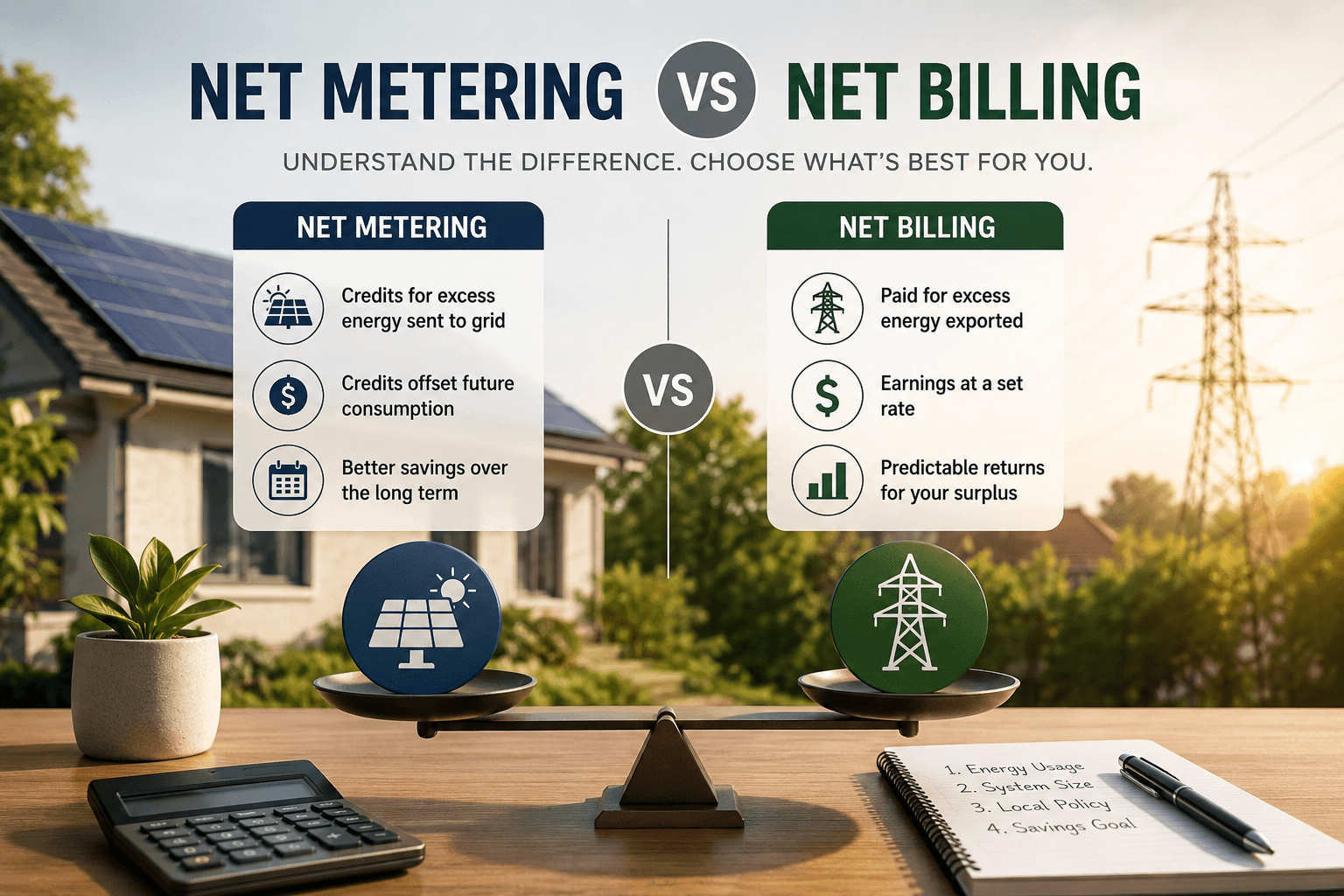
New York has used net metering and Value of Distributed Energy Resources, also called the Value Stack, to compensate customer-sited solar. NYSERDA explains that traditional net energy metering is a volumetric method where exported solar production is credited on a customer’s utility bill, while monetary metering converts generation into dollar credits.
For homeowners, the important question is not just “Can I get solar credits?” It is:
How will my utility value the electricity I send to the grid?
Ask each installer:
- Will my system use net metering, Value Stack, or another tariff?
- Are there monthly solar-related charges?
- What happens to excess credits at the end of the year?
- How does battery storage change the savings estimate?
- Are the projected bill savings based on my actual utility rate plan?
New York electricity prices can make solar attractive, but they also vary by utility and customer. EIA’s February 2026 Electric Power Monthly listed New York’s average residential electricity price at 29.99 cents per kWh for February 2026, compared with 26.22 cents in February 2025.
Use your actual electric bill, not a statewide average, when estimating solar payback.
Battery Storage Incentives in New York
If you are adding a battery, check NYSERDA’s Residential and Retail Energy Storage Incentives.
NYSERDA says the program supports grid-connected standalone energy storage or storage paired with renewable generation such as solar. Residential incentives are available for contractors installing storage on new or existing homes in New York State, with incentives available for up to 25 kWh of storage capacity.
A battery may help with backup power, time-of-use rate management, and self-consumption, but it does not automatically improve payback. Batteries add cost, so the ROI depends on:
- Battery price
- Available incentive
- Backup-power value to you
- Utility rate structure
- Whether you have time-of-use rates
- Outage frequency
- Solar export compensation
Run a solar-plus-storage scenario separately from solar-only in the solar payback estimate.
Community Solar Options for New Yorkers
If your roof is shaded, old, small, rented, or part of a condo/co-op with restrictions, community solar may be worth considering.
NYSERDA explains that community solar lets customers offset electricity use with renewable power from an offsite solar project without installing panels. Most projects use a subscription model that gives customers credits on their electric bills for their share of monthly generation.
New York also has Statewide Solar for All. NYSERDA says this program provides bill savings to low-income households by sharing discounts generated from community solar projects, and eligible utility customers are automatically enrolled if they are in their utility’s Energy Assistance Program.
Community solar usually does not give you the same ownership benefits as rooftop solar, but it may be simpler for renters, apartment residents, and homeowners with unsuitable roofs.
Mini Case Study: Estimating New York Solar Payback in 2026
This example is hypothetical. It is not a promise of savings.
Assumptions
- Location: Upstate New York
- System size: 7 kW
- Gross installed quote: $22,400
- Homeowner qualifies for Affordable Solar at $0.80/W
- Estimated first-year production: 7,000 kWh
- Electricity value used for rough math: 29.99 cents/kWh, based on EIA’s February 2026 New York residential average
- New York State solar tax credit calculated on post-rebate cost for illustration only
- No federal residential clean energy credit assumed for a new 2026 installation
Step 1: Estimate NY-Sun Affordable Solar incentive
7,000 W × $0.80 = $5,600
Step 2: Estimate reduced contract cost
$22,400 gross quote − $5,600 NY-Sun incentive = $16,800
Step 3: Estimate New York State solar tax credit
$16,800 × 25% = $4,200
This is below the $5,000 cap.
Step 4: Estimate net cost after incentive and state credit
$16,800 − $4,200 = $12,600
Step 5: Estimate annual bill value
7,000 kWh × $0.2999/kWh = $2,099/year
Step 6: Estimate simple payback
$12,600 ÷ $2,099 = about 6.0 years
What could change this result?
| Factor | How it changes payback |
|---|---|
| Lower electricity rate | Longer payback |
| Higher electricity rate | Shorter payback |
| Roof shading | Lower production and longer payback |
| No Affordable Solar eligibility | Higher net cost |
| Battery added | Higher upfront cost, possible backup value |
| Loan interest | Longer effective payback |
| Different utility credit rules | Changes bill savings |
| Tax liability too low | Credit may need carryforward |
Common Mistakes to Avoid
| Mistake | Why it matters | Better approach |
|---|---|---|
| Assuming the federal 30% credit still applies | New 2026 residential installations generally do not qualify | Verify current IRS guidance before signing |
| Ignoring tax liability | Nonrefundable credits only help if you owe enough tax | Ask a tax professional about carryforward |
| Comparing only gross solar quotes | Incentives can make a higher quote look better or worse | Compare net cost after verified incentives |
| Forgetting local sales tax rules | Local exemptions vary | Confirm the exact tax treatment in your jurisdiction |
| Assuming property taxes will not change | Local opt-outs and filing rules matter | Check with your assessor |
| Overestimating production | Shading, roof angle, snow, and equipment design affect output | Use site-specific production estimates |
| Not checking utility export rules | Bill credits drive ROI | Ask for the tariff and credit method in writing |
| Treating battery savings as guaranteed | Batteries often add cost | Compare solar-only vs. solar-plus-storage |
Expert Tips for Comparing New York Solar Quotes
When reviewing quotes, ask each installer for a one-page incentive breakdown.
It should show:
- Gross system cost
- NY-Sun incentive, if any
- Whether you qualify for Affordable Solar
- New York State solar tax credit estimate
- NYC abatement estimate, if applicable
- Sales tax treatment
- Battery incentive, if included
- Net cost after incentives
- Estimated annual production
- Estimated year-one bill savings
- Payback period
- Financing fees and interest
- Warranty coverage
- Roof work exclusions
A good solar quote should make the assumptions easy to inspect. If the quote hides incentive assumptions, annual production, or loan fees, ask for clarification before signing.
Sources and verification
For WordPress publishing, link naturally to these authority sources:
- NYSERDA NY-Sun dashboards when discussing regional solar rebate availability.
- New York Department of Taxation and Finance when explaining the state solar tax credit.
- IRS Residential Clean Energy Credit guidance when explaining the federal credit change.
- NYC Business when explaining the NYC solar tax abatement.
- EIA Electric Power Monthly when referencing current New York electricity prices.
- NREL PVWatts when explaining solar production estimates; PVWatts estimates energy production for grid-connected PV systems and uses long-term weather data to show expected output ranges.
FAQ: New York Solar Incentives 2026
Does New York still have a solar tax credit in 2026?
Yes. New York’s Solar Energy System Equipment Credit is equal to 25% of qualified expenditures, up to $5,000. It is nonrefundable, but unused credit can be carried forward for up to five years.
Is the federal solar tax credit available in New York in 2026?
For new residential systems completed after December 31, 2025, the federal Residential Clean Energy Credit is generally not available. The IRS says the credit is not available for property placed in service after December 31, 2025.
What is the NY-Sun rebate?
NY-Sun is New York’s solar incentive program. Incentives vary by region, sector, project size, and available MW block. In most cases, the incentive is handled through the contractor and reduces the project price upfront.
Who qualifies for Affordable Solar in New York?
NYSERDA says households earning less than 80% of area median income may qualify for additional Affordable Solar incentives, subject to an income eligibility application.
Does New York exempt solar from sales tax?
Eligible residential solar equipment and installation are exempt from the 4% New York State sales and use tax and the 3/8% MCTD tax. Local sales tax exemption depends on the local jurisdiction.
Does solar increase property taxes in New York?
New York’s RPTL Section 487 can exempt the increase in assessed value from eligible solar systems for 15 years, where available. Local rules matter, so homeowners should check with their assessor.
Does New York City have an extra solar incentive?
Yes. Eligible NYC properties may qualify for the Solar Electric Generating Systems Tax Abatement, which can provide a four-year property tax abatement equal to 5% of eligible system expenditures per year, subject to limits.
Are batteries eligible for incentives in New York?
NYSERDA offers residential energy storage incentives for eligible grid-connected storage projects installed by approved contractors, including storage paired with solar. Residential incentives are available for up to 25 kWh of storage capacity.
Conclusion
The most important thing to know about New York solar incentives 2026 is that the incentive stack has changed. The federal residential solar credit is generally no longer available for new post-2025 residential installations, but New York homeowners may still benefit from the state solar tax credit, NY-Sun incentives, Affordable Solar, sales tax exemptions, property tax protection, NYC abatements, battery incentives, and community solar options.
The right question is not “Does New York have solar incentives?” It is “Which incentives apply to my home, my utility, my tax situation, and my quote?”
Run your numbers with MySolarROI before signing a contract. A clear estimate can help you compare solar quotes, understand payback period, and decide whether solar makes financial sense for your New York home.