If you are thinking about solar, one of the first questions is simple: how do solar panels work, and how does that turn into lower electric bills?
The short answer: solar panels capture sunlight and convert it into electricity your home can use. But the full system includes more than panels. It usually includes an inverter, electrical wiring, mounting equipment, a utility meter, monitoring software, and sometimes a battery.
Understanding the basics helps you compare installer quotes, ask better questions, and avoid confusing sales claims. Your actual savings depend on your location, electricity rates, roof conditions, system size, incentives, utility rules, financing, and system design.
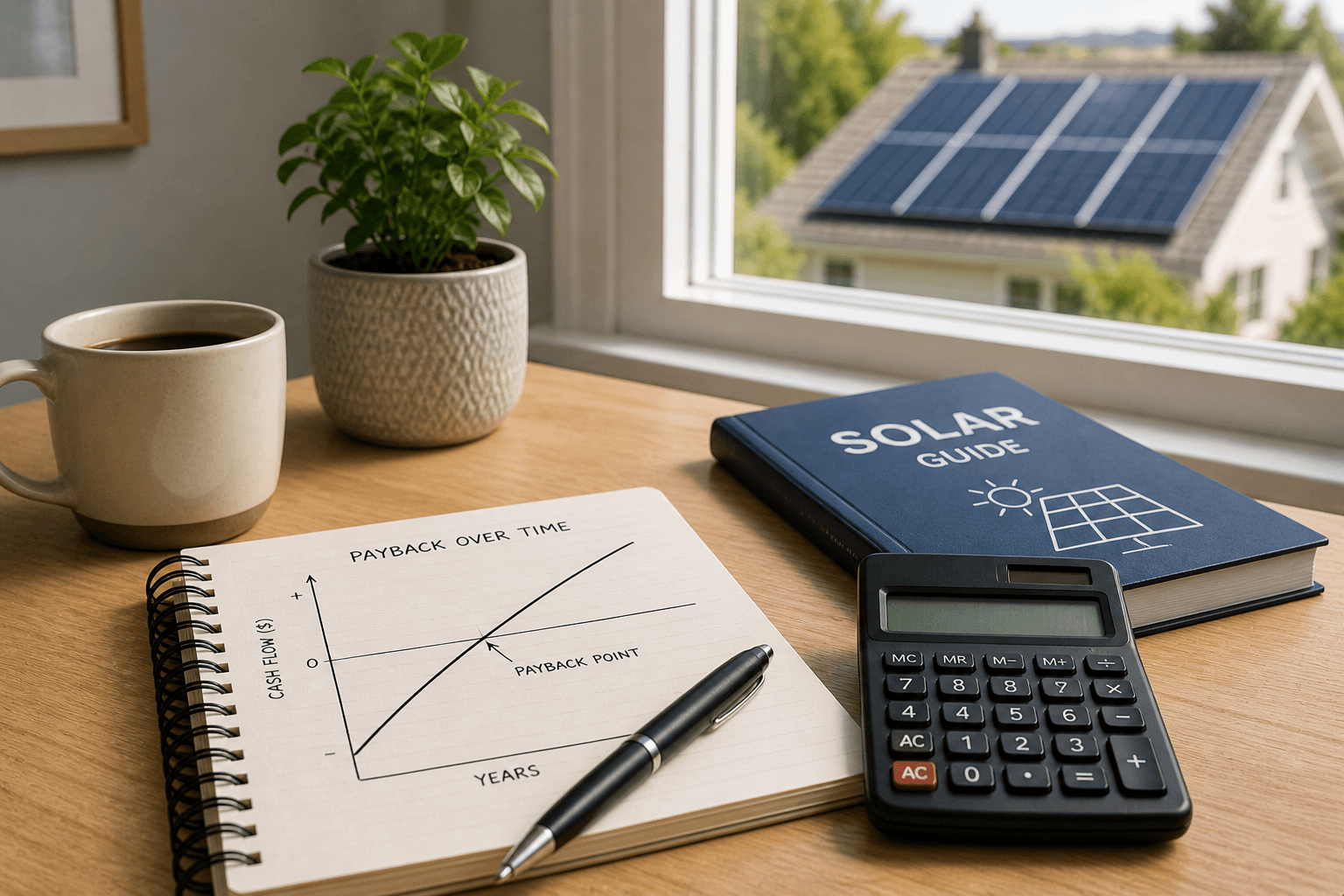
Before you request quotes, it is worth running your numbers with the solar ROI calculator so you can estimate payback period, bill savings, and long-term return.
How Solar Panels Work in Simple Terms
Solar panels use photovoltaic cells, often called PV cells, to convert sunlight into electricity. When sunlight hits a solar panel, energy from the light is absorbed by PV cells. That energy creates electrical charges that move through the cell, which creates an electric current. The U.S. Department of Energy describes this as the basic process behind photovoltaic solar technology.
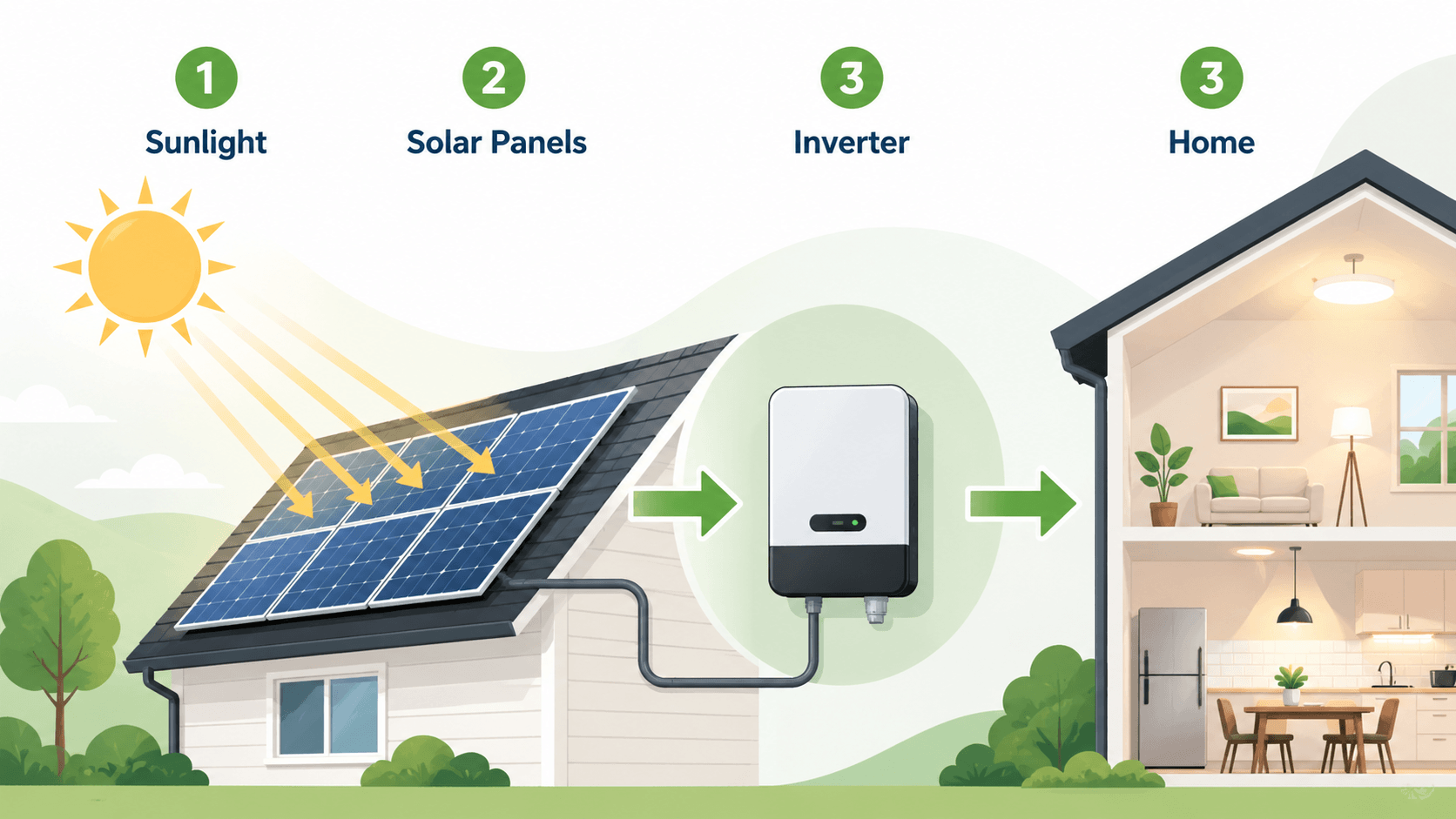
For a homeowner, the process looks like this:
- Sunlight hits the solar panels.
- PV cells create direct current electricity.
- The inverter converts that electricity into usable home electricity.
- Your home uses the solar power first.
- Extra electricity may go to the grid, a battery, or both.
- When solar production is low, your home uses grid power, battery power, or both.
Solar panels do not need hot weather to work. They need sunlight. A cool, sunny day can still be productive. Shade, roof direction, roof angle, clouds, dirt, snow, and system design can all affect output.
The Main Parts of a Home Solar System
A residential solar system is more than panels on a roof. Each part has a job.
| Component | What It Does | Why It Matters |
|---|---|---|
| Solar panels | Convert sunlight into DC electricity | Main source of solar production |
| Inverter | Converts DC electricity into AC electricity | Makes solar power usable in your home |
| Racking and mounting | Secures panels to the roof or ground | Affects safety, roof protection, and layout |
| Electrical wiring | Connects panels, inverter, panel box, and meter | Must meet code and utility requirements |
| Utility meter | Tracks electricity used and exported | Important for billing and net metering |
| Monitoring system | Shows production and system performance | Helps detect issues early |
| Battery, optional | Stores excess solar energy | Useful for backup power or time-of-use rates |
The inverter is especially important. Solar panels produce direct current electricity, while homes and the electric grid generally use alternating current electricity. Inverters convert DC into AC so the power can be used by household appliances and the grid.
Step-by-Step: What Happens When the Sun Hits Your Roof
1. Solar panels absorb sunlight
Each panel contains many solar cells. Those cells are connected together inside a weather-resistant panel, also called a module. Multiple panels connected together form a solar array. The U.S. Energy Information Administration explains that PV cells are the basic building blocks of a PV system, while panels and arrays increase total electricity-generating capacity.
2. The panels produce DC electricity
The electricity produced by panels starts as DC electricity. This is not the form of electricity most homes use directly.
3. The inverter converts DC to AC
The inverter changes solar electricity into AC electricity, which is the form used by most household appliances, outlets, and the electric grid. Some systems use one central string inverter. Others use microinverters attached to individual panels or power optimizers paired with a string inverter.
4. Your home uses the solar electricity
When your panels are producing power, your home usually uses that electricity first. For example, solar may help power your refrigerator, lighting, air conditioner, washer, dryer, electronics, and other loads during the day.
5. Extra electricity goes somewhere
If your system produces more electricity than your home is using at that moment, the extra electricity may be:
- Sent to the grid under your utility’s export or net metering rules
- Stored in a battery, if your system has one
- Limited by the inverter or utility settings in some cases
Net metering rules vary by state and utility. The Department of Energy defines net metering as an arrangement where solar system owners are compensated for solar generation exported to the grid, but notes that modern rules are often more complex than the older idea of a meter simply “running backward.”
6. Your home pulls power when solar is not enough
Solar panels produce less electricity at night, during heavy cloud cover, or when the system is shaded. When your panels are not producing enough power, your home uses electricity from the grid, a battery, or both.
Do Solar Panels Power Your House During an Outage?
Not always.
Many grid-tied solar systems automatically shut down during a power outage for safety. This helps protect utility workers who may be repairing power lines. If you want backup power during outages, you usually need a properly designed battery system or a special inverter setup that can safely isolate your home from the grid.
A solar battery can help, but it does not automatically back up every circuit in the house. Many homeowners choose to back up essentials, such as:
- Refrigerator
- Wi-Fi router
- Some lights
- Medical devices
- Garage door opener
- Sump pump
- Selected outlets
A battery can improve resilience, but it also increases system cost. That is why it should be evaluated as part of your solar payback estimate, not as an automatic add-on.
What Affects How Much Electricity Solar Panels Produce?
Solar panels do not produce the same amount of electricity on every roof. Production depends on several practical factors.
| Factor | Better for Solar | Can Reduce Production |
|---|---|---|
| Sun exposure | Open, sunny roof | Shade from trees, chimneys, nearby buildings |
| Roof direction | South-facing in much of the U.S. | North-facing roof sections |
| Roof angle | Tilt matched well to location | Very steep or very flat roof without design adjustments |
| Roof condition | Roof with many years of life left | Old roof that may need replacement soon |
| Local weather | Clear, sunny climate | Frequent heavy cloud cover |
| System size | Sized to match usage and roof space | Too small for goals or too large for utility rules |
| Equipment | Quality panels and inverter | Poor equipment match or weak design |
| Utility policy | Favorable net metering/export rates | Low export credits or restrictive interconnection rules |
The EIA notes that PV panels generally produce the most electricity when facing the sun directly, and fixed residential systems are usually positioned to optimize physical and economic performance.
Solar Panels, Net Metering, and Your Electric Bill
A solar system can reduce your electric bill in a few ways:
- It offsets electricity you would have bought from the utility.
- It may earn credit for exported electricity, depending on your utility rules.
- It can reduce exposure to future electricity rate increases.
- With a battery, it may help shift solar energy to evening hours in some rate plans.
However, solar does not always erase your entire bill. Many homeowners still pay fixed charges, minimum bills, grid fees, or non-bypassable charges. Exported solar may also be credited at a lower rate than retail electricity in some areas.
That is why “100% offset” does not always mean “$0 bill.” It usually means the system is expected to produce roughly as much electricity as the home uses over a year. Billing depends on your utility’s rules.
Before comparing quotes, review your net metering rules and model your savings using your actual bill.
Mini Case Study: How Solar Works Financially
Here is a simple example for a fictional homeowner.
Assumptions
- Home uses 10,000 kWh of electricity per year
- Solar system is expected to produce 8,500 kWh per year
- Retail electricity rate is $0.18 per kWh
- The homeowner uses most solar production directly
- Export credits are available, but not assumed to be equal to retail value
- Installed cost, financing, tax details, maintenance, and local incentives are not included in this basic production example
Simple annual value estimate
If 8,500 kWh of solar production offsets electricity valued at $0.18 per kWh:
8,500 kWh × $0.18 = $1,530 in estimated annual bill value
That does not mean the homeowner is guaranteed to save $1,530 every year. The result can change if:
- Electricity rates change
- The utility changes export credit rules
- The system produces more or less than expected
- The home uses more electricity after adding an EV or heat pump
- Shade increases over time
- Financing costs reduce net savings
- A battery changes when solar energy is used
This is exactly why homeowners should run a full ROI estimate, not rely on one sales quote. Use MySolarROI to compare system cost, bill savings, incentives, electricity rates, financing, and payback period before signing a contract.
Do Solar Panels Need Batteries?
No. Many homeowners install solar panels without batteries.
A battery may make sense if you want:
- Backup power during outages
- More control over when solar energy is used
- Protection from high evening electricity rates
- Less reliance on low export credits
- A way to store excess daytime production
A battery may not make sense if:
- Your utility has strong net metering
- Outages are rare
- Battery costs make the payback period too long
- You only care about lowest upfront cost
- Your quote does not clearly show battery value
For many homeowners, the right approach is to compare two scenarios: solar-only and solar-plus-battery. That makes the tradeoff clearer.
How Incentives Affect Solar ROI
Solar incentives can change the payback period, but they vary by location and eligibility. Incentives may include state rebates, utility programs, property tax exemptions, sales tax exemptions, renewable energy credits, or special local programs.
The federal Residential Clean Energy Credit changed significantly. The IRS states that the credit equaled 30% of qualifying clean energy property costs for systems installed from 2022 through December 31, 2025, and that the credit is not available for property placed in service after December 31, 2025. The IRS also clarifies that paying before the deadline does not qualify a homeowner if installation is completed after December 31, 2025.
This is not tax advice. Homeowners should confirm current rules with the IRS, a qualified tax professional, DSIRE, state energy offices, and their utility before assuming any incentive applies.
For planning, check your state solar incentives and include only incentives you are likely eligible to claim.
Common Mistakes Homeowners Make
| Mistake | Why It Matters | Better Approach |
|---|---|---|
| Focusing only on monthly payment | Low payments can hide long loan terms or dealer fees | Compare total cost, interest, and payback |
| Assuming solar eliminates the full bill | Fixed charges and export rules may remain | Review utility bills and tariff rules |
| Ignoring roof condition | Removing panels later for roof work can add cost | Check roof age before installing |
| Comparing quotes by panel count only | Panel wattage and system design vary | Compare system size, production, cost per watt, and warranties |
| Forgetting shade | Shade can reduce output | Ask for a shade and production analysis |
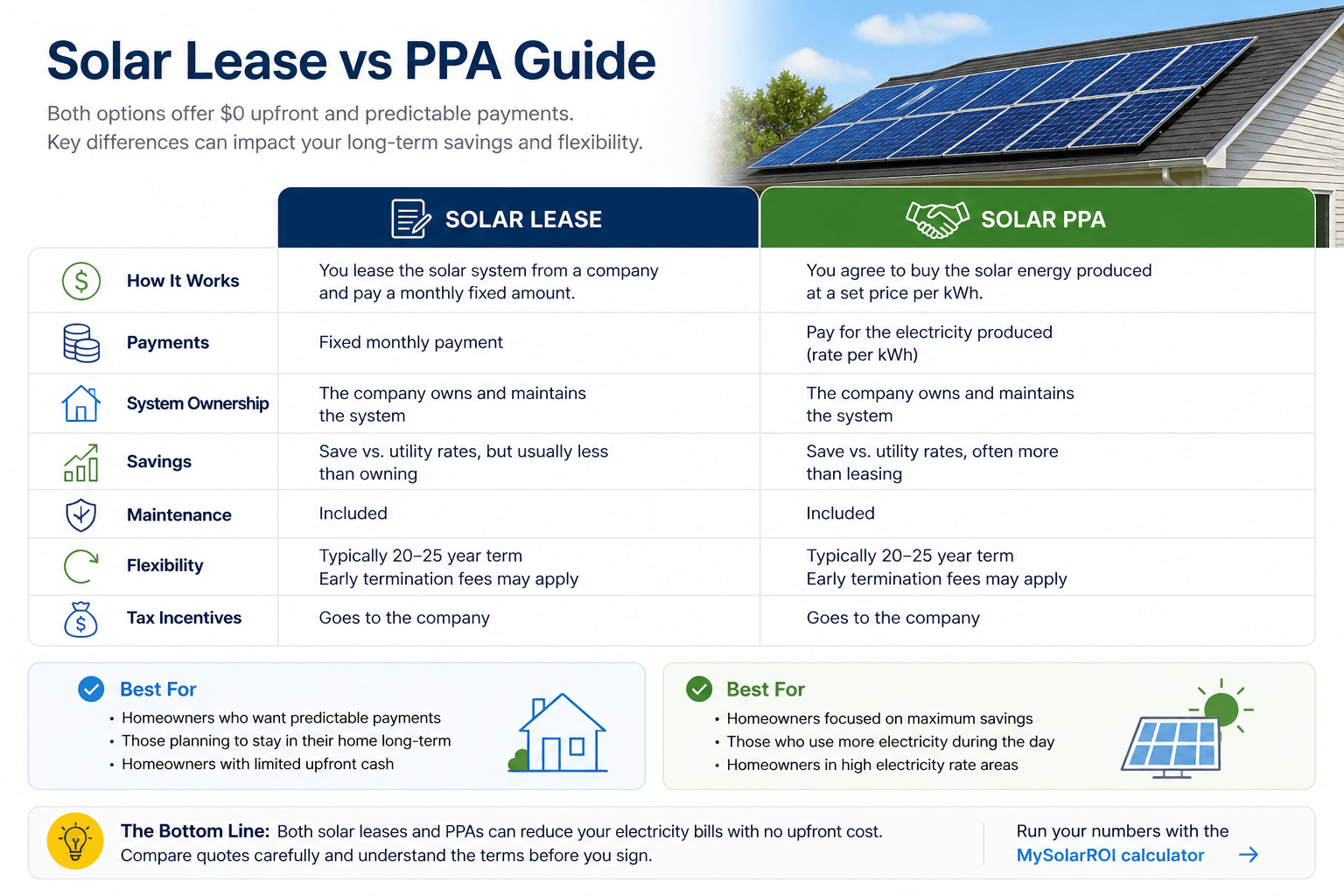
| Not reading financing terms | Interest, escalators, and fees affect ROI | Compare cash, loan, lease, and PPA options |
| Assuming incentives are automatic | Eligibility rules vary | Verify before signing |
Expert Tips Before You Request Solar Quotes
- Gather 12 months of electric bills.
- Know your average annual kWh usage.
- Ask whether the quote includes a production guarantee.
- Compare cash price separately from financed price.
- Ask how the installer modeled shade.
- Confirm whether roof work is needed first.
- Review equipment warranties and workmanship warranties.
- Ask how net metering or export credits are handled.
- Model your ROI before discussing monthly payments.
- Get at least two or three quotes.
The Department of Energy recommends working with qualified solar professionals and notes that NABCEP certification is an industry-standard certification for solar professionals.
When Solar Panels Usually Make the Most Sense
Solar is often more attractive when:
- Your electric bills are high
- Your roof gets strong sunlight
- Your roof is in good condition
- Your utility rates are high or rising
- Your state or utility offers useful incentives
- Your net metering or export rules are favorable
- You plan to stay in the home long enough to benefit
- You can avoid expensive financing terms
Solar may be less attractive when:
- Your roof is heavily shaded
- You plan to move very soon
- Your utility rates are low
- Your roof needs replacement
- The quote has high financing fees
- Export credits are weak and you use little daytime electricity
The practical question is not “Do solar panels work?” They do. The better question is: Do solar panels work well for your home, your utility rules, and your budget?
Run your numbers with the solar ROI calculator before comparing installer proposals.
External Source Suggestions
For fact-checking and homeowner research, use these reputable sources:
- U.S. Department of Energy: solar technology basics and homeowner solar guidance.
- U.S. Energy Information Administration: photovoltaic cells, panels, arrays, and system efficiency.
- IRS: current federal clean energy credit rules and eligibility language.
- DSIRE: state and utility solar incentive research.
- Your utility website: net metering, interconnection, export credits, and rate plans.
- Your state energy office or public utility commission: local consumer protections and solar policies.
Image Suggestions
| Placement | Description | File Name | SEO Alt Text | Caption |
|---|---|---|---|---|
| After introduction | Simple diagram showing sunlight, panels, inverter, home, grid, and battery | how-solar-panels-work-home-diagram.webp | How solar panels work for a home with inverter, grid, and battery | Solar panels create electricity, but the full system includes an inverter, meter, and sometimes a battery. |
| Near inverter section | Close-up illustration of DC to AC conversion | solar-inverter-dc-to-ac.webp | Solar inverter converting DC electricity from panels into AC electricity for the home | The inverter makes solar electricity usable for most home appliances. |
| Near case study | Homeowner reviewing solar savings estimate on laptop | homeowner-solar-roi-estimate.webp | Homeowner estimating solar ROI and payback period before comparing quotes | Solar savings depend on system size, rates, utility rules, incentives, and financing. |
FAQ
How do solar panels work at night?
Solar panels do not produce electricity at night because they need sunlight. At night, your home typically uses grid electricity, battery electricity, or both.
Do solar panels work on cloudy days?
Yes, solar panels can still produce electricity on cloudy days, but usually less than they produce in full sun. Actual output depends on cloud cover, system design, and local conditions.
What does a solar inverter do?
A solar inverter converts DC electricity from solar panels into AC electricity used by most homes and the electric grid. It may also monitor system performance and communicate with monitoring software.
Can solar panels power my whole house?
They can offset a large share of your annual electricity use if the system is sized properly. Whether they cover all usage depends on roof space, sunlight, electricity consumption, utility rules, and budget.
Do I need a battery with solar panels?
Not always. A battery can help with backup power and storing extra solar energy, but it adds cost. Many homeowners install solar without batteries, especially where net metering rules are favorable.
What happens to extra solar electricity?
Extra electricity may be exported to the grid, stored in a battery, or limited depending on your system and utility rules. Compensation for exported power depends on your utility’s net metering or export policy.
How long does it take solar panels to pay for themselves?
Solar payback depends on installed cost, electricity rates, incentives, production, financing, and utility rules. A calculator can estimate your payback period using your actual numbers.
Are solar panels worth it for homeowners?
Solar can be worth it when the system is well-priced, the roof is suitable, electricity rates are high enough, and utility rules support savings. The best answer comes from comparing costs, production, and payback for your specific home.
Conclusion
Understanding how solar panels work makes it easier to evaluate solar quotes with confidence. Panels convert sunlight into electricity, the inverter makes that electricity usable, and your utility rules determine how extra production affects your bill.
The technology is only one part of the decision. Your real outcome depends on system size, roof conditions, local rates, incentives, financing, battery choices, and net metering rules.
Before you sign a solar contract, use the MySolarROI solar calculator to estimate your savings, payback period, and long-term ROI based on your own home.