If you are considering solar panels without the federal tax credit, the decision comes down to one question:
Do the savings, incentives, utility rules, and long-term benefits still justify the cost?
For many years, the federal Residential Clean Energy Credit made solar economics easier to understand because qualifying homeowners could reduce their net cost with a federal tax credit.
But for new residential solar projects in 2026 and later, homeowners should be careful. Current IRS guidance says the Residential Clean Energy Credit was 30% for qualified clean energy property installed from 2022 through December 31, 2025, and that the credit is not available for property placed in service after December 31, 2025.
That does not mean solar is automatically a bad decision. It means the math needs to be more honest.
Without the federal tax credit, your solar payback period may be longer and your ROI may be lower. But solar may still be worth it if your electricity rates are high, system cost is reasonable, your roof is a good fit, state or utility incentives apply, and your utility gives fair credit for solar energy.
This guide explains how to evaluate solar panels without the federal tax credit, what numbers matter most, and when solar may still make financial sense.
This article is educational only. It is not tax, legal, or financial advice. Always verify current rules with official IRS guidance or a qualified tax professional before relying on any tax assumption.
Before comparing installer quotes, use the MySolarROI solar ROI calculator to estimate payback period and ROI with and without verified incentives.
Solar Panels Without Federal Tax Credit: Quick Answer
Solar panels can still be worth it without the federal tax credit, but the system has to stand on stronger fundamentals.
That means you should pay closer attention to:
- gross system cost
- cash price vs financed price
- electricity rate
- annual solar production
- state, local, and utility incentives
- net metering or export credit rules
- financing costs
- roof suitability
- how long you plan to stay in the home
| Solar May Still Be Worth It Without the Federal Credit When | Solar May Be Less Attractive When |
|---|---|
| Electricity rates are high | Electricity bills are already low |
| System cost is fair | The quote is overpriced |
| Roof gets strong sun exposure | The roof is shaded or needs major work |
| State or utility incentives apply | No meaningful incentives are available |
| Net metering or export credits are favorable | Excess solar is credited at a low rate |
| Financing terms are reasonable | Loan fees and interest reduce most savings |
| You plan to stay long enough | You may move before payback |
The key is not whether solar has a federal credit. The key is whether the full project still produces a reasonable return using current assumptions.
What Changed With the Federal Solar Tax Credit?
The federal residential solar tax credit is part of the Residential Clean Energy Credit.
For qualifying residential clean energy property installed from 2022 through December 31, 2025, the IRS says the credit equaled 30% of eligible costs. The IRS also says the credit is not available for property placed in service after December 31, 2025.
| Project Timing | Planning Assumption | What Homeowners Should Do |
|---|---|---|
| System placed in service before January 1, 2026 | May be eligible if all IRS rules are met | Review IRS Form 5695 and speak with a tax professional |
| Contract signed in 2025 but installed in 2026 | Do not assume eligibility | Confirm placed-in-service timing and IRS rules |
| New residential installation placed in service after December 31, 2025 | Do not automatically include the federal residential credit | Model ROI without the federal credit |
| Lease or PPA | Homeowner usually does not own the system | Ask who owns the system and who receives incentives |
For more detail, read the federal solar tax credit 2026 guide.
How Much Difference Does the Federal Tax Credit Make?
The federal tax credit can make a large difference in the net cost of a solar system. Without it, the upfront cost used in a payback calculation may be much higher.
Here is a simplified example:
| Scenario | Gross System Cost | Federal Credit Assumed | Net Cost Before Other Incentives |
|---|---|---|---|
| Old 30% credit assumption | $24,000 | $7,200 | $16,800 |
| No federal residential credit | $24,000 | $0 | $24,000 |
This difference affects payback period.
| Scenario | Net Cost | Estimated Annual Savings | Simple Payback |
|---|---|---|---|
| With old 30% credit assumption | $16,800 | $1,800 | 9.3 years |
| Without federal residential credit | $24,000 | $1,800 | 13.3 years |
Simple payback calculations:
$16,800 ÷ $1,800 = 9.3 years
$24,000 ÷ $1,800 = 13.3 years
This example is simplified. It does not include state incentives, utility rebates, financing, maintenance, panel degradation, roof work, batteries, or utility rate changes. But it shows why outdated tax credit assumptions can make solar look more attractive than it really is.
How to Calculate Solar Payback Without the Federal Tax Credit
To calculate solar payback without the federal tax credit, remove the federal credit from the net cost calculation and use only verified incentives.
The basic formula is:
Solar payback period = net solar system cost ÷ annual electricity bill savings
Use this process:
- Start with the gross installed system cost.
- Remove any automatic federal residential credit assumption.
- Subtract only verified state, local, or utility incentives.
- Estimate annual solar production.
- Apply your actual electricity rate and export credit rules.
- Estimate annual bill savings.
- Include financing costs if using a loan.
- Divide net cost by annual savings.
For a detailed explanation, read the solar payback period guide.
When Solar Can Still Be Worth It Without the Federal Credit
Solar may still make sense without the federal tax credit when the system has strong savings potential on its own.
High electricity rates
High electricity rates can improve solar value because each kWh of solar electricity offsets more expensive grid power.
Example:
| Annual Solar Offset | Electricity Value | Estimated Annual Value |
|---|---|---|
| 9,000 kWh | $0.12/kWh | $1,080 |
| 9,000 kWh | $0.18/kWh | $1,620 |
| 9,000 kWh | $0.28/kWh | $2,520 |
The same system can produce much stronger savings in a high-rate utility territory.
Reasonable system cost
Without the federal credit, the gross system price matters even more.
Compare:
- gross installed cost
- cost per watt
- cash price
- financed price
- equipment included
- warranty terms
- roof or electrical upgrade costs
For pricing context, read the solar panel cost 2026 guide.
Strong state or utility incentives
Even without the federal residential credit, some state, local, or utility incentives may still exist.
Possible incentives include:
- state rebates
- utility rebates
- local incentives
- state tax credits
- property tax exemptions
- sales tax exemptions
- battery incentives
- renewable energy credit programs
DSIRE describes itself as a comprehensive source of information on incentives and policies that support renewables and energy efficiency in the United States. Use it as a starting point, then verify with your state energy office and utility. :contentReference[oaicite:1]{index=1}
For incentive planning, read the solar tax credit calculator guide.
Favorable net metering or export credits
If your utility gives fair credit for exported solar electricity, annual bill savings may be stronger.
If export credits are low, your system may need to be sized more carefully around direct household usage.
Read the net metering explained guide before assuming every kWh of solar production has the same value.
Good roof conditions
A good roof can improve solar economics.
Important roof factors include:
- sun exposure
- shade
- roof age
- roof orientation
- roof pitch
- usable roof area
- local weather patterns
If roof work is needed before installation, include that cost in your payback and ROI calculation.
When Solar May Be Less Attractive Without the Federal Credit
Without the federal tax credit, weak assumptions become more important.
| Warning Sign | Why It Matters | What to Do |
|---|---|---|
| High system price | More cost must be recovered through savings | Get multiple quotes |
| Low electricity rate | Each kWh of solar saves less money | Use your actual utility bill |
| Low export credit | Extra solar production may have limited value | Check utility tariff and avoid oversizing |
| High financing fees | Loan costs can reduce ROI | Compare cash and financed price |
| Shaded roof | Production may be lower than expected | Ask for a shade analysis |
| Roof replacement needed | Project cost may increase | Include roof-related costs |
| Moving soon | You may not benefit long enough | Compare payback period with ownership timeline |
Solar does not need a federal credit to be worthwhile, but without that credit, poor quote quality and weak utility rules are harder to ignore.
Mini Case Study: Solar Without Federal Tax Credit
Here is a simplified homeowner example. These numbers are for illustration only and are not guaranteed.
Actual results depend on location, utility rates, roof conditions, system design, state incentives, financing, net metering rules, installer pricing, and actual solar production.
| Assumption | Example Value |
|---|---|
| Gross system cost | $24,000 |
| Federal residential credit | $0 assumed for new 2026 installation |
| Verified utility rebate | $1,000 |
| Net cost before financing | $23,000 |
| Estimated annual production | 9,800 kWh |
| Effective electricity value | $0.20/kWh |
| Estimated annual value | $1,960 |
| Simple payback | 11.7 years |
Simple payback calculation:
$23,000 ÷ $1,960 = 11.7 years
This system might still make sense if the homeowner plans to stay in the home long enough, the quote is fairly priced, and utility rules are favorable.
But if the effective electricity value were only $0.12/kWh, the result would change:
| Scenario | Net Cost | Annual Value | Simple Payback |
|---|---|---|---|
| Higher electricity value | $23,000 | $1,960 | 11.7 years |
| Lower electricity value | $23,000 | $1,176 | 19.6 years |
This shows why electricity rates and utility credits matter so much when there is no federal tax credit reducing the net cost.
Use the MySolarROI calculator to test both conservative and base-case scenarios before comparing installer quotes.
How Financing Changes Solar Without the Federal Credit
Financing can make or break the numbers when the federal credit is not available.
If you use a solar loan, ask for:
- cash price
- financed price
- APR
- loan term
- dealer fee
- monthly payment
- total repayment amount
- whether the payment assumes an incentive paydown
A quote may still show a low monthly payment without the federal credit, but that does not mean it has strong ROI.
A longer loan can lower monthly payments while increasing total repayment. Dealer fees can make the financed system cost higher than the cash price.
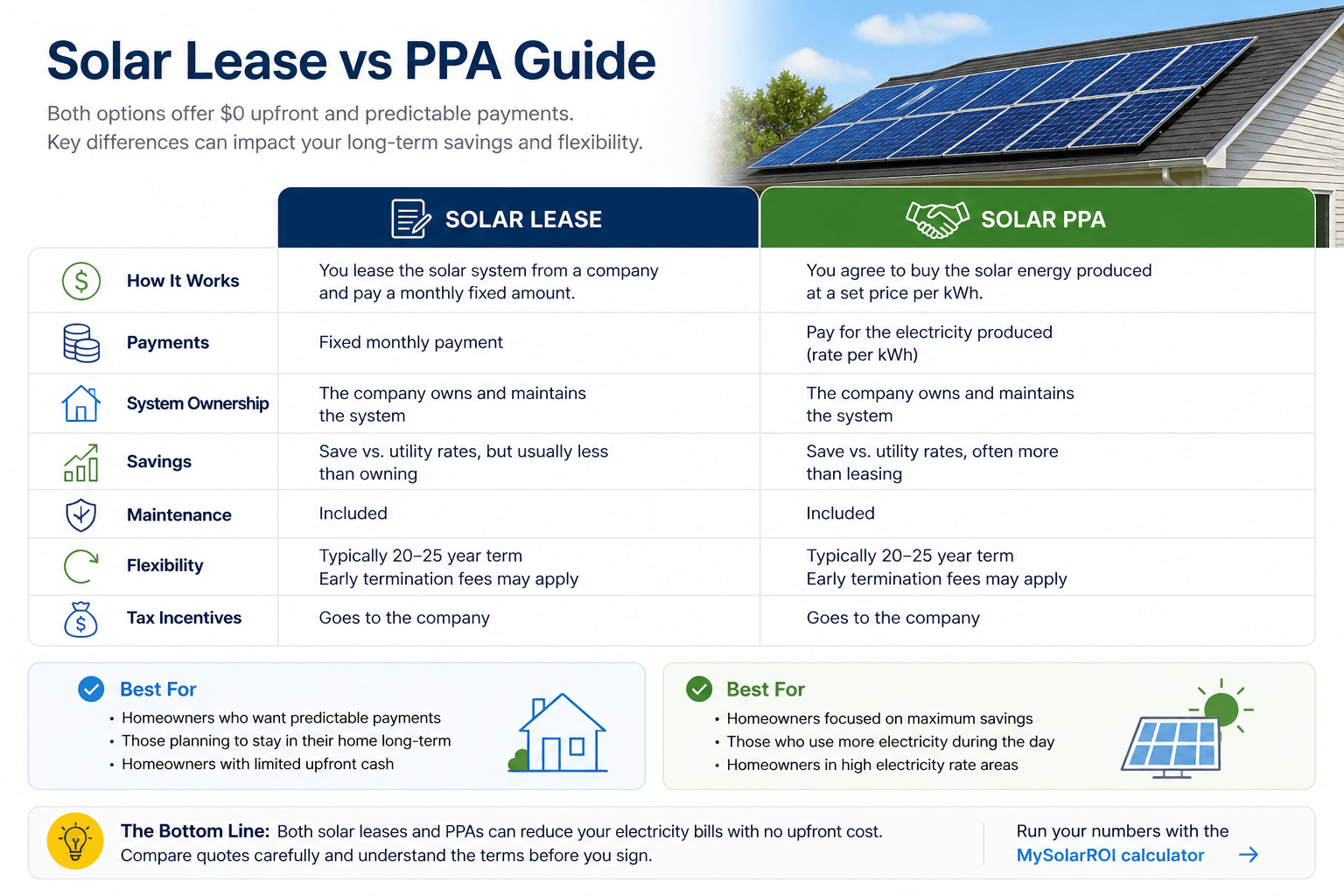
Use the solar financing comparison guide before choosing cash, a loan, a lease, or a PPA.
Should You Wait for New Incentives?
Some homeowners may wonder whether they should wait for new federal, state, or utility incentives.
There is no universal answer.
Waiting may make sense if:
- your current quotes are overpriced
- your roof needs work first
- you are not sure how long you will stay in the home
- your state or utility is considering new programs
- financing terms are unfavorable
Moving forward may make sense if:
- your electricity rates are high
- you have strong local incentives now
- your roof is a good fit
- your quotes are competitive
- you plan to stay long enough for payback
- you want energy resilience or battery backup
Do not base the decision only on the possibility of future incentives. Base it on current verified numbers, then update the calculation if new programs appear.
Checklist: How to Evaluate Solar Without the Federal Credit
Before signing a contract, review this checklist:
- Have I removed the old federal credit from the base case?
- Have I verified all state, local, and utility incentives?
- Do I know the cash price and financed price?
- Do I know the total repayment amount if financing?
- Do I understand my electricity rate?
- Do I know how my utility credits exported solar?
- Have I checked whether fixed charges remain after solar?
- Has the installer explained annual production?
- Have I compared production with PVWatts or another reliable tool?
- Have I included roof or electrical upgrade costs?
- Have I compared multiple quotes?
- Have I run conservative, base, and optimistic scenarios?
If several answers are unclear, wait before signing.
Common Mistakes When Evaluating Solar Without the Federal Credit
| Mistake | Why It Can Hurt the Estimate | Better Approach |
|---|---|---|
| Using old 30% credit assumptions | Can make payback look too short | Use current IRS guidance and model without the credit for new 2026 projects |
| Assuming state incentives apply | Eligibility and funding may vary | Verify with DSIRE, state energy office, and utility |
| Ignoring financing costs | Interest and fees can reduce ROI | Compare cash and financed scenarios |
| Assuming full net metering | Export credits vary by utility | Check your utility tariff |
| Oversizing the system | Extra exported energy may have low value | Size around usage and export rules |
| Comparing only monthly payment | May hide high total repayment | Review total cost and payback |
| Trusting one quote | Pricing and assumptions vary | Compare multiple installer proposals |
External Sources to Check
Before relying on any solar tax credit, incentive, production, or savings estimate, verify assumptions with reputable sources.
- IRS Residential Clean Energy Credit guidance
- IRS Form 5695 instructions
- DSIRE incentive and policy database
- NREL PVWatts solar production calculator
- Your state energy office
- Your local utility’s current net metering, net billing, or solar buyback tariff
FAQ About Solar Panels Without Federal Tax Credit
Are solar panels worth it without the federal tax credit?
Solar panels can still be worth it without the federal tax credit if electricity rates are high, system cost is fair, roof conditions are good, state or utility incentives apply, financing is reasonable, and utility export credits support strong savings.
How does losing the federal tax credit affect solar payback?
Without the federal tax credit, net system cost may be higher, which can lengthen payback period. The exact difference depends on system cost, annual savings, state incentives, financing, and utility rules.
Can I still get state or utility solar incentives?
Possibly. Some state, local, and utility incentives may still exist, but rules vary by location and program. Check DSIRE, your state energy office, and your utility before including incentives in your calculation.
Should I include the old 30% federal credit in a 2026 solar quote?
For a new residential solar installation placed in service after December 31, 2025, do not automatically include the old 30% federal credit. Current IRS guidance says the Residential Clean Energy Credit is not available after that date.
Is solar still worth it in high-electricity-rate states?
It can be. Higher electricity rates can make solar savings stronger because each kWh of solar electricity offsets more expensive utility power. But system cost, export credits, incentives, and financing still matter.
Does financing matter more without the federal tax credit?
Yes. Without the federal credit reducing net cost, loan interest, dealer fees, and total repayment can have a bigger impact on ROI. Always compare cash price and financed price.
Should I wait for new solar incentives?
Waiting may make sense if current quotes are overpriced, your roof needs work, or local programs may change. But future incentives are uncertain. Use current verified incentives for your base-case ROI calculation.
What is the best way to compare solar without the federal credit?
Compare gross cost, cash price, financed price, annual production, electricity rate, export credit rules, verified incentives, payback period, and long-term ROI. Run conservative and base-case scenarios before signing.
Conclusion
Solar panels without the federal tax credit can still be worth it, but the decision depends more heavily on the core numbers.
Without the federal residential credit, homeowners should pay closer attention to system cost, electricity rates, state and utility incentives, net metering rules, financing terms, roof conditions, and how long they plan to stay in the home.
Do not rely on outdated quotes or calculators that automatically subtract a 30% federal credit from new 2026 residential projects. Use current IRS guidance, verify local incentives, and compare multiple scenarios.
Before speaking with installers, use the MySolarROI solar ROI calculator to estimate solar savings, payback period, and long-term ROI with only verified incentives included.