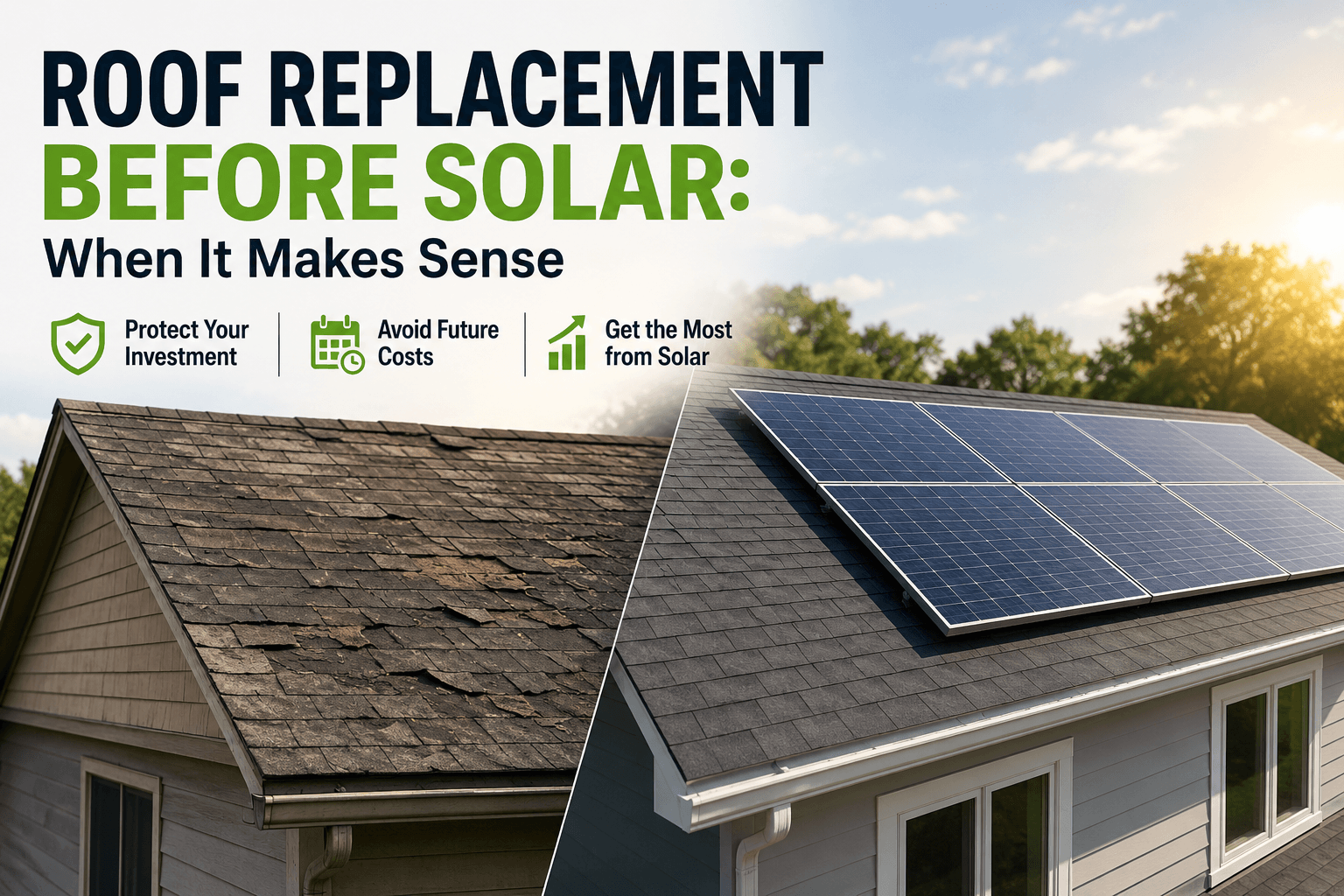
If you are planning to install solar panels, one of the first questions to ask is not about panels, batteries, or financing. It is simpler: is your roof ready for solar?
Roof replacement before solar can make sense when your roof is older, damaged, near the end of its useful life, or likely to need major work within the next few years. Solar panels are a long-term investment, and installing them on a roof that may soon need replacement can create extra costs later.
The U.S. Department of Energy recommends considering the age of your roof and how soon it may need replacement before installing solar. DOE also notes that roof suitability depends on roof condition, shade, size, shape, slope, and orientation.
This guide explains when replacing your roof before solar is smart, when it may not be necessary, what questions to ask contractors, and how roof timing can affect solar ROI and payback period.
First establish annual bill reduction in the self-consumption and export savings calculator. Then enter supported bill reduction, net cash cost, annual upkeep and your chosen horizon in the cash ROI calculator. It does not retrieve tariffs, model roof production or simulate battery operation. For borrowing, use the separate fixed-rate loan calculator; cash ROI does not model a loan.
Why Roof Condition Matters Before Installing Solar Panels
Solar panels are usually designed to stay on your roof for decades. DOE has noted that solar panels commonly last about 25 to 30 years, which is similar to the useful life of many roofing materials.
That creates a practical problem: if your roof only has a few good years left, installing solar now may mean paying later to remove the panels, replace the roof, and reinstall the system.
A roof that is not solar-ready can affect:
- Installation approval
- Mounting design
- Leak risk
- Warranty coverage
- Insurance questions
- Solar payback period
- Long-term ROI
- Home resale conversations
This does not mean every homeowner needs a new roof before solar. It means the roof should be evaluated before you sign a solar contract.
When Roof Replacement Before Solar Makes Sense
Replacing your roof before solar usually makes sense when the roof is close to replacement anyway. DOE advises that if you expect to need a new roof within the next few years, you may want to consider making that improvement before installing solar.
Here are the most common situations where replacing first is worth considering.
1. Your Roof Is Near the End of Its Useful Life
If your roof is old enough that a roofer says replacement is likely within a few years, doing the roof first may avoid extra labor later.
This is especially important for asphalt shingle roofs, which are common on U.S. homes. Actual life depends on material quality, installation, climate, ventilation, storm damage, and maintenance.
A simple rule of thumb:
| Roof Situation | Solar Timing Decision |
|---|---|
| Roof is new or recently replaced | Solar may be reasonable if structure is sound |
| Roof has 10+ years of life left | Solar may still make sense, depending on inspection |
| Roof has 5-10 years left | Compare replacement now vs. future panel removal costs |
| Roof has less than 5 years left | Strongly consider roof replacement before solar |
| Roof has leaks, soft decking, or major damage | Fix roof issues before solar |
The goal is not perfection. The goal is to avoid installing a long-term solar system on a roof that is likely to fail early.
2. Your Roof Has Existing Leaks or Damage
Solar panels should not be used to “cover up” a roof problem. If your roof has active leaks, missing shingles, sagging areas, damaged flashing, soft decking, or storm damage, those problems should be addressed first.
Ask for a roof inspection before moving forward. A solar installer may evaluate solar suitability, but a licensed roofer or structural professional can give a more focused view of roof condition.
DOE recommends having a solar installer, roofing expert, or structural engineer help determine whether your roof can support solar panels.
3. Your Roof Decking or Structure Needs Work
Solar panels add weight and require mounting points. Most homes can support rooftop solar, but not every roof is automatically ready.
Potential issues include:
- Weak decking
- Old or damaged rafters
- Previous water damage
- Poor attic ventilation
- Multiple layers of old shingles
- Unpermitted roof work
- Sagging roof planes
If structural work is needed, it is usually better to handle it before solar installation.
4. You Want to Avoid Future Panel Removal Costs
If you replace the roof after solar is installed, the solar panels and mounting equipment typically must be removed and reinstalled. DOE notes that during a roof replacement, solar panels and mounting systems need to be removed so the work can be completed.
That can add cost, coordination, downtime, and warranty complexity. Even if your system is working well, roof replacement later may require:
- Solar company scheduling
- Roofer scheduling
- Temporary system shutdown
- Removal and storage of panels
- Reinstallation and inspection
- Possible electrical reconnection
- Permit or utility coordination in some areas
That extra work can reduce your effective solar ROI if it was not included in your original calculation.
Use the MySolarROI solar cost calculator to test how adding roof-related costs changes the total project economics.
When You May Not Need a New Roof Before Solar
Roof replacement before solar is not always the right move. In many cases, homeowners can install solar without replacing the roof.
You may not need a new roof first if:
- The roof was recently replaced
- A roofer confirms it has many years of useful life left
- There are no leaks or structural issues
- The roofing material is compatible with solar mounting
- The solar installer is comfortable warranting the roof penetrations
- You plan to install panels on a roof section that is in good condition
The key is documentation. Do not rely only on a salesperson saying, “Your roof looks fine.” Ask for written findings from the roof review or inspection.
Roof Replacement Before Solar: Cost and ROI Considerations
A new roof can improve solar readiness, but it also increases total project spending. That matters because solar ROI depends on your full cost, electricity savings, incentives, financing terms, and how long the system produces value.
DOE has previously estimated that combining roof replacement and solar may save money compared with doing both separately because contractors can coordinate work and reduce duplicated costs.
Still, a roof replacement is not automatically a “solar cost.” From an ROI perspective, you should separate the numbers.
How to Think About the Costs
| Cost Item | Should It Be Included in Solar ROI? | Why It Matters |
|---|---|---|
| Solar panels, inverter, racking, wiring, labor | Yes | These are direct solar system costs |
| Electrical upgrades required for solar | Usually yes | They may be necessary for the system |
| Battery storage | Yes, if included | It affects total cost and backup value |
| New shingles or roof decking | Usually no, or separate | The roof also serves the home regardless of solar |
| Solar panel removal/reinstall later | Yes, as a risk scenario | It can reduce long-term savings |
| Roof repairs needed only for safe installation | Case by case | Ask contractors and tax professionals |
For homeowner decision-making, it is helpful to run two calculations:
- Solar-only ROI
- Solar plus roof timing scenario
That way, you can see whether replacing the roof now improves or weakens the overall financial picture.
Can a New Roof Count Toward the Solar Tax Credit?
Homeowners should be careful here.
The IRS states that traditional building components that primarily serve a roofing or structural function generally do not qualify as residential clean energy credit expenses. The IRS gives examples such as roof trusses and traditional shingles that support solar panels. Solar roofing tiles or solar shingles may qualify if they generate clean energy.
In plain English: ordinary roof replacement is generally not treated the same as solar equipment.
Do not assume your full roof replacement qualifies for a solar tax credit just because you are installing solar at the same time. Incentive rules can change, eligibility depends on your situation, and tax treatment should be confirmed with a qualified tax professional.
For current incentive research, check IRS guidance and DSIRE, which tracks renewable energy and energy-efficiency incentives by location.
Mini Case Study: Replacing the Roof First vs. Waiting
Here is a realistic example to show how roof timing can affect solar payback. This is not a guarantee. Actual results depend on location, electricity rates, roof conditions, incentives, utility rules, financing, and system design.
Homeowner Assumptions
| Assumption | Example |
|---|---|
| Solar system quote | $22,000 |
| Estimated annual electric bill savings | $1,900 |
| Roof age | 18 years |
| Roofer estimate | Roof likely needed within 3-5 years |
| Roof replacement quote | $14,000 |
| Future solar removal/reinstall quote | $4,000 |
| Financing | Not included in simple example |
Scenario A: Install Solar Now, Replace Roof Later
If the homeowner installs solar now:
- Solar cost: $22,000
- Estimated annual savings: $1,900
- Simple solar payback: about 11.6 years
- Future removal/reinstall cost: $4,000
- Adjusted project cost: $26,000
- Adjusted simple payback: about 13.7 years
Scenario B: Replace Roof First, Then Install Solar
If the homeowner replaces the roof first:
- Solar cost: $22,000
- Roof cost: considered separately as a home maintenance cost
- Avoided future solar removal/reinstall: $4,000
- Solar system can stay in place longer without roof interruption
- Simple solar payback remains about 11.6 years if roof cost is treated separately
The better answer depends on whether the roof replacement was already needed. If the roof is near the end of its life, replacing it first may protect the solar investment. If the roof has plenty of life left, replacing it early could weaken the overall home improvement budget.
Run both scenarios in the MySolarROI solar ROI calculator before comparing installer proposals.
Questions to Ask Before Replacing Your Roof for Solar
Before signing either a roofing or solar contract, ask direct questions.
Questions for the Roofer
- How many years of useful life does my roof likely have left?
- Are there signs of leaks, soft decking, or ventilation issues?
- Is the roof structure suitable for solar?
- Should any decking, flashing, or underlayment be upgraded?
- What roofing material do you recommend if solar will be installed?
- Will the roof warranty remain valid after solar installation?
- Do you coordinate with solar installers?
Questions for the Solar Installer
- Did you inspect the roof in person or only use satellite imagery?
- Do you recommend roof replacement before solar?
- Who is responsible if a roof leak appears after installation?
- What roof penetrations will be made?
- What flashing and mounting system will be used?
- What happens if the roof needs replacement later?
- What does panel removal and reinstallation cost?
- Does your workmanship warranty cover roof penetrations?
- Will you coordinate with my roofer?
DOE recommends asking solar installers whether roof repair is needed before installation and who is responsible if roof damage or leaks occur.
Best Roofing Materials for Solar Panels
Most common roofing materials can work with solar, but installation methods and costs vary.
| Roofing Material | Solar Compatibility | Homeowner Notes |
|---|---|---|
| Asphalt shingles | Common and usually straightforward | Often easiest for standard mounting |
| Standing seam metal | Often very solar-friendly | Some systems can clamp without roof penetrations |
| Tile | Possible but more complex | Tiles can crack; may require special mounting |
| Flat roof membrane | Possible | Requires proper tilt, ballast, or attachment design |
| Wood shake | Often more challenging | Fire, brittleness, and mounting concerns may apply |
| Slate | Possible but expensive/fragile | Requires experienced contractors |
The best choice depends on your climate, budget, roof structure, local code, and installer experience.
Common Mistakes Homeowners Make
Mistake 1: Getting Only a Solar Quote
A solar quote does not always tell you whether your roof is ready. If your roof is older, get a roofer’s opinion too.
Mistake 2: Assuming the Roof Qualifies for Solar Incentives
Traditional roofing materials generally do not qualify for the residential clean energy credit just because they support panels, according to IRS guidance.
Mistake 3: Ignoring Panel Removal Costs
If your roof may need replacement soon, ask for a written estimate for future solar removal and reinstallation.
Mistake 4: Comparing Quotes Without Roof Assumptions
One installer may include roof-related work. Another may not. That makes quote comparison misleading.
For a better apples-to-apples comparison, use the MySolarROI solar panels calculator to estimate system size, then compare cost, production, warranties, and roof assumptions across quotes.
Mistake 5: Financing Everything Without Separating Costs
Bundling roof replacement and solar into one loan may be convenient, but it can make ROI harder to understand. Separate the roof cost, solar cost, interest rate, loan term, and expected savings before deciding.
Should You Install Solar and Replace the Roof at the Same Time?
In many cases, yes, installing solar during a roof replacement can be efficient. DOE notes that it can often save money to install solar at the same time as roof replacement because the work can be coordinated.
Potential benefits include:
- One major home project instead of two
- Better coordination between roofer and solar installer
- Lower risk of removing panels later
- Cleaner mounting design
- Better roof warranty planning
- More accurate long-term ROI assumptions
But there are also trade-offs:
- Higher upfront project cost
- More complex financing
- More contractor coordination
- More decisions at once
- Possible delays if permits or schedules do not align
If your roof is in poor condition, combining the projects may be practical. If your roof is in good condition, replacing it early may not be financially necessary.
Sources and verification
For homeowners who want to verify assumptions before signing a contract, these sources are worth checking:
- U.S. Department of Energy Homeowner’s Guide to Solar for roof suitability, roof age, shade, and solar basics.
- DOE Planning a Home Solar Electric System for guidance on roof age, HOA issues, utility rules, and installer estimates.
- IRS Residential Clean Energy Credit guidance for what types of solar-related expenses may qualify and what traditional roof components generally do not.
- DSIRE for state, local, federal, and utility incentive research.
FAQ: Roof Replacement Before Solar
Should I replace my roof before installing solar panels?
You should consider replacing your roof before solar if it is old, damaged, leaking, structurally weak, or likely to need replacement within the next few years. If the roof is newer and a qualified professional confirms it has many years left, replacement may not be necessary.
How old is too old for a roof before solar?
There is no single age that applies to every roof. Material, climate, installation quality, ventilation, and maintenance all matter. The practical question is whether the roof is likely to last long enough to support the solar system without needing major work soon.
What happens if I need a new roof after installing solar?
The solar panels and mounting system usually need to be removed before the roof can be replaced, then reinstalled afterward. That can add cost, scheduling complexity, and system downtime.
Can I include roof replacement in my solar tax credit?
Generally, traditional roofing materials and structural components do not qualify simply because they support solar panels. IRS guidance says solar roofing tiles or shingles may qualify if they generate clean energy, but ordinary shingles and roof trusses generally do not. Always confirm current rules with a qualified tax professional.
Is it cheaper to do solar and roofing together?
It can be cheaper in some cases because contractors may coordinate labor, reduce duplicated work, and avoid future panel removal. But the total upfront cost will be higher, so homeowners should compare both scenarios.
Will solar panels damage my roof?
A properly installed solar system should not damage a suitable roof. Problems are more likely when the roof is already weak, installation quality is poor, flashing is incorrect, or responsibilities are unclear. Ask about workmanship warranties and roof leak coverage before signing.
Should I ask a roofer or solar installer first?
If your roof is older or questionable, start with a roofer or structural professional. Then ask solar installers to design around the confirmed roof condition. If your roof is newer, you can start with solar quotes but still ask for roof-specific findings.
Conclusion: Roof Replacement Before Solar Is About Timing
Roof replacement before solar makes the most sense when your roof is already near the end of its life, has damage, or would likely require major work soon after installation. In that situation, replacing the roof first can help avoid future panel removal costs and protect your solar investment.
If your roof is newer, structurally sound, and has many years of useful life left, replacing it early may not improve your ROI.
The best decision comes from comparing real numbers: roof condition, solar cost, expected bill savings, incentives, utility rules, financing, and how long you plan to stay in the home.
Use the MySolarROI solar ROI calculator to estimate your solar payback period before comparing installer quotes. Run one scenario with roof replacement first and another without it so you can see how the timing changes your return.