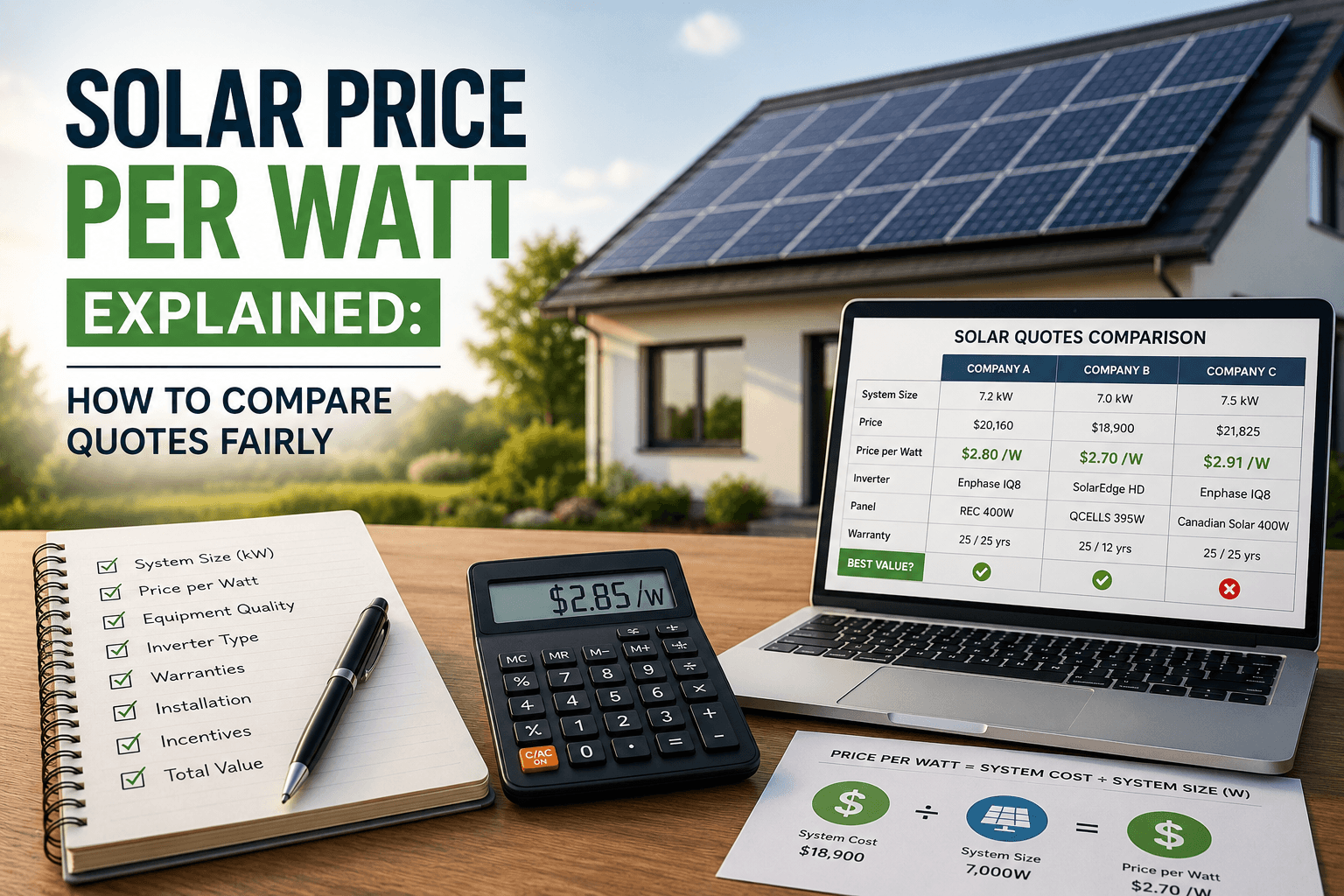
When homeowners compare solar quotes, one number usually shows up fast: solar price per watt.
It sounds simple. Lower price per watt means a better deal, right?
Not always.
Solar price per watt is useful because it helps you compare system prices across different sizes. But it can also be misleading if one quote includes battery storage, financing fees, roof work, panel upgrades, or different equipment while another quote does not.
This guide explains how solar price per watt works, what should be included, what should be separated, and how to compare solar quotes fairly before choosing an installer.
Your actual solar economics depend on your location, electricity rate, system size, roof conditions, incentives, utility rules, financing, equipment, and long-term energy usage. Before signing a contract, use the MySolarROI solar cost calculator to test how system price affects savings, payback period, and return on investment.
What Is Solar Price per Watt?
Solar price per watt is the installed cost of a solar system divided by the system’s size in watts.
The basic formula is:
Solar price per watt = Total installed solar cost ÷ System size in watts
For example:
| Solar System Size | Total Installed Cost | Solar Price per Watt |
|---|---|---|
| 6 kW / 6,000 watts | $18,000 | $3.00/W |
| 8 kW / 8,000 watts | $24,000 | $3.00/W |
| 10 kW / 10,000 watts | $30,000 | $3.00/W |
Price per watt makes it easier to compare a smaller system with a larger one.
Without this metric, a $22,000 quote might look cheaper than a $28,000 quote. But if the first system is 6 kW and the second is 9 kW, the second quote may actually be cheaper per watt.
Why Solar Price per Watt Matters
Solar price per watt matters because it helps homeowners compare quotes using a common unit.
It can help you answer questions like:
- Is this quote unusually expensive?
- Am I paying more because of premium equipment?
- Is one installer offering a better value for the same system size?
- Are batteries, electrical upgrades, or financing costs making the quote look higher?
- How does the system price affect my solar payback period?
The U.S. Department of Energy explains that whether solar is financially attractive depends on several factors, including electricity usage, system size, roof conditions, utility rates, incentives, and how excess solar energy is credited by the utility.
That means price per watt is important, but it is not the full story.
A lower price per watt does not automatically mean better long-term savings. A fair comparison also needs to consider expected production, equipment quality, warranty terms, net metering rules, financing, and installer reliability.
How to Calculate Solar Price per Watt
To calculate solar price per watt, you need two numbers:
- The total installed cost of the solar system
- The system size in watts
Most residential solar systems are quoted in kilowatts, or kW. One kilowatt equals 1,000 watts.
So an 8 kW system equals 8,000 watts.
Example Calculation
Suppose an installer gives you this quote:
- System size: 8.5 kW
- Total installed cost: $25,500
Convert kilowatts to watts:
8.5 kW × 1,000 = 8,500 watts
Then divide total cost by watts:
$25,500 ÷ 8,500 watts = $3.00 per watt
So the quote is $3.00/W before incentives.
Quick Formula Table
| Step | Formula | Example |
|---|---|---|
| Convert kW to watts | kW × 1,000 | 8.5 × 1,000 = 8,500 W |
| Calculate price per watt | Total cost ÷ watts | $25,500 ÷ 8,500 = $3.00/W |
| Compare quotes | Use same scope | Solar-only vs. solar-only |
Gross vs. Net Solar Price per Watt
One of the biggest mistakes homeowners make is comparing gross price per watt from one quote with net price per watt from another.
These are not the same.
Gross Price per Watt
Gross price per watt is the system price before incentives, tax credits, rebates, or other discounts.
Example:
- Solar system cost: $24,000
- System size: 8,000 watts
- Gross price per watt: $3.00/W
Net Price per Watt
Net price per watt is the system price after incentives or credits are applied.
Example:
- Solar system cost: $24,000
- Incentives or credits: $4,000
- Net cost: $20,000
- System size: 8,000 watts
- Net price per watt: $2.50/W
Which One Should You Use?
Use gross price per watt when comparing installer pricing.
Use net price per watt when estimating your financial return.
Why?
Because incentives may depend on your tax situation, state, utility, installation date, ownership structure, and eligibility. Installer A should not look cheaper just because they made a more aggressive assumption about incentives.
For 2026, homeowners should be especially careful with federal incentive assumptions. The IRS states that the Residential Clean Energy Credit equals 30% for qualified property installed from 2022 through December 31, 2025, and that the credit is not available for property placed in service after December 31, 2025.
Always verify current federal, state, and utility incentives before treating them as guaranteed savings.
What Should Be Included in Solar Price per Watt?
For a fair solar price per watt comparison, the number should usually include the full installed cost of the solar-only system.
That typically includes:
| Cost Item | Should It Be Included? | Why It Matters |
|---|---|---|
| Solar panels | Yes | Main equipment cost |
| Inverters or microinverters | Yes | Required to convert solar power |
| Racking and mounting | Yes | Secures panels to the roof |
| Standard electrical work | Yes | Needed for safe installation |
| Permits and interconnection | Yes | Required in most areas |
| Labor and installation | Yes | Major part of total cost |
| Installer overhead and margin | Yes | Part of the contracted system price |
| Monitoring equipment | Usually yes | Often included in modern systems |
If one quote excludes permits, design, interconnection fees, or standard electrical work, it may look cheaper than it really is.
What Should Be Separated from Solar Price per Watt?
Some items should usually be separated so you can compare quotes fairly.
These include:
| Item | Why It Should Be Separated |
|---|---|
| Battery storage | Adds major cost and changes the purpose of the system |
| Main panel upgrade | May be necessary, but not part of the solar array itself |
| Roof replacement or roof repair | Home improvement cost, not solar equipment cost |
| EV charger installation | Related electrical upgrade, but separate from solar |
| Tree removal | Site preparation, not solar system cost |
| Financing dealer fees | Can inflate the contract price |
| Extended warranties | Optional add-on |
| Critter guards | Useful in some areas, but not always standard |
This does not mean these items are bad. It means they should be shown clearly.
A solar-only quote at $3.00/W should not be compared directly with a solar-plus-battery quote at $4.50/W. Those are different projects.
For battery-specific planning, compare storage separately and then run the combined economics through the MySolarROI solar ROI calculator.
Solar Price per Watt vs. Total System Cost
Solar price per watt and total system cost answer different questions.
| Metric | What It Tells You | Best Used For |
|---|---|---|
| Total system cost | How much the project costs overall | Budgeting and financing |
| Price per watt | Cost relative to system size | Comparing quotes |
| Cost per kWh produced | Cost compared with expected output | Long-term value |
| Payback period | Time to recover net cost through savings | Financial decision-making |
| ROI | Long-term return compared with investment | Comparing solar with other uses of cash |
A larger system may cost more overall but less per watt. That happens because some costs, such as permitting, design, sales, and truck rolls, do not increase perfectly with system size.
For example:
| Quote | System Size | Total Cost | Price per Watt |
|---|---|---|---|
| Quote A | 6 kW | $19,200 | $3.20/W |
| Quote B | 9 kW | $27,000 | $3.00/W |
| Quote C | 11 kW | $31,900 | $2.90/W |
Quote C has the highest total cost, but the lowest price per watt.
That does not automatically make it the best choice. If your home cannot use or receive fair credit for that extra production, the larger system may not produce better savings.
Use the MySolarROI solar panels calculator to estimate a system size based on electricity usage before comparing quote prices.
What Is a Fair Solar Price per Watt?
There is no single fair solar price per watt for every home.
A fair price depends on:
- State and local labor costs
- System size
- Roof complexity
- Equipment brand and efficiency
- Inverter type
- Installer quality
- Permitting and utility requirements
- Electrical upgrades
- Financing structure
- Local competition
- Warranty and service terms
NREL tracks installed solar system cost trends and models residential PV costs as part of its solar market research. Its work shows that installed cost is made up of more than just panels, including hardware, labor, permitting, overhead, supply chain costs, and other soft costs.
EnergySage and other marketplace data can also be useful for seeing current quote ranges, but homeowners should still compare local quotes because pricing varies by market, roof, equipment, and installer.
The most practical approach is to get at least three quotes and compare them using the same scope:
- Solar-only price
- Same system size or similar annual production
- Same cash price basis
- Same battery assumptions
- Same financing assumptions
- Same incentives included or excluded
Why Two Quotes Can Have Different Prices per Watt
Two solar quotes can differ for good reasons or bad reasons.
Good Reasons for a Higher Price per Watt
A higher price per watt may be reasonable if the quote includes:
- Better inverter equipment
- Higher-efficiency panels
- Stronger workmanship warranty
- More complex roof layout
- Additional safety or electrical work
- Better monitoring and service support
- Higher local permitting or interconnection costs
Warning Signs of an Unfairly High Price
A quote deserves closer review if:
- The installer will not show the cash price
- Financing fees are hidden inside the system cost
- The price per watt is much higher than other local quotes with similar equipment
- Incentives are presented as guaranteed without explaining eligibility
- The system is oversized without a clear reason
- Battery costs are blended into solar price per watt
- The proposal focuses on monthly payment instead of total cost
A solar quote should make the numbers easier to understand, not harder.
How Financing Can Distort Solar Price per Watt
Solar loans can be helpful, but they can also make quote comparisons confusing.
Some solar loans include dealer fees. These fees may increase the contract price in exchange for a lower advertised interest rate.
For example:
| Quote Type | System Size | Cash Price | Financed Contract Price | Price per Watt Used |
|---|---|---|---|---|
| Cash quote | 8 kW | $24,000 | N/A | $3.00/W |
| Loan quote with fee | 8 kW | $24,000 | $30,000 | $3.75/W |
| Same system, different loan | 8 kW | $24,000 | $27,000 | $3.38/W |
If you compare only monthly payments, the true system cost can be hard to see.
Ask every installer for:
- Cash price
- Financed price
- Loan interest rate
- Loan term
- Dealer fee or financing markup
- Total payments over the life of the loan
- Assumptions about incentives or tax credits
Then use the MySolarROI solar payback calculator to see how financing changes your payback period.
Solar Price per Watt and System Production Are Not the Same
A lower price per watt does not always mean a lower cost per unit of electricity.
Why?
Because two systems with the same size can produce different amounts of electricity.
Production depends on:
- Roof direction
- Roof angle
- Shade
- Local sunlight
- Panel placement
- Inverter design
- Weather
- Clipping assumptions
- Degradation over time
For example:
| Quote | System Size | Price per Watt | Estimated Year 1 Production | Cost per Year 1 kWh |
|---|---|---|---|---|
| Quote A | 8 kW | $3.00/W | 10,800 kWh | $2.22 per Year 1 kWh |
| Quote B | 8 kW | $2.85/W | 9,400 kWh | $2.43 per Year 1 kWh |
Quote B has a lower price per watt, but Quote A may produce more electricity because of better design, less shade, or better panel placement.
That is why homeowners should compare both:
- Price per watt
- Estimated annual production
- Bill savings
- Payback period
- Long-term ROI
Mini Case Study: Comparing Two Solar Quotes
Here is a simplified example.
A homeowner uses about 10,500 kWh of electricity per year and receives two solar quotes.
Quote Comparison
| Item | Quote A | Quote B |
|---|---|---|
| System size | 8.0 kW | 8.4 kW |
| Cash price | $25,600 | $26,460 |
| Price per watt | $3.20/W | $3.15/W |
| Estimated Year 1 production | 10,000 kWh | 10,700 kWh |
| Battery included? | No | No |
| Main panel upgrade included? | No | No |
| Financing included? | No | No |
| Workmanship warranty | 10 years | 25 years |
At first glance, Quote B is slightly cheaper per watt.
Now look deeper:
- Quote B is larger.
- Quote B produces more estimated electricity.
- Quote B has a longer workmanship warranty.
- Both quotes are cash prices.
- Neither includes a battery or electrical upgrade.
In this case, Quote B may be the better value if the production estimate is realistic and the installer is reputable.
But the answer could change if:
- Quote B used overly optimistic production assumptions
- The utility gives low credit for exported solar power
- The homeowner does not use enough electricity to benefit from the larger system
- Quote A uses better equipment or has stronger local service
- Financing terms are different
This is why price per watt is a starting point, not the final decision.
Run your own numbers with the MySolarROI solar ROI calculator before comparing installer quotes side by side.
Step-by-Step: How to Compare Solar Quotes Fairly
Use this process before choosing a solar installer.
1. Ask for the Cash Price First
Even if you plan to finance, ask for the cash price.
This gives you the cleanest way to compare solar price per watt.
2. Separate Solar, Battery, and Electrical Upgrades
Ask the installer to break out:
- Solar system cost
- Battery cost
- Main panel upgrade
- Roof work
- EV charger
- Other add-ons
Do not compare a solar-only quote with a solar-plus-storage quote.
3. Calculate Gross Price per Watt
Use the pre-incentive cash price.
Formula:
Gross price per watt = Cash solar-only price ÷ system watts
This helps you compare installer pricing.
4. Compare Equipment
Check:
- Panel brand and model
- Panel wattage
- Inverter type
- Warranty length
- Monitoring
- Battery brand, if included
A cheaper quote with weaker equipment is not always a better deal.
5. Compare Estimated Production
Ask for annual production estimates.
Then compare:
- System size
- Year 1 kWh estimate
- Shade assumptions
- Degradation assumptions
- Utility bill offset
6. Review Utility Credit Rules
Net metering and solar buyback rules can strongly affect savings.
The Department of Energy notes that net metering depends on state and utility policies, and that exported solar power is not always credited in a simple one-for-one way.
A system that looks good on price can produce weaker savings if exported electricity receives a low credit.
7. Check Incentives Carefully
Use DSIRE, state energy offices, utility websites, and tax professionals when needed. DSIRE describes itself as a comprehensive source for U.S. renewable energy and efficiency incentives and policies.
Do not rely only on sales proposal assumptions.
8. Compare Payback and ROI
After you normalize the quote, compare the financial result.
Look at:
- Net cost
- Estimated annual bill savings
- Payback period
- Financing impact
- Long-term savings
- ROI
This is where price per watt becomes useful. It feeds into the bigger financial picture.
Common Solar Price per Watt Mistakes
| Mistake | Why It Hurts Comparison | Better Approach |
|---|---|---|
| Comparing gross price to net price | Makes one quote look artificially cheaper | Compare gross to gross and net to net |
| Blending battery cost into solar cost | Inflates solar price per watt | Separate solar and battery pricing |
| Ignoring financing fees | Hides true project cost | Ask for cash and financed prices |
| Comparing different system sizes only by total cost | Larger systems may look expensive unfairly | Use price per watt |
| Ignoring production estimates | Cheap systems may produce less power | Compare kWh output too |
| Assuming incentives are guaranteed | Eligibility can vary | Verify with official sources |
| Choosing only the lowest price | May overlook quality, warranty, and service | Compare value, not just price |
Expert Tips for Homeowners
Ask for a One-Page Quote Summary
A good quote summary should show:
- System size
- Cash price
- Price per watt
- Equipment
- Estimated annual production
- Battery cost, if any
- Incentives assumed
- Financing terms
- Warranty details
If a proposal makes these numbers hard to find, ask for clarification.
Compare Annual Production, Not Just System Size
An 8 kW system on a shaded roof may produce less than a 7 kW system on a better roof section.
Watch for Over-Sizing
A larger system may reduce your bill more, but only if your utility credits excess production fairly.
Do Not Let Monthly Payment Replace Total Cost
Monthly payment matters for your budget. But total cost matters for ROI.
Use the Same Assumptions for Every Quote
When comparing quotes, use the same:
- Electricity rate
- Utility credit value
- Incentive assumptions
- Financing assumptions
- Annual usage
- System lifetime assumptions
External Source Suggestions
For current solar cost, incentive, and policy research, homeowners should verify details with reputable sources such as:
- U.S. Department of Energy homeowner solar guidance for solar basics, net metering, and utility considerations.
- NREL solar installed cost analysis for residential PV cost modeling and market research.
- IRS Residential Clean Energy Credit guidance for federal tax credit eligibility and dates.
- DSIRE for state, local, and utility renewable energy incentives and policies.
- SEIA and Wood Mackenzie market reports for broader U.S. solar market trends.
FAQ: Solar Price per Watt
What does solar price per watt mean?
Solar price per watt means the total installed cost of a solar system divided by the system size in watts. For example, a $24,000 system that is 8,000 watts costs $3.00 per watt.
Is lower solar price per watt always better?
No. A lower solar price per watt may be attractive, but you also need to compare equipment, production estimates, warranties, financing terms, installer quality, and utility credit rules.
Should battery cost be included in solar price per watt?
Usually, no. Battery cost should be separated from the solar-only price so you can compare solar quotes fairly. After that, you can evaluate the combined solar-plus-battery project.
Should I compare solar quotes before or after incentives?
Compare installer pricing before incentives. Then compare financial results after incentives, using verified eligibility assumptions. This avoids making one installer look cheaper because they used more optimistic incentive assumptions.
Why is my solar quote more expensive per watt than another quote?
Your quote may be higher because of roof complexity, premium equipment, electrical upgrades, local permitting costs, labor costs, warranties, or financing fees. Ask the installer for a detailed cost breakdown.
How many solar quotes should I get?
Most homeowners should get at least three quotes. This helps you compare price per watt, system design, production estimates, equipment, warranties, and financing terms.
What is the difference between price per watt and cost per kWh?
Price per watt measures installation cost compared with system size. Cost per kWh looks at cost compared with electricity production. For long-term value, production and savings matter as much as system size.
Can MySolarROI help compare solar price per watt?
Yes. You can use MySolarROI to estimate how system cost, incentives, electricity rates, financing, and system size may affect solar savings, payback period, and ROI.
Conclusion: Use Solar Price per Watt, But Do Not Stop There
Solar price per watt is one of the best tools for comparing solar quotes fairly. It helps you normalize different system sizes and quickly spot quotes that need a closer look.
But it should not be the only number you use.
A fair solar comparison should also consider equipment quality, annual production, utility credit rules, incentives, financing terms, battery costs, warranties, and installer reputation.
The best quote is not always the cheapest quote. It is the quote that gives you a clear system design, realistic production estimate, transparent pricing, and financial assumptions you can verify.
Before choosing an installer, calculate your solar ROI with MySolarROI so you can see how price per watt affects your payback period, long-term savings, and overall return.