Solar batteries can make a home solar system more useful, but they also add a major upfront cost. For many homeowners, the real question is not just “How much does a battery cost?” It is: Will the battery improve my savings, backup protection, or long-term solar ROI enough to justify the price?
In 2026, solar battery cost depends on battery size, usable storage capacity, installation complexity, backup panel work, brand, inverter compatibility, local labor rates, incentives, utility rules, and whether the battery is installed with solar or added later.
A typical home battery installation can cost thousands of dollars, often around the low-to-mid five figures before local incentives. EnergySage reports that solar batteries typically cost $15,228 before incentives for about 13.5 kWh of storage, based on its recent marketplace data.
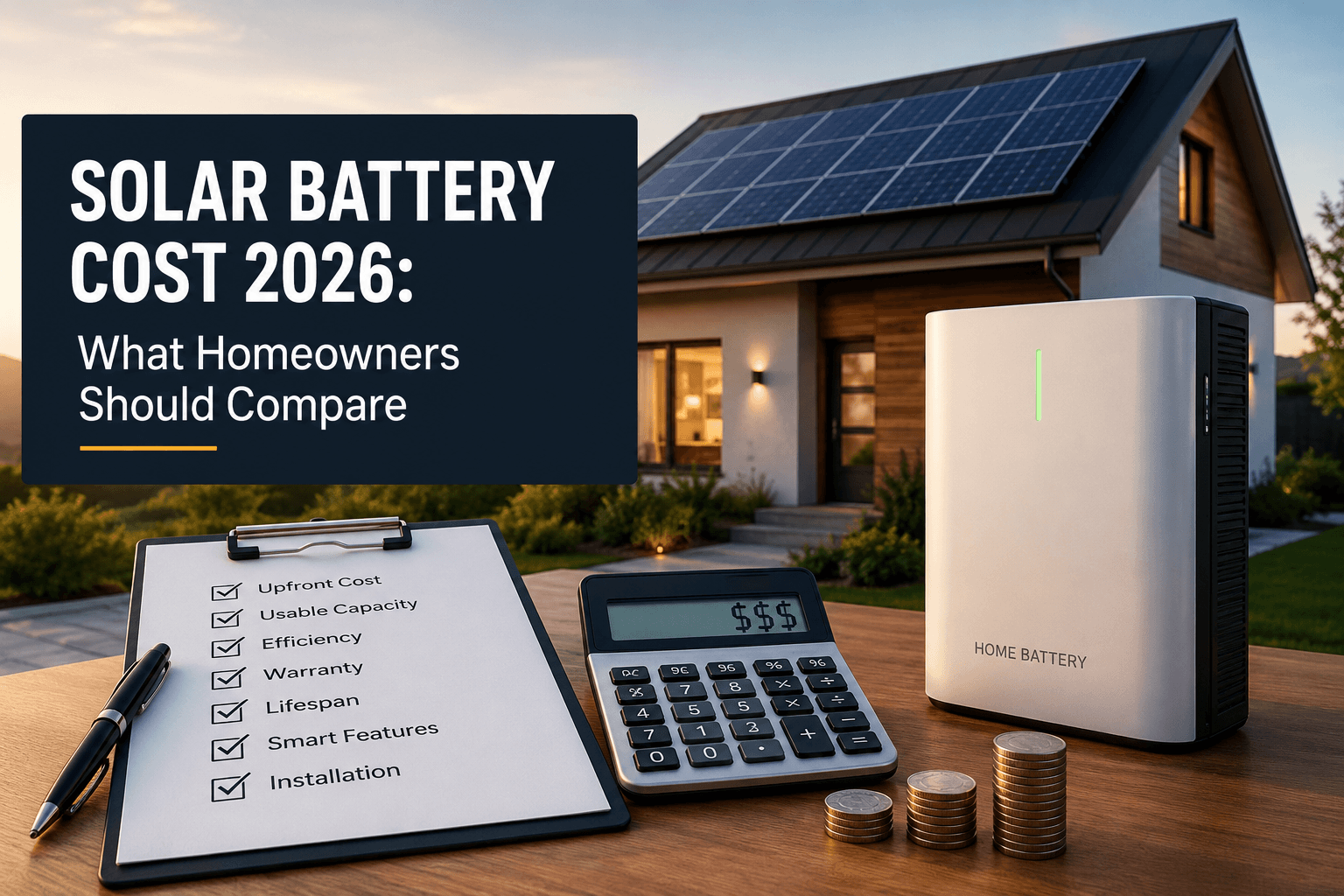
This guide explains what homeowners should compare before choosing a battery: installed cost, usable capacity, backup value, incentives, warranty terms, utility rates, and payback math.
Want to test the numbers first? Use the MySolarROI solar ROI calculator to estimate solar savings, payback period, and ROI before comparing installer quotes.
What Is Included in Solar Battery Cost?
A solar battery quote usually includes more than the battery itself. The battery hardware may be the most visible part of the proposal, but the installed price can also include electrical equipment, permits, labor, backup controls, and panel work.
A complete solar battery quote may include:
- Battery unit or battery modules
- Battery inverter or hybrid inverter
- Backup gateway or transfer equipment
- Critical loads panel
- Electrical wiring and conduit
- Permitting and inspection
- Labor and commissioning
- Monitoring app setup
- Warranty registration
- Possible main electrical panel upgrades
This is why two batteries with similar storage capacity can have very different installed prices.
For example, one quote may only back up a refrigerator, lights, internet, and a few outlets. Another quote may be designed for larger loads, such as a well pump, HVAC equipment, or more circuits. Those are very different systems, even if the battery brand is the same.
Solar Battery Cost 2026: What Price Range Should Homeowners Expect?
For many U.S. homeowners, a single home battery installation commonly lands around the low-to-mid five figures before local rebates or incentives. The final price depends heavily on battery size, brand, usable capacity, installation complexity, labor costs, and backup design.
EnergySage reports a typical cost of $15,228 before incentives for 13.5 kWh of home battery storage. That does not mean every homeowner will pay that exact amount. A smaller battery, simple installation, or strong local incentive may reduce the net cost. A larger backup system, panel upgrade, or multiple batteries may increase it.
| Battery Setup | Common Use Case | What to Compare |
|---|---|---|
| 5–7 kWh battery | Limited backup or small evening use | Essential circuits only |
| 10–15 kWh battery | Common home backup size | Fridge, lights, Wi-Fi, outlets, select appliances |
| 20+ kWh battery | Longer backup or larger loads | More circuits, longer outage coverage |
| Multiple batteries | Whole-home or near whole-home backup | Higher output, longer runtime, more cost |
The lowest price is not always the best value. A $12,000 battery may be a poor fit if it cannot power the circuits you care about. A $20,000 system may make more sense if it supports frequent outages, essential medical equipment, or high evening electricity rates.
To compare battery value alongside solar panel cost, use the solar cost calculator before accepting a quote.
Compare Usable Capacity, Not Just Battery Size
One of the most common mistakes homeowners make is comparing batteries by nameplate capacity only.
Battery capacity can be listed in different ways. What matters most for everyday use is how much energy the battery can actually deliver.
| Battery Term | What It Means | Why It Matters |
|---|---|---|
| Nameplate capacity | Total listed battery size | Useful for basic comparison |
| Usable capacity | Energy the battery can actually deliver | Better for backup and savings estimates |
| Continuous power output | Power the battery can supply steadily | Determines what can run at the same time |
| Peak power output | Short burst of power | Helps with appliance startup loads |
| Round-trip efficiency | Energy retained after charging and discharging | Affects real savings |
| Warranty throughput | Energy covered under warranty | Important for long-term value |
A larger battery is not automatically better. The right battery size depends on your goal.
Ask yourself:
- Do I want backup power during outages?
- Do I want to store solar energy for evening use?
- Do I want to reduce peak-rate electricity purchases?
- Do I want to support essential loads or the whole home?
- Do I plan to add an EV, heat pump, or other major electric load?
If you are still sizing your solar system, start with the solar panels calculator to estimate how much solar production your home may need.
Why Solar Battery Prices Vary So Much
Solar battery quotes vary because every home has a different electrical setup, utility rate plan, backup goal, and solar design.
Battery Size
More storage usually means a higher total cost. But adding a second battery may reduce the cost per usable kWh if some installation costs are already included.
Ask installers to show:
- Total battery capacity
- Usable battery capacity
- Installed cost per usable kWh
- Number of batteries or modules
- Expansion options
Backup Scope
Backing up a few essential circuits usually costs less than whole-home backup.
A critical loads panel may support:
- Refrigerator
- Wi-Fi router
- Lights
- Select outlets
- Garage door opener
- Sump pump
- Medical device circuit
- Small kitchen appliances
Whole-home backup may require more battery capacity, higher output, load management equipment, or electrical upgrades.
Electrical Panel Condition
Older electrical panels, limited breaker space, outdated wiring, or service constraints can increase installation cost. Some homes may need a main panel upgrade before a battery can be safely installed.
Solar Compatibility
If you already have solar panels, the battery must work with your existing inverter or be added through a compatible design. Adding a battery later can sometimes cost more than installing solar and storage together because the installer has to revisit the site, redesign part of the system, and integrate new equipment.
Utility Rate Structure
Battery economics often improve when electricity is expensive during evening hours or when exported solar energy receives a lower credit than imported electricity costs.
EIA data shows that U.S. electricity prices have continued to rise, with residential average revenues per kWh increasing year over year in March 2026. Local rates vary widely, so homeowners should use their own utility bill rather than a national average.
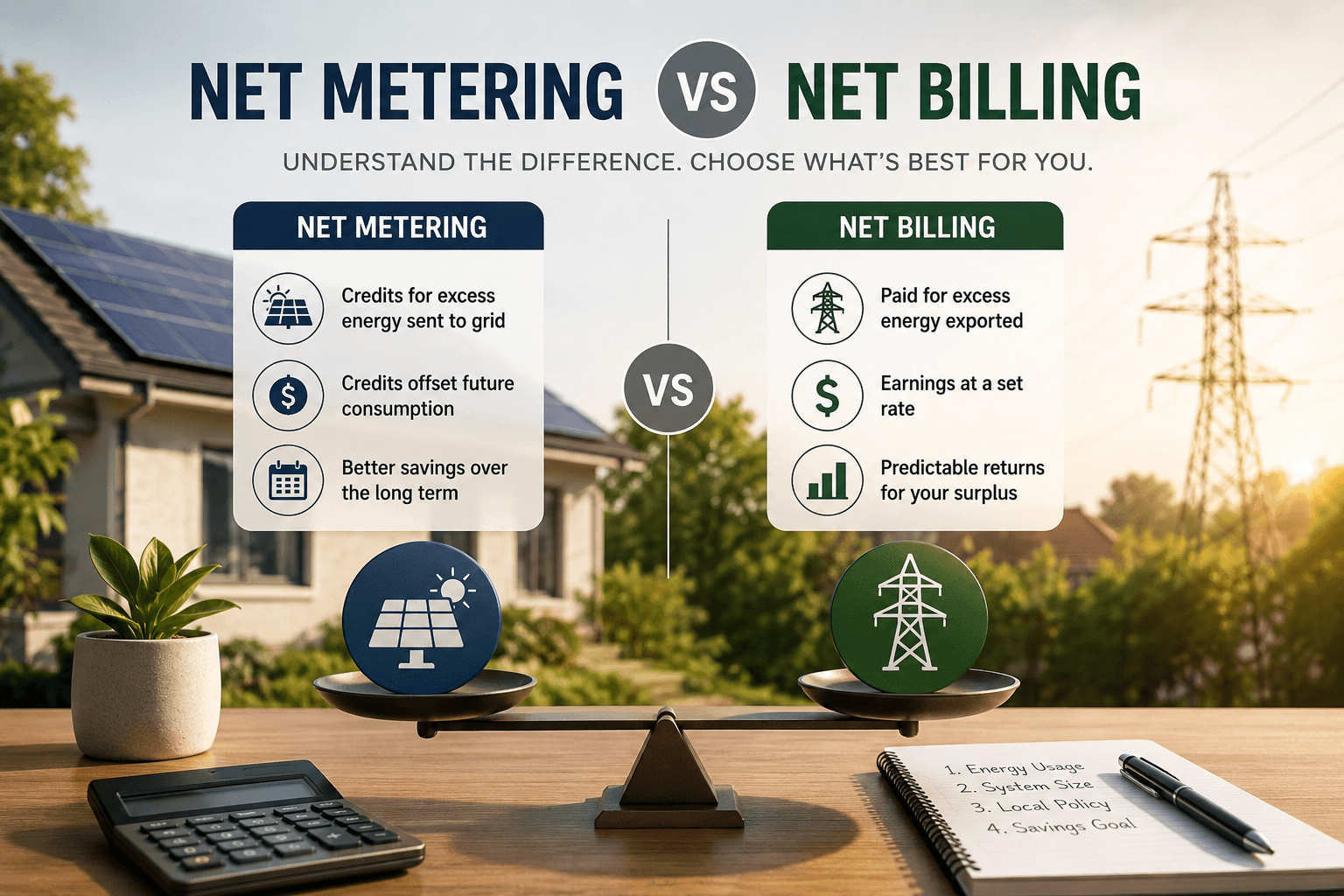
For a deeper explanation of how utility credits affect solar savings, read Net Metering Explained for Solar Homeowners.
Solar Battery Quote Comparison Table
Use this table when reviewing battery proposals from installers.
| Quote Item | What to Ask | Why It Matters |
|---|---|---|
| Usable capacity | How many usable kWh are included? | Determines real backup and storage value |
| Power output | What can the battery run at once? | Important for appliances, pumps, and HVAC |
| Backup design | Essential loads or whole home? | Major difference in cost and performance |
| Installed price | What is included in the total? | Helps avoid surprise add-ons |
| Incentives | Which rebates or credits are assumed? | Impacts net cost if eligible |
| Warranty | Years, cycles, and throughput? | Protects long-term value |
| Monitoring | Is app monitoring included? | Helps track battery performance |
| Panel work | Is a panel upgrade required? | Can add significant cost |
| Solar integration | AC-coupled or DC-coupled? | Affects compatibility and efficiency |
| Operating mode | Backup, self-consumption, or time-of-use? | Determines how savings are created |
A strong quote should explain the battery design in plain English. If a proposal only lists a brand name and total price, ask for more detail before signing.
For a broader quote checklist, see How to Compare Solar Quotes.
Do Solar Batteries Qualify for Federal Tax Credits in 2026?
This is one of the most important issues homeowners need to verify.
The IRS states that the Residential Clean Energy Credit equals 30% of qualified clean energy property costs installed from 2022 through December 31, 2025. The IRS also says the credit is not available for property placed in service after December 31, 2025. Battery storage technology was eligible beginning in 2023, but the end date matters for 2026 projects.
That means homeowners should be careful with older articles that still describe the previous longer phaseout schedule. For a 2026 battery purchase, do not assume the federal residential clean energy credit applies unless current IRS guidance and your tax professional confirm eligibility.
This article is educational and not tax, legal, or financial advice.
For more details, read Federal Solar Tax Credit 2026: What Homeowners Need to Know.
Other Solar Battery Incentives May Still Exist
Even if the federal residential credit is not available for a 2026 homeowner-owned battery, other incentives may still apply depending on your location and utility.
Possible battery incentives include:
- State battery rebates
- Utility storage incentives
- Virtual power plant programs
- Demand response payments
- Local resilience programs
- Time-of-use savings
- Solar-plus-storage financing structures
Programs can change quickly. Before relying on any incentive, check official state energy office websites, utility program pages, DSIRE, and installer documentation.
Is a Solar Battery Worth It Financially?
A solar battery can be worth it, but the reason matters.
Homeowners usually buy batteries for one or more of these reasons:
- Backup power during outages
- Bill savings from storing solar energy or avoiding peak rates
- More control over how solar energy is used at home
Only the second reason is strictly financial. Backup power has real value, but that value is partly personal.
A homeowner with frequent outages, a home office, medical equipment, a sump pump, or refrigerated medication may value backup more than someone with a stable grid and low electricity rates.
Solar Battery Payback Formula
A simple battery payback estimate looks like this:
Battery payback period = Net battery cost ÷ Estimated annual battery benefit
Annual battery benefit may include:
- Avoided peak-rate electricity purchases
- Increased self-consumption of solar power
- Reduced grid imports
- Utility battery program payments
- Backup value, if you choose to assign a dollar amount
Be conservative. In many homes, batteries do not pay for themselves quickly if the only benefit is storing solar energy. Payback may improve in areas with high time-of-use rates, weak export credits, or utility battery programs.
To test this with your own assumptions, use the solar payback calculator.
Mini Case Study: Battery Payback Example
Here is a simple example for a homeowner considering a battery in 2026.
Assumptions
- Installed battery cost: $15,000
- Federal residential tax credit: $0 assumed for 2026 homeowner-owned installation
- Local rebate: $1,500
- Net battery cost: $13,500
- Estimated annual bill savings from time-of-use shifting: $650
- Estimated annual utility battery program credit: $250
- Total estimated annual financial benefit: $900
Simple Math
| Item | Amount |
|---|---|
| Installed battery cost | $15,000 |
| Local rebate | -$1,500 |
| Estimated net cost | $13,500 |
| Annual battery benefit | $900 |
| Estimated simple payback | 15 years |
In this example, the battery has a long financial payback. But the homeowner may still choose it if backup power is important.
What could change the result?
- Higher evening electricity rates
- Larger utility battery payments
- Lower installed price
- More frequent outages
- Larger solar system with excess daytime production
- Different net billing or net metering rules
- Battery degradation over time
- Financing costs
Actual results depend on location, electricity rates, roof conditions, incentives, utility rules, financing, battery size, and system design.
Use the MySolarROI solar ROI calculator to compare solar savings, battery cost, payback period, and long-term ROI before making a decision.
Solar Battery Cost vs. Solar-Only Cost
Adding a battery usually increases the upfront cost of going solar. Whether that is a good decision depends on your goal.
| Option | Best For | Main Advantage | Main Limitation |
|---|---|---|---|
| Solar only | Lower upfront cost and bill savings | Often faster payback | Usually no backup during outages |
| Solar + battery | Backup and better self-consumption | More control over solar energy | Higher upfront cost |
| Battery only | Backup or time-of-use savings without solar | Can charge from grid where allowed | No solar production benefit |
| Generator | Long outage backup | Can run during extended outages with fuel | Fuel, noise, maintenance, emissions |
Many homeowners assume solar panels automatically work during a power outage. Most grid-tied solar systems shut down during outages unless they include proper backup equipment, such as a compatible battery, inverter, and isolation system.
That is why battery design matters just as much as battery price.
When a Solar Battery Makes More Sense
A solar battery may be easier to justify when several of these apply:
- You have frequent or costly power outages
- Your utility has high evening time-of-use rates
- Your solar export credits are low
- You want backup for essential circuits
- You use a lot of electricity after sunset
- You work from home and need reliable power
- You have a well pump, sump pump, or medical equipment
- Your utility offers battery program payments
- You plan to add an EV, heat pump, or other major electric load
In these situations, a battery may provide both financial and practical value.
When a Battery May Not Be Worth the Cost
A solar battery may be harder to justify when:
- Your utility offers strong 1-to-1 net metering
- Your electricity rate is low
- You rarely have outages
- You only care about the fastest financial payback
- The quote requires expensive panel upgrades
- The battery is oversized for your real needs
- Financing costs erase the savings
- You do not understand the warranty terms
This does not mean batteries are bad. It means the value should match your goal.
If your priority is cost control, compare battery and non-battery scenarios using the solar cost calculator.
Cash, Loan, Lease, or PPA: Financing Changes Battery Cost
Financing can change the real cost of a solar battery.
A cash purchase may have the clearest payback math. A loan may reduce upfront cost but increase the total paid over time through interest. A lease or PPA may bundle equipment, service, and monthly payments, but the ownership structure can affect incentives, savings, and long-term flexibility.
Before financing a battery, compare:
- Monthly payment
- Interest rate
- Loan term
- Dealer fees
- Total cost over time
- Ownership of incentives
- Warranty and service coverage
- Early payoff terms
- Home sale transfer terms
For a deeper comparison, read Solar Financing Comparison: Cash vs. Loans vs. Leases vs. PPAs.
Common Solar Battery Quote Mistakes
| Mistake | Why It Hurts | Better Approach |
|---|---|---|
| Comparing only total price | Ignores usable capacity and backup scope | Compare cost per usable kWh |
| Assuming whole-home backup | Many systems only back up selected circuits | Ask for a backed-up loads list |
| Ignoring power output | Battery may not run large appliances | Confirm continuous and peak output |
| Forgetting panel work | Electrical upgrades can raise cost | Ask what is included |
| Assuming incentives apply | Federal residential rules changed after 2025 | Verify current eligibility |
| Overestimating savings | Battery savings depend on rates and utility rules | Use conservative assumptions |
| Ignoring financing | Interest increases total cost | Compare cash and financed payback |
| Not checking warranty | Capacity and throughput limits matter | Review warranty terms before signing |
How to Compare Solar Battery Brands
Battery brand matters, but it should not be the only decision. A strong battery installed poorly can disappoint. A properly designed system that matches your backup needs may be more valuable than simply buying the largest battery.
Compare:
- Usable storage capacity
- Continuous power output
- Peak power output
- Warranty length
- Warranty throughput
- End-of-warranty capacity
- Operating temperature range
- App and monitoring quality
- Compatibility with your solar inverter
- Installer experience
- Service process if something fails
Also ask whether the system can be expanded later. Some homeowners start with one battery and add another after seeing how the system performs.
Questions to Ask Before Signing a Battery Contract
Ask these questions before you commit:
- What is the usable kWh capacity?
- Which circuits will be backed up?
- Can this battery run my HVAC, well pump, refrigerator, or sump pump?
- How long can it power my essential loads?
- What is the installed cost before and after incentives?
- Are permits, inspections, and panel work included?
- What happens if the battery fails under warranty?
- Is the system eligible for utility battery programs?
- Will this battery improve my solar payback period or mainly provide backup?
- How does financing affect total cost?
A good installer should answer these clearly without pressure.
Expert Tips for Homeowners
- Start with your goal: savings, backup, or both.
- Use your actual utility rate schedule.
- Compare usable kWh instead of only battery nameplate size.
- Ask for both solar-only and solar-plus-battery scenarios.
- Be cautious with savings estimates that assume perfect battery use.
- Verify incentives directly with official sources.
- Do not finance a battery without checking total interest cost.
- Make sure backed-up circuits match your outage priorities.
- Compare battery value as part of your full solar ROI, not as a separate guess.
External Source Suggestions
When verifying battery costs, incentives, and electricity rate assumptions, check:
- IRS Residential Clean Energy Credit guidance
- ENERGY STAR battery storage tax credit information
- U.S. Energy Information Administration electricity price data
- DSIRE state incentive database
- State energy office websites
- Local utility battery program pages
- Installer proposals and warranty documents
FAQ
How much does a solar battery cost in 2026?
Many home battery installations cost around the low-to-mid five figures before incentives. EnergySage reports a typical cost of $15,228 before incentives for about 13.5 kWh of battery storage, although actual quotes vary by location, equipment, and installation complexity.
Do solar batteries qualify for the federal tax credit in 2026?
The IRS says the Residential Clean Energy Credit is not available for property placed in service after December 31, 2025. Homeowners considering a 2026 battery should verify current IRS rules and speak with a qualified tax professional.
Is a solar battery worth it if I have net metering?
It depends on your net metering rules. If your utility offers full 1-to-1 net metering, a battery may not improve financial payback much. If export credits are low or evening electricity rates are high, a battery may provide more value.
How many batteries do I need for my home?
It depends on what you want to power and for how long. Essential-load backup may only need one battery. Whole-home backup, HVAC support, well pumps, or longer outage protection may require multiple batteries or load management.
Can solar panels work during an outage without a battery?
Most grid-tied solar systems shut down during outages for safety unless they include equipment designed for backup operation. A battery system with proper isolation equipment can allow selected loads to keep running.
What is the difference between battery backup and whole-home backup?
Battery backup often means selected essential circuits are powered during an outage. Whole-home backup attempts to support most or all household loads, but it usually requires more battery capacity, higher output, and additional electrical work.
Does a solar battery improve solar ROI?
Sometimes. A battery may improve ROI if it helps avoid high peak electricity rates, increases self-consumption where export credits are low, or earns utility program payments. In other cases, it mainly adds backup value rather than faster financial payback.
Should I install solar and battery together or add a battery later?
Installing both together can reduce some labor and integration costs. Adding a battery later can still make sense, but compatibility, inverter type, electrical work, and permitting should be reviewed first.
Conclusion: Compare Solar Battery Cost by Value, Not Just Price
Solar battery cost in 2026 is only one part of the decision. The better question is whether the battery’s usable capacity, backup design, warranty, incentives, utility savings, and installed price match your real goals.
For some homeowners, a battery is mainly a backup power investment. For others, it can improve solar savings in markets with time-of-use rates, weak export credits, or utility battery programs.
Before you sign a solar-plus-storage contract, run the numbers. Use the MySolarROI solar ROI calculator to estimate solar savings, payback period, ROI, and how battery cost may affect your overall return.