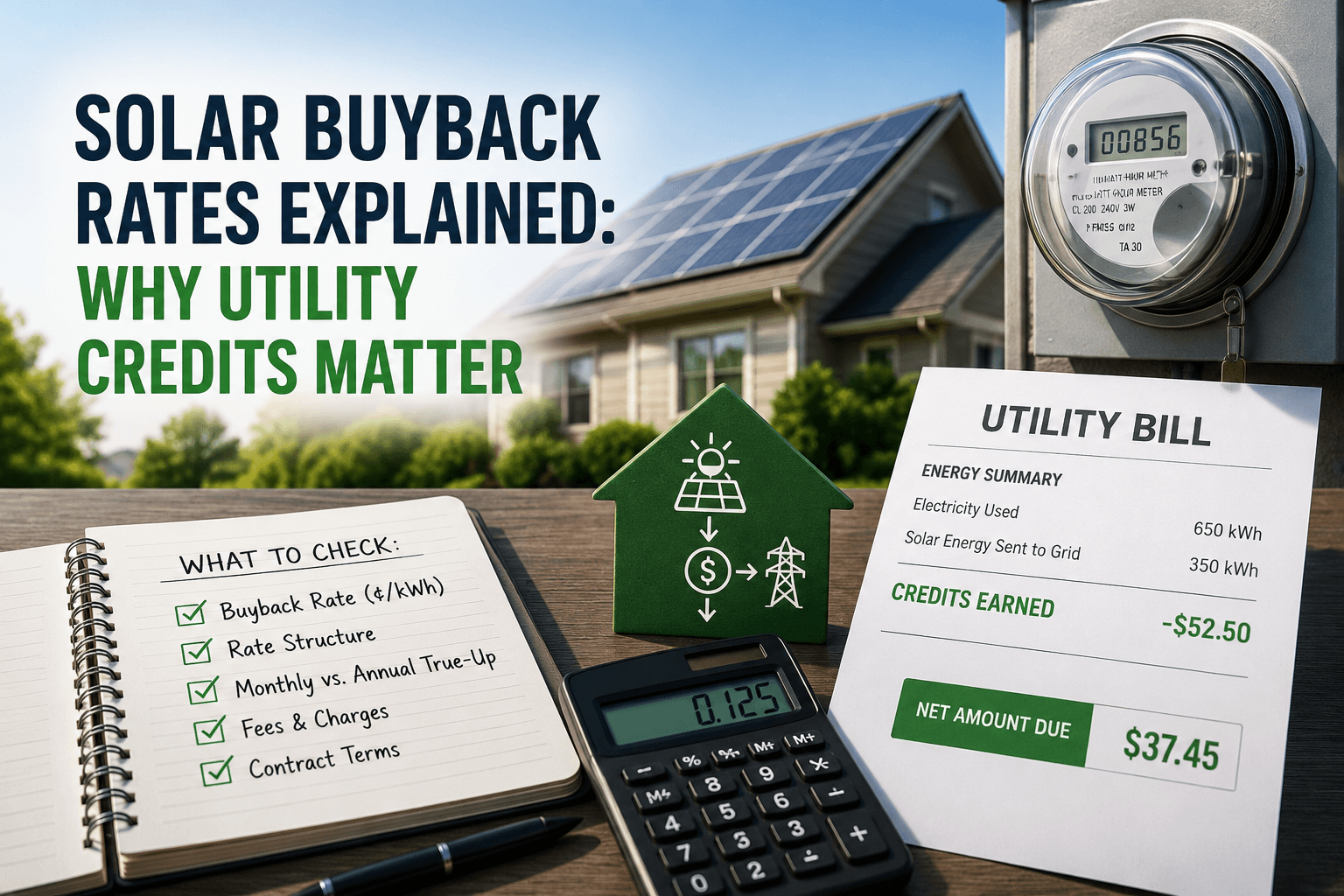
Solar Buyback Rates Explained: Why Utility Credits Matter
When homeowners compare solar quotes, they usually look at system cost, panel count, monthly bill savings, and the estimated payback period. Those numbers matter, but one detail can quietly change the entire financial picture: solar buyback rates.
Solar buyback rates determine how much your utility credits you for extra solar electricity your panels send back to the grid. In some areas, excess solar power may be credited close to the retail electricity rate. In others, exported electricity may receive a lower avoided-cost, wholesale, or time-based credit.
That difference can affect your solar savings, payback period, battery decision, and long-term ROI.
This guide explains how solar buyback rates work, how they compare with net metering and net billing, what to check on your utility bill, and how to estimate the impact before signing a solar contract. Actual results depend on your location, electricity rates, system size, roof conditions, incentives, financing, utility rules, and how much solar power your home uses during the day.
Want to run your own numbers? Use the MySolarROI solar ROI calculator to estimate how system cost, incentives, electricity rates, and utility credits may affect your solar payback.
What Are Solar Buyback Rates?
Solar buyback rates are the credit rates used to compensate homeowners for excess solar electricity sent to the grid.
Here is the simple version:
Your solar panels may produce more electricity than your home uses during sunny daytime hours. If your system is connected to the grid and your utility allows exports, that extra electricity flows to the grid. Your utility may then apply a credit to your electric bill.
The important question is:
How much is each exported kilowatt-hour worth?
That value may be based on:
- The full retail electricity rate
- A lower export credit
- The utility’s avoided cost
- A wholesale energy value
- A time-of-use export schedule
- A monthly or annual true-up formula
- A retail electric provider’s solar buyback plan
- A value-of-solar tariff
The U.S. Department of Energy notes that solar economics depend on usage, system design, electricity rates, roof conditions, and utility rules, which is why homeowners should understand local billing policies before going solar.
Why Solar Utility Credits Matter
Solar savings usually come from two main sources:
- Solar power you use directly at home
- Solar power you export to the grid
Solar electricity used inside your home is often the most valuable because it reduces the amount of power you buy from the utility. Exported solar electricity depends on your utility’s credit rules.
| Solar energy type | How it affects your bill | Why it matters |
|---|---|---|
| Solar used directly at home | Reduces grid electricity purchases | Often close to retail-rate value |
| Solar exported to the grid | Earns a bill credit or payment | Value depends on buyback rules |
| Solar stored in a battery | Can be used later when the sun is down | May help when export credits are low |
| Extra annual solar production | May roll over, be paid out, or expire | Depends on true-up rules |
This is why two homes with the same solar system can have different financial results. If one homeowner receives full retail credit and another receives a much lower export rate, their payback periods may look very different.
To see how this connects to long-term return, read How to Calculate Solar ROI: Step-by-Step Guide.
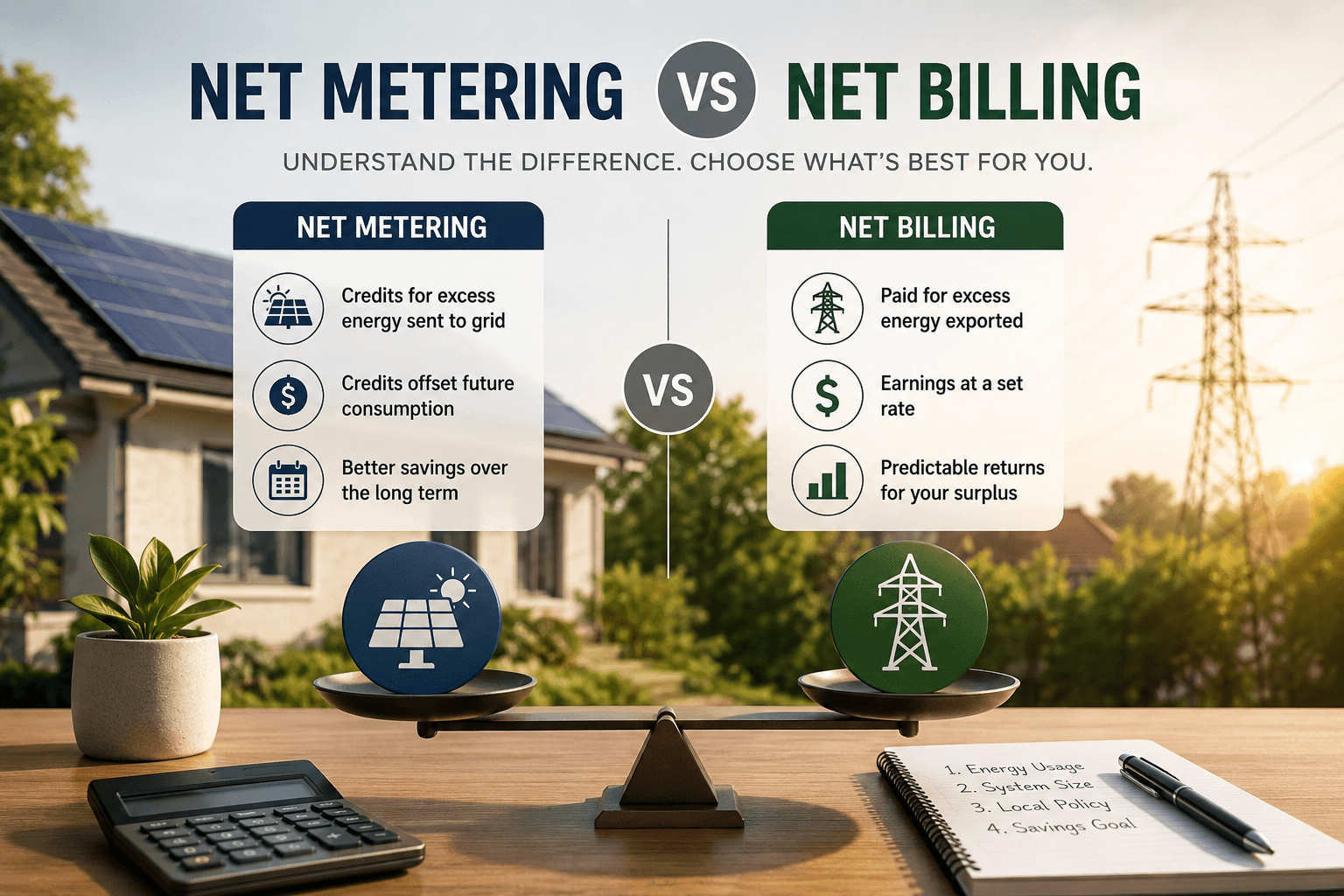
Solar Buyback Rates vs. Net Metering
Solar buyback rates are closely related to net metering, but they are not always the same thing.
Net Metering
Traditional net metering allows excess solar electricity to offset electricity pulled from the grid. In many older net metering structures, exported solar power may be credited at or near the retail electricity rate.
For example:
- You use 1 kWh from the grid at night.
- You export 1 kWh of solar during the day.
- Your bill may offset those amounts, depending on your utility rules.
Net metering rules vary by state and utility. DSIRE is a useful database for checking renewable energy incentives and policies across the United States.
For a deeper explanation, read Net Metering Explained for Solar Homeowners.
Net Billing
Net billing separates the value of electricity you buy from the grid and electricity you export to the grid.
For example:
- You may pay 18 cents per kWh for electricity from the grid.
- You may receive 6 cents per kWh for exported solar power.
That difference means solar power used directly at home is worth more than solar power exported to the grid.
Solar Buyback Plans
In some deregulated electricity markets, a “solar buyback plan” may refer to a specific retail electricity plan that credits exported solar energy.
These plans can vary widely. Some may offer higher export credits but also include higher import rates, monthly fees, caps, or contract terms. The buyback rate alone does not tell the full story.
Common Types of Solar Buyback Credits
| Credit structure | How it usually works | Homeowner takeaway |
|---|---|---|
| Full retail net metering | Exports offset imports near the retail electricity rate | Often improves payback, but rules vary |
| Net billing | Imports and exports are valued separately | Self-consumption becomes more important |
| Avoided-cost credit | Exports are credited near the utility’s avoided cost | May reduce savings from oversized systems |
| Time-of-use export rate | Credit changes by hour or season | Battery storage and usage timing may matter |
| Monthly rollover | Unused credits carry to future bills | Helpful for seasonal solar production |
| Annual true-up | Remaining credits are settled periodically | Check payout rate and expiration rules |
| Low or no export credit | Extra solar has limited bill value | System sizing becomes very important |
The key lesson is simple: do not assume every kilowatt-hour your solar system produces has the same value.
How Solar Buyback Rates Affect Payback Period
Your solar payback period is the time it takes for estimated savings to recover your net system cost.
A simple formula is:
Solar payback period = Net solar cost ÷ Estimated annual savings
Solar buyback rates affect the annual savings part of that formula.
Example: Same Solar System, Different Buyback Rates
Assume a homeowner installs a solar system that produces 10,000 kWh per year.
Assumptions:
- Net solar cost after eligible incentives: $18,000
- Retail electricity rate: $0.18 per kWh
- Solar used directly at home: 70%
- Solar exported to the grid: 30%
- No battery included
- Simplified example only
| Scenario | Self-used solar value | Exported solar value | Estimated annual savings | Simple payback |
|---|---|---|---|---|
| Full retail credit | 7,000 kWh × $0.18 = $1,260 | 3,000 kWh × $0.18 = $540 | $1,800 | 10.0 years |
| Lower export credit | 7,000 kWh × $0.18 = $1,260 | 3,000 kWh × $0.06 = $180 | $1,440 | 12.5 years |
| Minimal export value | 7,000 kWh × $0.18 = $1,260 | 3,000 kWh × $0.02 = $60 | $1,320 | 13.6 years |
The system size did not change. The solar production did not change. The roof did not change.
Only the export credit changed.
That one difference changed the simple payback period from about 10 years to more than 13 years.
Before comparing installer quotes, use the Solar Payback Calculator to test how lower or higher utility credits may affect your break-even timeline.
Why Electricity Rates Still Matter
Solar buyback rates matter, but they are only one part of the equation. Your retail electricity rate also plays a major role.
The U.S. Energy Information Administration publishes average electricity prices by state and customer type. Its Electric Power Monthly shows that residential electricity prices vary significantly across the country, which means solar savings potential can look very different from one state to another.
In general:
- Higher electricity rates can make self-used solar more valuable.
- Lower export credits can make oversized systems less attractive.
- Time-of-use rates can make batteries or load shifting more important.
- Fixed utility charges can reduce the chance of eliminating the full bill.
This is why a generic “average solar savings” number is not enough. A homeowner in California, Texas, New York, Florida, or New Jersey may face very different electric rates, incentive rules, and export credit structures.
To estimate your own bill impact, use the Solar Savings Calculator.
How to Find Your Solar Buyback Rate
Before signing a solar contract, check the rules for your exact utility, rate plan, and address.
1. Start With Your Electric Bill
Your electric bill should show:
- Utility company name
- Rate plan
- Monthly usage
- Energy charges
- Delivery charges
- Fixed customer charge
- Time-of-use periods, if applicable
- Retail electricity price
In deregulated electricity markets, your retail electric provider and your delivery utility may be different companies.
2. Search for Your Solar Tariff
Look for utility terms such as:
- Net metering tariff
- Net billing tariff
- Distributed generation rider
- Renewable energy rider
- Interconnection agreement
- Solar buyback plan
- Excess generation credit
- Net surplus compensation
3. Confirm the Export Credit
Ask whether exported solar power is credited at:
- Retail rate
- Supply-only rate
- Avoided-cost rate
- Wholesale market rate
- Time-based rate
- Fixed cents-per-kWh rate
- Plan-specific buyback rate
4. Check Rollover and True-Up Rules
This part is easy to miss.
Ask:
- Do solar credits roll over month to month?
- Are credits reset annually?
- Are leftover credits paid out?
- If paid out, at what rate?
- Can credits offset fixed charges?
- Is there a minimum monthly bill?
- Are there system size limits?
- Do battery exports qualify?
- Can the utility change the rate plan later?
5. Get the Rules in Writing
A solar quote may include an estimate, but the utility tariff controls how credits are actually applied. Save a copy of the utility policy, buyback plan, or interconnection document before you sign.
For quote review help, use the Solar Quote Comparison Calculator and read How to Compare Solar Quotes.
Mini Case Study: Why Buyback Rates Changed the Decision
Here is a simplified homeowner example.
Assumptions:
- Annual household electricity use: 12,000 kWh
- Estimated solar production: 11,000 kWh per year
- Net solar cost: $21,000
- Retail electricity rate: $0.20 per kWh
- Solar used directly at home: 65%
- Solar exported to the grid: 35%
- No battery included
- Actual results depend on location, rates, roof conditions, incentives, utility rules, financing, and system design.
Scenario A: Strong Export Credit
- Self-used solar: 7,150 kWh × $0.20 = $1,430
- Exported solar: 3,850 kWh × $0.20 = $770
- Estimated annual savings: $2,200
- Simple payback: $21,000 ÷ $2,200 = 9.5 years
Scenario B: Lower Export Credit
- Self-used solar: 7,150 kWh × $0.20 = $1,430
- Exported solar: 3,850 kWh × $0.07 = $269.50
- Estimated annual savings: $1,699.50
- Simple payback: $21,000 ÷ $1,699.50 = 12.4 years
What Changed?
The system cost, production estimate, and electricity usage stayed the same. The only change was the export credit.
In the lower-credit scenario, the homeowner may want to:
- Reduce system size slightly
- Shift more electricity use to daytime hours
- Compare a battery option
- Ask for a more conservative savings estimate
- Review multiple quote designs
- Test payback under several utility credit assumptions
This is why solar buyback rates should be reviewed before choosing a system size. You can also compare system size and estimated output with the Solar Panels Calculator.
Should You Oversize Solar If Buyback Rates Are Low?
Low solar buyback rates can make oversizing less attractive.
If your system produces far more power than your home uses, more electricity may be exported to the grid. If the utility pays a low export credit, those extra panels may add cost without adding enough savings.
Oversizing may still make sense if:
- You plan to buy an electric vehicle.
- You expect your electricity use to increase.
- You are replacing gas appliances with electric ones.
- Your utility has favorable rollover rules.
- You are adding battery storage.
- Your roof layout works better with a slightly larger system.
- The extra panels have a low incremental cost.
Oversizing may be risky if:
- Export credits are low.
- Credits expire quickly.
- Fixed charges cannot be offset.
- The utility caps eligible system size.
- The installer assumes full retail credit when your utility does not offer it.
For more sizing help, read How Much Solar Power Do I Need? and Solar Panel Output Calculator Guide.
Do Batteries Help When Buyback Rates Are Low?
Batteries can help in some homes, but they are not automatically worth it.
A battery may improve solar value when:
- Export credits are much lower than retail electricity rates.
- Evening electricity prices are high.
- Your utility uses time-of-use rates.
- Backup power is important to you.
- Your home exports a large share of solar production.
- Incentives reduce the battery cost.
A battery may not make financial sense if:
- Net metering is very favorable.
- Your home already uses most solar power during the day.
- Battery cost is high.
- Outages are rare and backup power is not a priority.
- Financing costs reduce the return.
The IRS states that qualified battery storage technology may qualify for the Residential Clean Energy Credit when it meets eligibility requirements, including battery capacity rules. Homeowners should confirm eligibility with a qualified tax professional.
For more detail, read Solar Battery ROI: Is Battery Storage Worth It? and How Much Solar Battery Backup Do You Need?.
Questions to Ask Before Choosing a Solar Buyback Plan
Use this checklist before signing a solar contract.
| Question | Why it matters |
|---|---|
| What is the export credit per kWh? | Determines the value of excess solar power |
| Is the credit retail, avoided-cost, or time-based? | Helps you understand real savings |
| Do credits roll over monthly? | Important for seasonal production |
| What happens at annual true-up? | Prevents surprise credit loss |
| Can credits offset fixed charges? | Some bill charges may remain |
| Is there a minimum monthly bill? | May limit bill reduction |
| Is there a system size cap? | Oversized systems may not qualify |
| Are there extra meter or interconnection fees? | Fees can reduce savings |
| Do battery exports qualify? | Rules vary by utility |
| Can the plan terms change? | Long-term savings may depend on policy stability |
Common Mistakes Homeowners Make
Mistake 1: Assuming All Solar Power Has the Same Value
Solar used directly at home and solar exported to the grid may not be worth the same amount.
Mistake 2: Ignoring Fixed Utility Charges
Even with solar, you may still pay customer charges, delivery charges, grid access fees, or minimum bills.
Mistake 3: Comparing Buyback Rates Without Import Rates
A plan with a high buyback rate may also have a higher electricity purchase rate or monthly fee. Compare the full plan, not just the export credit.
Mistake 4: Oversizing Without Checking Export Rules
A larger system may produce more electricity, but if much of that electricity earns a low export credit, ROI may not improve.
Mistake 5: Trusting One Savings Estimate
Ask installers to show savings under several scenarios:
- Strong export credit
- Moderate export credit
- Low export credit
- Time-of-use rates
- With and without battery storage
- Cash vs. loan financing
For financing comparisons, read Solar Financing Comparison: Cash vs. Loans vs. Leases vs. PPAs.
Expert Tips for Better Solar ROI
- Use your real electric bill, not a generic state average.
- Confirm your utility’s export credit before choosing system size.
- Ask whether the quote assumes retail net metering.
- Review monthly rollover and annual true-up rules.
- Be careful with systems that produce far more than your annual usage.
- Compare solar-only and solar-plus-battery options separately.
- Check incentives through DSIRE and your utility before signing.
- Run your numbers with the Solar Cost Calculator.
External Source Suggestions
Use these sources to verify current rules and assumptions:
- U.S. Department of Energy: homeowner solar guidance
- DSIRE: state incentives, net metering, and renewable energy policies
- U.S. Energy Information Administration: electricity price data
- IRS: Residential Clean Energy Credit guidance
- NREL PVWatts: solar production estimates
NREL’s PVWatts Calculator estimates energy production for grid-connected photovoltaic systems and can help homeowners compare production assumptions by location and system design.
FAQ: Solar Buyback Rates
What are solar buyback rates?
Solar buyback rates are the credit rates used to compensate homeowners for excess solar electricity sent to the grid. The credit may be based on retail rates, avoided cost, wholesale value, time-of-use pricing, or a specific utility plan.
Are solar buyback rates the same as net metering?
Not exactly. Net metering is a billing structure. Solar buyback rates are the actual value assigned to exported electricity. Some net metering programs credit exports near the retail rate, while net billing programs may use a lower export rate.
Do all utilities pay for excess solar power?
No. Some utilities provide bill credits, some pay a lower net surplus rate, some roll credits forward, and some offer limited compensation after certain caps or true-up periods. Always check your utility tariff.
How do solar buyback rates affect solar ROI?
Higher export credits can increase annual savings and shorten the payback period. Lower export credits can reduce savings, especially if your system exports a large share of production.
Should I get a battery if my buyback rate is low?
A battery may help if export credits are low and electricity from the grid is expensive during evening hours. However, the battery cost, incentives, outage needs, and usage patterns should be modeled separately.
Can solar credits eliminate my entire electric bill?
Sometimes, but not always. Many utility bills include fixed charges, minimum charges, delivery fees, or non-bypassable charges that solar credits may not fully offset.
Where can I find my solar buyback rate?
Start with your utility bill, utility website, solar tariff, interconnection documents, or retail electricity provider plan. You can also check DSIRE for state-level solar policies.
Is a higher solar buyback rate always better?
Not always. A plan with a higher buyback rate may also have higher import rates, monthly fees, or contract restrictions. Compare the full electric plan, not only the export credit.
Conclusion
Solar buyback rates matter because they determine how much value you receive for excess solar power sent to the grid. A solar system that looks attractive under full retail net metering may have a longer payback period under lower export credits or net billing.
The smartest approach is to check your utility rules, understand how credits roll over, size your system around realistic usage, and compare more than one savings scenario.
Before you sign a solar contract, use the MySolarROI solar ROI calculator to estimate how solar buyback rates, system cost, electricity prices, incentives, and financing may affect your payback period and long-term return.