How much electricity will solar panels actually produce on your roof?
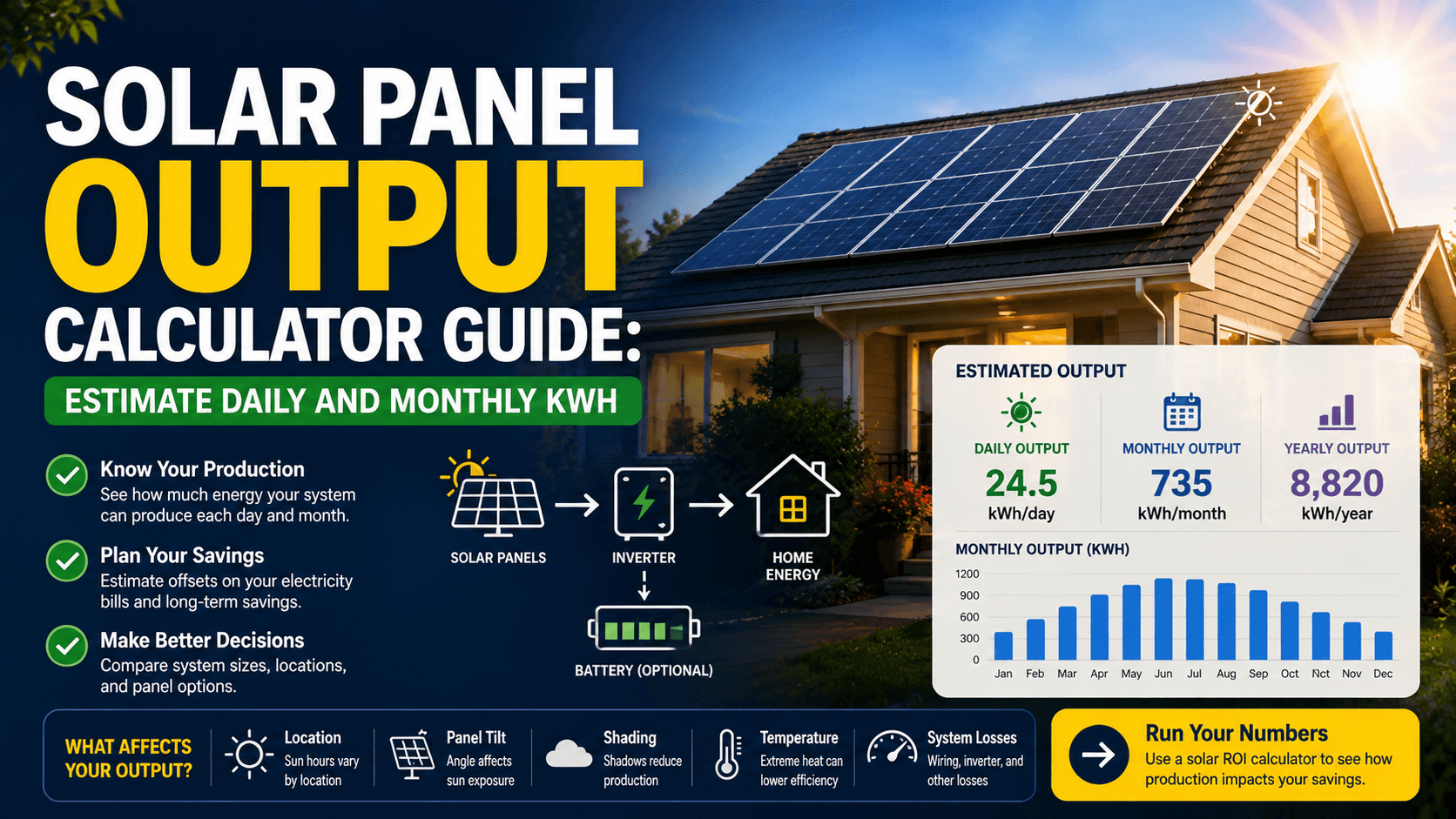
That is one of the first questions homeowners ask before comparing solar quotes. A Solar Panel Output Calculator helps estimate daily and monthly solar production in kilowatt-hours, or kWh, based on your system size, local sunlight, roof direction, shading, and equipment performance.
The goal is not to guess. Solar panel output changes by location, season, weather, roof angle, shade, and system design. A 7 kW solar system in Arizona will not produce the same monthly kWh as a 7 kW system in New York, even if both use similar panels.
In this guide, you will learn how solar panel output is calculated, how to estimate daily and monthly kWh, what affects production, and how to connect your output estimate to savings, payback period, and ROI.
Use the kWh sizing and panel-count calculator for an initial energy estimate, or select its production mode when you already know DC capacity. For roof-specific weather, tilt and azimuth modeling, follow the PVWatts guide. Neither production nor system size is automatically a dollar saving; apply your tariff in the savings calculator before evaluating cash ROI.
What Is Solar Panel Output?
Solar panel output is the amount of electricity a solar panel or solar energy system produces over time.
For homeowners, output is usually measured in kilowatt-hours, or kWh, because your utility bill also uses kWh.
Here is the difference between the most common terms:
| Term | What It Means | Homeowner Example |
|---|---|---|
| Watt | Instant power at one moment | A 400-watt solar panel rating |
| Kilowatt | 1,000 watts | A 7 kW rooftop solar system |
| Kilowatt-hour | Electricity produced or used over time | 850 kWh used in one month |
A panel’s watt rating does not mean it produces that wattage all day. A 400-watt panel may reach close to its rating under strong sun and ideal test conditions, but real-world output rises and falls throughout the day.
That is why homeowners should estimate solar production in kWh, not just compare panel wattage.
Solar Panel Output Calculator Formula
A simple solar panel output formula is:
Daily solar output = System size × Peak sun hours × Performance ratio
Where:
- System size is your total solar panel capacity in kilowatts.
- Peak sun hours estimate the useful sunlight available in your location.
- Performance ratio adjusts for real-world losses such as heat, inverter conversion, wiring, dirt, shade, and system design.
Example:
- Solar system size: 6 kW
- Peak sun hours: 4.5
- Performance ratio: 0.80
6 × 4.5 × 0.80 = 21.6 kWh per day
Estimated monthly output:
21.6 × 30 = 648 kWh per month
This is a planning estimate, not a guaranteed result. Actual solar panel output can be higher or lower depending on roof conditions, weather, season, shade, equipment, and utility rules.
For a more detailed production estimate, the PVWatts Calculator Guide explains how homeowners can use NREL’s PVWatts tool to estimate solar production by location and system design.
Daily and Monthly Solar Panel Output Examples
The table below shows estimated output using:
- 4.5 peak sun hours per day
- 80% performance ratio
- 30-day month
- 365-day year
| Solar System Size | Estimated Daily Output | Estimated Monthly Output | Estimated Annual Output |
|---|---|---|---|
| 4 kW | 14.4 kWh | 432 kWh | 5,256 kWh |
| 5 kW | 18.0 kWh | 540 kWh | 6,570 kWh |
| 6 kW | 21.6 kWh | 648 kWh | 7,884 kWh |
| 7 kW | 25.2 kWh | 756 kWh | 9,198 kWh |
| 8 kW | 28.8 kWh | 864 kWh | 10,512 kWh |
| 10 kW | 36.0 kWh | 1,080 kWh | 13,140 kWh |
These numbers are useful for early planning, but they should not replace a location-based estimate. Your roof direction, shade, utility rules, panel layout, and local weather can all change the result.
If you already know your monthly electric usage, compare it with your estimated production using the Solar Panel Calculator Guide.
How to Estimate Solar Panel Output Step by Step
Step 1: Find Your Monthly Electricity Usage
Start with your electric bill. Look for your monthly kWh usage.
For the best estimate, collect 12 months of usage instead of relying on one bill. Many homes use much more electricity during summer or winter because of air conditioning, heating, pool pumps, dehumidifiers, or electric vehicle charging.
Helpful numbers to gather:
- Last 12 months of kWh usage
- Highest-use month
- Lowest-use month
- Average monthly usage
- Current electricity rate
- Planned future usage, such as an EV, heat pump, or home addition
The U.S. Department of Energy recommends reviewing your home’s electricity use and considering efficiency improvements before choosing a solar system. NREL’s PVWatts Calculator also estimates the energy production of grid-connected PV systems for specific locations.
If your electricity use has recently changed, use your expected future usage instead of only looking backward.
Step 2: Choose a Solar System Size
Solar system size is usually measured in kilowatts.
The formula is:
System size = Number of panels × Panel wattage ÷ 1,000
Example:
18 panels × 420 watts ÷ 1,000 = 7.56 kW system
A 7.56 kW system does not produce 7.56 kWh every hour. The system size tells you the installed power capacity. Actual kWh production depends on sunlight, roof conditions, and system performance.
For a deeper sizing explanation, read How Much Solar Power Do I Need? System Size Explained.
Step 3: Estimate Peak Sun Hours
Peak sun hours are not the same as daylight hours.
A home may have 12 hours of daylight, but only part of that daylight has strong enough sun to produce high solar output. Peak sun hours estimate the amount of usable solar energy available in your area.
Peak sun hours depend on:
- State and region
- Season
- Roof direction
- Roof tilt
- Shade
- Weather patterns
- Local solar resource
A sunny region usually produces more kWh from the same system size than a cloudy region. That is why solar output should be estimated by address or ZIP code when possible.
NREL’s PVWatts Calculator estimates solar production using location and system details, and its output range is based on analysis of long-term historical weather data.
Step 4: Apply a Performance Ratio
Solar panels rarely operate at perfect lab-rated output all day. A performance ratio adjusts your estimate for real-world losses.
Common causes of output loss include:
- Heat
- Inverter conversion losses
- Wiring losses
- Dust or pollen
- Snow cover
- Shade
- Panel mismatch
- Roof orientation
- System age
A simple estimate often uses a performance ratio around 75% to 85%, but the right assumption depends on your roof and equipment.
If your quote shows unusually high production for your roof, ask the installer what performance ratio, shade assumptions, and degradation assumptions they used.
Step 5: Convert Daily Output to Monthly and Annual Output
Once you estimate daily output, you can convert it into monthly and annual production.
Formula:
Monthly solar output = Daily output × 30
Annual solar output = Daily output × 365
Example:
- Estimated daily output: 25 kWh
- Monthly estimate: 25 × 30 = 750 kWh
- Annual estimate: 25 × 365 = 9,125 kWh
This is a simplified average. A more accurate estimate should show production by month because solar output changes throughout the year.
What Affects Solar Panel Output?
Solar panel output is not only about panel wattage. Two similar homes in the same city can produce different amounts of solar electricity because roof conditions and system design matter.
| Factor | How It Affects Output |
|---|---|
| Location | Sunnier regions usually produce more kWh per installed kW |
| Roof direction | South-facing roofs often produce strong annual output in the U.S. |
| Roof tilt | Tilt changes seasonal production patterns |
| Shade | Trees, chimneys, and nearby buildings can reduce output |
| Weather | Clouds, smoke, snow, and storms reduce production |
| Temperature | High heat can reduce panel efficiency |
| Panel wattage | Higher-watt panels can increase system capacity in limited space |
| Inverter design | Inverter sizing and type affect output and shade performance |
| System age | Panel production can gradually decline over time |
| Maintenance | Dirt, debris, or snow can temporarily reduce output |
If your roof has shade or multiple roof planes, your installer should model production more carefully than a basic calculator can.
For help understanding equipment performance, read Solar Panel Efficiency: What Really Matters.
Solar Panel Output by Season
Solar panels usually produce more electricity in sunnier months and less during darker or snowier months.
A typical seasonal pattern may look like this:
| Season | Typical Output Pattern | Why It Happens |
|---|---|---|
| Spring | Strong production | Cooler temperatures and improving sunlight |
| Summer | High production | Long days and strong sun, though heat can reduce efficiency |
| Fall | Moderate production | Shorter days and changing weather |
| Winter | Lower production | Short days, lower sun angle, snow, and clouds in many areas |
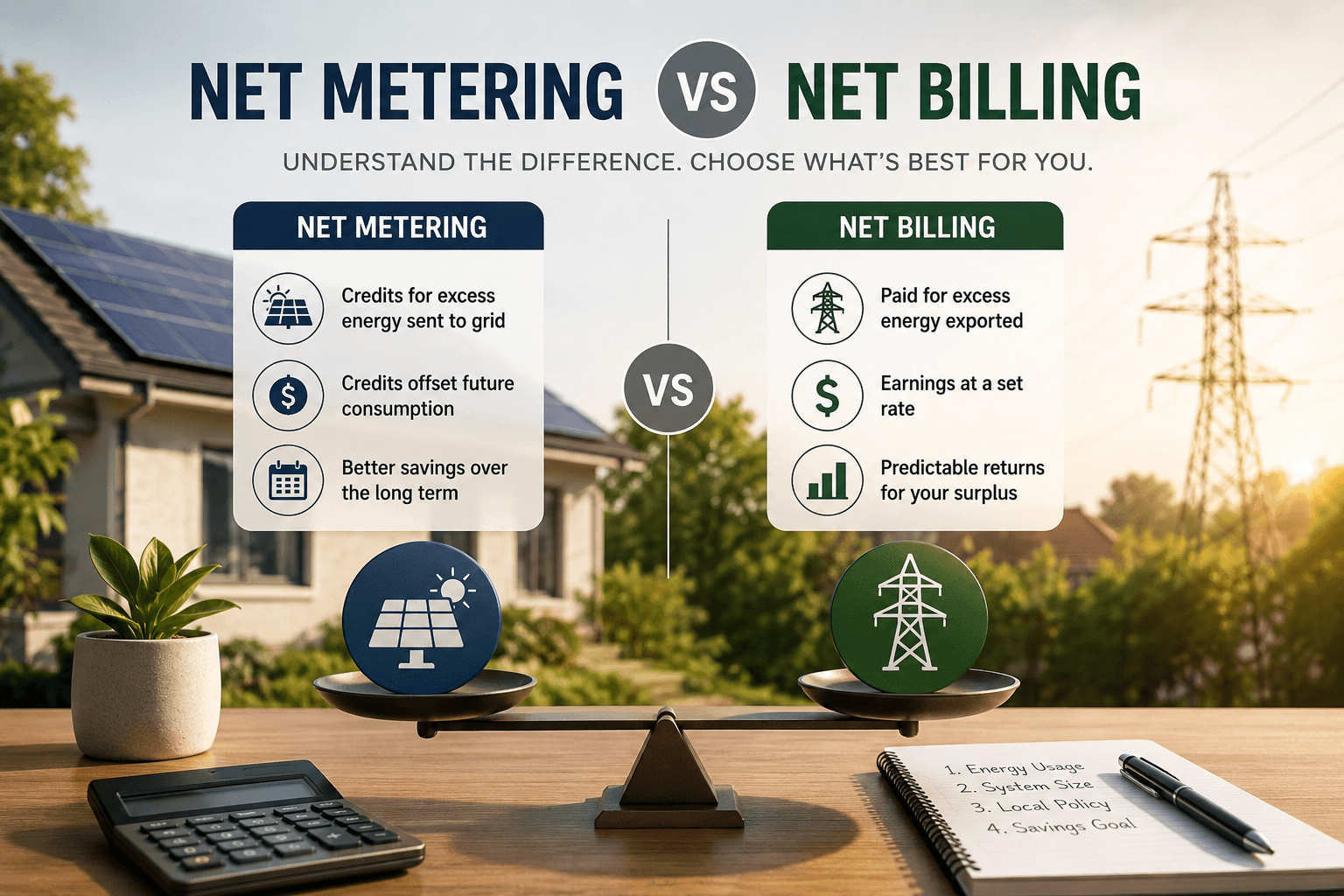
Monthly production matters because your electric bill also changes by season. If your system overproduces in spring but underproduces in winter, net metering or solar export credits may affect the financial value of that electricity.
For more detail, read Net Metering Explained for Solar Homeowners.
Mini Case Study: Estimating Monthly Solar Output
Let’s walk through a simple homeowner example.
Homeowner Assumptions
- Monthly electricity use: 850 kWh
- Proposed solar system size: 7 kW
- Peak sun hours estimate: 4.5
- Performance ratio: 80%
- Major shading: Not assumed
- Electricity rate: Depends on utility
- Financing: Not included in this output-only estimate
Output Estimate
Formula:
7 kW × 4.5 peak sun hours × 0.80 = 25.2 kWh per day
Monthly estimate:
25.2 × 30 = 756 kWh per month
Annual estimate:
25.2 × 365 = 9,198 kWh per year
What This Means
If the home uses about 850 kWh per month and the system produces about 756 kWh per month on average, solar may offset a large portion of annual usage, but not necessarily 100%.
The homeowner should still review:
- Seasonal solar output
- Roof direction
- Shading
- Local net metering rules
- Utility rate plan
- Available incentives
- Installed system cost
- Financing terms
- Installer production assumptions
This output estimate is useful, but it is not the same as a financial savings estimate.
To understand payback, compare production, electricity rates, incentives, and project cost with the Solar Payback Calculator Guide.
Solar Panel Output vs. Solar Savings
Solar output tells you how many kilowatt-hours your system may generate. Solar savings show how much that electricity could reduce your utility bill after factoring in your electricity rate, net metering rules, incentives, and how much solar power you use at home.
They are related, but they are not the same.
| Question | Solar Output Estimate | Solar Savings Estimate |
|---|---|---|
| What does it measure? | kWh produced | Dollars saved |
| Main input | System size and sunlight | Output, rate plan, and utility rules |
| Affected by shade? | Yes | Yes |
| Affected by electricity rates? | No | Yes |
| Affected by net metering? | Indirectly | Strongly |
| Affected by incentives? | No | Yes |
| Affected by system cost? | No | Yes |
A solar system can produce a lot of electricity, but savings depend on how your utility credits that electricity.
For example:
- Solar used directly in your home may offset electricity at your retail rate.
- Extra solar exported to the grid may receive full retail credit, partial credit, avoided-cost credit, or another utility-specific value.
- Under time-of-use rates, the value of solar depends on when electricity is produced and when you use power.
After estimating output, use the Solar Savings Calculator Guide to estimate bill savings more carefully.
How Much Solar Output Do You Need to Cover Your Electric Bill?
To estimate the solar output needed to cover your electric bill, start with annual usage.
Formula:
Required annual solar output = Annual household kWh usage × Target offset percentage
Example:
- Annual home usage: 10,200 kWh
- Target offset: 90%
10,200 × 0.90 = 9,180 kWh per year
Then estimate the system size needed:
System size = Required annual output ÷ Annual production per kW
If your area produces about 1,300 kWh per year per installed kW:
9,180 ÷ 1,300 = 7.06 kW
So the homeowner might start by evaluating a system around 7 kW.
This is only a starting point. Actual annual production per kW depends on location, roof angle, shade, equipment, and system design.
If you are comparing quotes by cost and production, read Solar Panel Cost 2026: Homeowner Pricing Guide and Solar Panel Cost by State: What Homeowners Should Compare.
How Solar Panel Output Affects ROI
Solar panel output is one of the biggest drivers of solar ROI.
Higher output can improve ROI when the electricity is valuable to you. Lower output can extend the payback period if your system costs the same but produces fewer kWh.
Your solar ROI depends on:
- Total installed cost
- Annual kWh production
- Electricity rate
- Utility export credit rules
- Incentives and tax credits
- Financing costs
- System degradation
- Maintenance costs
- How much solar power you use directly
This is why solar output should be reviewed before signing a contract. A lower-cost system is not always better if it produces much less electricity. A higher-cost system is not always better if the extra production does not create enough extra value.
For the full financial method, read How to Calculate Solar ROI: Step-by-Step Guide.
Common Mistakes When Estimating Solar Panel Output
Mistake 1: Using Panel Wattage as Daily Production
A 400-watt panel does not produce 400 watts all day. Output changes as the sun moves, clouds pass, and temperatures rise.
A panel rating is useful, but it is only one input in a solar output estimate.
Mistake 2: Ignoring Seasonal Changes
Monthly solar output can vary a lot. A system may produce strongly in May and much less in December, depending on location and weather.
Ask installers for monthly production estimates, not just annual output.
Mistake 3: Assuming Every Roof Performs the Same
Roof direction, tilt, and shade can create major differences between similar homes.
A south-facing, lightly shaded roof may produce more than an east-west roof with afternoon shade.
Mistake 4: Confusing Output With Savings
Solar output is measured in kWh. Solar savings are measured in dollars.
To estimate savings, you need:
- Solar production
- Electricity rate
- Net metering or export credit rules
- System cost
- Incentives
- Financing details
Mistake 5: Forgetting Future Electricity Use
Your electricity use may increase if you add:
- Electric vehicle charging
- Heat pump heating and cooling
- Electric water heating
- Pool equipment
- Home office equipment
- Battery storage
- Home addition or accessory dwelling unit
Plan for realistic future usage, not only last year’s bill.
Mistake 6: Accepting Installer Estimates Without Questions
Installer software can be useful, but every projection depends on assumptions.
Ask:
- What shade assumptions were used?
- Is output shown monthly or only annually?
- Does the estimate include panel degradation?
- Does it account for roof tilt and direction?
- Does it assume full net metering credit?
- What utility rate was used for savings?
For a quote review checklist, read Solar Quote Comparison Checklist: What to Review Before Signing.
How to Compare Solar Quotes Using Output Estimates
When you receive solar quotes, compare projected production carefully.
| Quote Item | What to Check |
|---|---|
| System size | Is the total kW size clearly listed? |
| Panel count | How many panels are included? |
| Panel wattage | What is each panel’s rating? |
| Annual production | How many kWh are projected per year? |
| Monthly production | Does the quote show seasonal production? |
| Shading assumptions | Did the installer account for trees and obstructions? |
| Degradation | Does the proposal account for panel aging? |
| Net metering | How are exported kWh credited? |
| Savings estimate | What electricity rate assumptions are used? |
| Warranty | What production warranty applies? |
| Cost per watt | How does price compare with system size? |
If two quotes show very different annual output for a similar system size on the same roof, ask why. The difference may come from assumptions rather than better equipment.
Before choosing an installer, review How to Compare Solar Quotes: A Homeowner Checklist.
Solar Panel Output and Battery Storage
If you plan to add a solar battery, output estimates become even more important.
A battery does not create electricity. It stores solar power so you can use it later, such as in the evening, during peak-rate periods, or during outages.
Battery value depends on:
- How much extra solar your system produces
- When your home uses electricity
- Net metering or export credit rules
- Time-of-use rates
- Battery capacity
- Backup needs
- Battery cost and incentives
The U.S. Department of Energy explains that battery storage can help homeowners save solar energy for later use, including when the power goes out.
To evaluate storage separately, read Solar Battery ROI: Is Battery Storage Worth It?.
Expert Tips for More Accurate Solar Output Estimates
Use these tips before comparing quotes:
- Use 12 months of utility bills.
- Estimate production by address or ZIP code.
- Ask for monthly production, not only annual output.
- Check shade assumptions carefully.
- Compare solar-only output before adding batteries.
- Look at both kWh production and dollar savings.
- Confirm whether estimates include panel degradation.
- Review net metering rules before assuming full bill offset.
- Compare system size, output, and total cost together.
- Use a Solar Panel Output Calculator before signing a contract.
For a broader calculator comparison, read Solar Calculator Comparison: How to Choose the Right Tool.
Sources and verification
For fact-checking and additional homeowner research, review:
- NREL PVWatts Calculator
- U.S. Department of Energy: Planning a Home Solar Electric System
- U.S. Energy Information Administration electricity data
- DSIRE incentive database
- Your local utility’s net metering page
- Your state energy office
FAQ
How do I calculate solar panel output?
Use this simple formula: system size in kW × peak sun hours × performance ratio = estimated daily kWh. For monthly output, multiply daily kWh by about 30. For annual output, multiply daily kWh by 365.
How many kWh does a solar panel produce per day?
A single panel’s daily kWh depends on panel wattage, sunlight, temperature, roof angle, and shade. For example, a 400-watt panel receiving 4.5 peak sun hours with an 80% performance ratio may produce about 1.44 kWh per day.
How much does a 7 kW solar system produce per month?
Using 4.5 peak sun hours and an 80% performance ratio, a 7 kW system may produce about 756 kWh per month on average. Actual monthly output can vary by location, roof conditions, season, and weather.
How many solar panels do I need for 1,000 kWh per month?
It depends on your location, roof conditions, panel wattage, and performance ratio. If each installed kW produces about 120 kWh per month, you may need about 8.3 kW of solar capacity. The number of panels depends on each panel’s wattage.
Why is my solar panel output lower than expected?
Common causes include clouds, shade, snow, dirt, high temperatures, inverter clipping, equipment issues, seasonal changes, or unrealistic proposal assumptions. Compare actual production with monthly estimates, not just annual averages.
Is solar output the same as solar savings?
No. Solar output is the electricity your system produces in kWh. Solar savings depend on how that electricity offsets your bill, your utility rate, net metering rules, incentives, and total system cost.
What is the best solar panel output calculator?
For production modeling, NREL’s PVWatts Calculator is a strong public resource. For homeowner financial planning, use a Solar ROI Calculator to connect output estimates with cost, savings, incentives, and payback.
Does shade affect monthly solar output?
Yes. Shade from trees, chimneys, nearby buildings, or roof obstructions can reduce solar output. Even partial shade can matter depending on panel layout, inverter type, and time of day.
Conclusion
A Solar Panel Output Calculator helps you estimate how many kWh your solar panels may produce per day, month, and year. That estimate is the starting point for choosing system size, comparing installer quotes, and calculating solar savings.
The most important inputs are system size, local sunlight, roof direction, shade, performance losses, and seasonal changes. But output alone does not tell the full financial story. To estimate payback and ROI, you also need electricity rates, incentives, net metering rules, financing terms, and total installed cost.