Trying to figure out how much solar you need for an RV can get confusing fast.
A coffee maker, laptop, fridge, lights, water pump, fan, and phone chargers may not seem like much. But once you add up daily watt-hours, cloudy days, battery limits, inverter losses, and roof space, guessing can lead to an undersized system or an expensive setup you do not fully use.
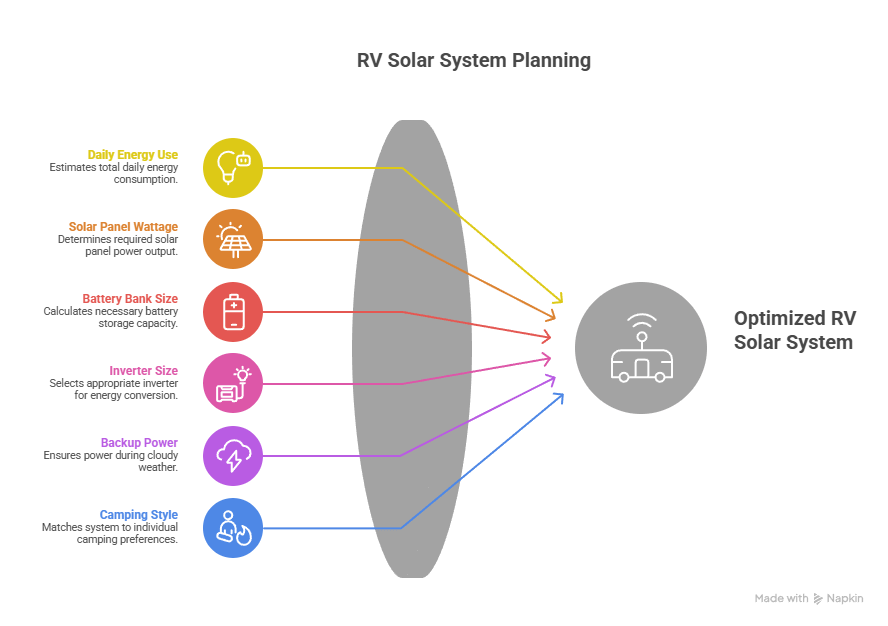
A solar RV calculator helps you estimate:
- Daily energy use
- Solar panel wattage
- Battery bank size
- Inverter size
- Backup power for cloudy days
- Whether your planned system fits your camping style
This guide walks through the same basic logic an RV solar calculator uses, with practical examples you can apply before buying panels, batteries, charge controllers, or a complete solar kit.
Results will vary based on location, sun exposure, weather, battery type, appliance efficiency, roof space, travel season, shade, and how you actually use power. Solar panels generate electricity from sunlight, while batteries store energy for later use when the sun is not available.
Planning solar for your RV and your home? Use the Solar ROI Calculator to estimate how solar savings, electricity rates, and system size could affect your home solar payback period.
What Is a Solar RV Calculator?
A solar RV calculator is a sizing tool that estimates the solar equipment needed to power your RV appliances.
Instead of starting with “How many panels should I buy?” it starts with a better question:
How much electricity do you use each day?
Most RV solar calculations use watt-hours.
The basic formula is:
Watts × Hours Used Per Day = Watt-Hours Per Day
For example:
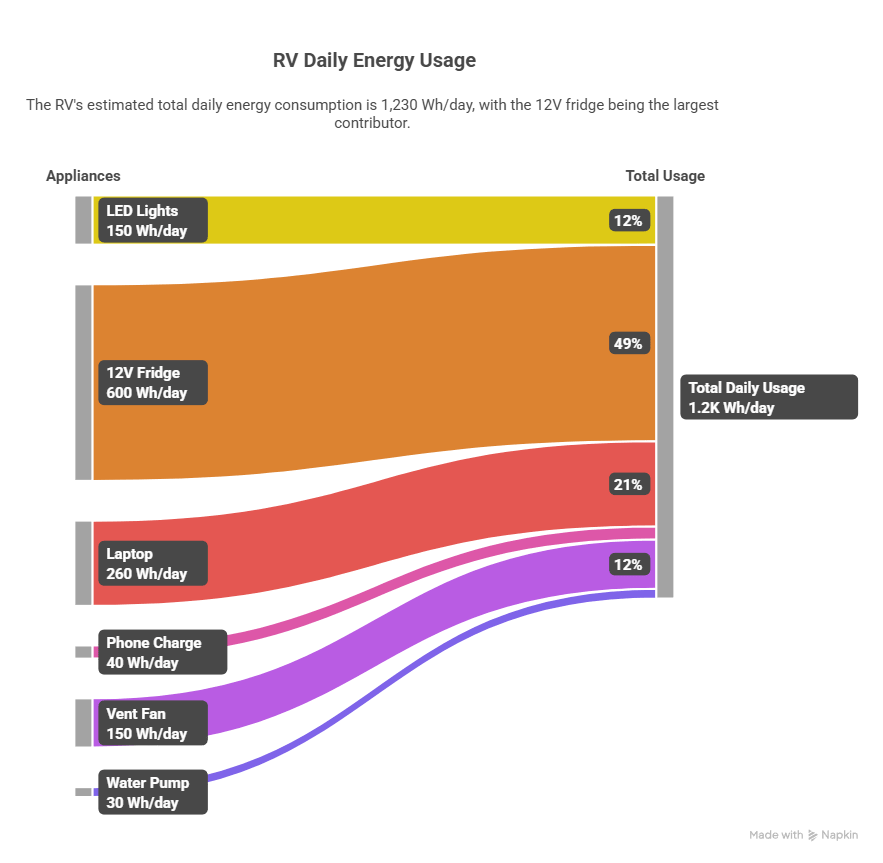
| Appliance | Watts | Hours Per Day | Daily Energy Use |
|---|---|---|---|
| LED lights | 30W | 5 | 150 Wh |
| 12V fridge | 60W | 10 | 600 Wh |
| Laptop | 65W | 4 | 260 Wh |
| Phone charging | 20W | 2 | 40 Wh |
| Vent fan | 25W | 6 | 150 Wh |
| Water pump | 60W | 0.5 | 30 Wh |
| Estimated total | 1,230 Wh/day |
In this example, the RV uses about 1.23 kWh per day.
That daily usage estimate becomes the foundation for sizing your solar panels, batteries, and inverter.
For homeowners comparing RV solar with rooftop solar, MySolarROI also offers a Solar Savings Calculator and Solar Cost Calculator to estimate home solar costs, bill savings, and payback.
Why RV Solar Sizing Matters
RV solar is different from home solar.
A home solar system is usually connected to the electric grid and sized around monthly utility bills. An RV solar system is often designed around limited roof space, battery storage, and off-grid power needs.
That means the goal is usually not maximum production. The goal is enough reliable energy for your travel style.
A weekend camper may only need a small system for lights, phone charging, and a fridge. A full-time RVer working remotely may need far more solar and battery capacity for laptops, internet equipment, cooking appliances, fans, and backup days.
Solar production can change depending on:
- Time of day
- Season
- Clouds and weather
- Shade from trees
- Dust or dirt on panels
- Roof angle
- Panel temperature
- Parking location
Those variables matter even more on an RV, where your location and parking conditions often change.
How to Use a Solar RV Calculator
A useful RV solar calculator should guide you through five steps.
If you are sizing a home system instead of an RV setup, use the Solar Panels Calculator to estimate panel count, system size, and cost.
1. List Every Appliance You Want to Power
Start with everything you expect to use while camping.
Common RV loads include:
- 12V refrigerator
- LED lights
- Water pump
- Roof vent fan
- Phone chargers
- Laptop chargers
- Wi-Fi router or Starlink
- CPAP machine
- TV
- Microwave
- Coffee maker
- Induction cooktop
- Blender
- Furnace fan
- Air conditioner
Do not assume small appliances are always small loads. A coffee maker may run for only a few minutes, but it can draw high wattage. A refrigerator may draw less power at a time, but it cycles throughout the day.
2. Estimate Daily Watt-Hours
Use this formula for each appliance:
Watts × Daily Hours = Daily Watt-Hours
If an appliance runs in cycles, estimate the active run time, not the total time it is plugged in.
Example:
| Device | Wattage | Estimated Use | Daily Watt-Hours |
|---|---|---|---|
| 12V fridge | 60W | 10 hrs cycling | 600 Wh |
| Laptop | 65W | 5 hrs | 325 Wh |
| Internet router | 50W | 6 hrs | 300 Wh |
| LED lights | 30W | 4 hrs | 120 Wh |
| Vent fan | 25W | 8 hrs | 200 Wh |
| Phone charging | 20W | 3 hrs | 60 Wh |
| Water pump | 60W | 0.5 hr | 30 Wh |
| Total | 1,635 Wh/day |
This RV uses about 1.6 kWh per day.
3. Choose Backup Days
Backup days are the number of days you want to run without strong solar production.
For RV use:
| Camping Style | Suggested Backup Days |
|---|---|
| Weekend camping in sunny areas | 1 day |
| Mixed campground and off-grid use | 1–2 days |
| Boondocking | 2–3 days |
| Remote work from RV | 2–4 days |
| Winter or shaded camping | 3+ days |
More backup days require more battery capacity.
4. Adjust for Battery Depth of Discharge
Not every battery should be drained completely.
Lithium iron phosphate batteries are commonly used in RV solar setups because they can usually use more of their rated capacity than traditional lead-acid batteries, but actual limits depend on the battery model and manufacturer guidance.
A simple planning approach:
| Battery Type | Conservative Usable Capacity Assumption |
|---|---|
| Lead-acid | 50% |
| AGM | 50% |
| Lithium / LiFePO4 | 80%–90% |
Battery formula:
Battery Capacity Needed = Daily Wh × Backup Days ÷ Usable Battery Percentage
Example:
- Daily use: 1,600 Wh
- Backup days: 2
- Battery usable capacity: 80%
1,600 × 2 ÷ 0.80 = 4,000 Wh
That means this RV would need about 4 kWh of battery capacity for two backup days.
For a 12V battery bank:
Amp-hours = Watt-hours ÷ Voltage
4,000 Wh ÷ 12V = about 333 Ah
So a practical setup might be around 300–400Ah at 12V, depending on actual equipment and safety margin.
Battery sizing matters for both RV and home solar. If you are also thinking about backup power at home, see our guide on how much solar battery backup you need.
5. Estimate Solar Panel Wattage
Solar panel sizing depends on daily energy use, peak sun hours, and system losses.
A simplified formula:
Solar Watts = Daily Wh ÷ Peak Sun Hours ÷ System Efficiency
For planning, many RV owners use a system efficiency factor of 70%–80% to account for real-world losses from heat, wiring, charge controller conversion, inverter use, dust, angle, and imperfect sun exposure.
Example:
- Daily use: 1,600 Wh
- Peak sun hours: 4.5
- Efficiency: 75%
1,600 ÷ 4.5 ÷ 0.75 = 474 watts
A reasonable system size might be 500–600 watts of solar panels, assuming good sun and moderate loads.
RV Solar Calculator Formula Summary
Use this table as a quick reference.
| What You Need to Calculate | Formula |
|---|---|
| Appliance energy use | Watts × Hours = Wh/day |
| Total daily use | Add all appliance Wh/day |
| Battery capacity | Daily Wh × Backup Days ÷ Usable Battery % |
| Amp-hours | Watt-hours ÷ Battery Voltage |
| Solar panel watts | Daily Wh ÷ Peak Sun Hours ÷ Efficiency |
| Inverter size | Highest simultaneous AC watt load × safety margin |
For a deeper home solar version of this process, read our guide on how much solar power you need before comparing installer quotes.
Example: Weekend RV Solar System
Let’s say you camp mostly on weekends and want to power a fridge, lights, phone chargers, a fan, and occasional laptop use.
Assumptions
| Input | Estimate |
|---|---|
| Daily energy use | 900 Wh/day |
| Backup days | 1 |
| Battery type | Lithium |
| Usable battery capacity | 80% |
| Peak sun hours | 4.5 |
| System efficiency | 75% |
Battery Calculation
900 Wh × 1 ÷ 0.80 = 1,125 Wh
At 12V:
1,125 ÷ 12 = 94 Ah
A 100Ah lithium battery could be a reasonable starting point for this light-use setup, assuming the real loads match the estimate.
Solar Panel Calculation
900 ÷ 4.5 ÷ 0.75 = 267 watts
A practical system might use 300 watts of panels.
What Could Change the Result?
You may need more capacity if:
- You camp in shade
- You use a CPAP machine overnight
- You run a 120V fridge through an inverter
- You travel in winter
- You want two or more backup days
- You use high-wattage cooking appliances
Example: Boondocking RV Solar System
Now let’s size a more demanding setup for off-grid camping.
Assumptions
| Input | Estimate |
|---|---|
| Daily energy use | 2,500 Wh/day |
| Backup days | 2 |
| Battery type | Lithium |
| Usable battery capacity | 80% |
| Peak sun hours | 4 |
| System efficiency | 75% |
Battery Calculation
2,500 Wh × 2 ÷ 0.80 = 6,250 Wh
At 12V:
6,250 ÷ 12 = 521 Ah
This setup may need about 500–600Ah at 12V, or an equivalent higher-voltage battery system.
Solar Panel Calculation
2,500 ÷ 4 ÷ 0.75 = 833 watts
A practical setup may use around 800–1,000 watts of solar panels, if roof space allows.
Expert Tip
For larger RV systems, consider whether a 24V or 48V battery architecture makes more sense than 12V. Higher-voltage systems can reduce current and wiring demands, but they require compatible components and proper installation.
What Size Inverter Do You Need for RV Solar?
The inverter converts DC battery power into AC power for household-style outlets.
To size an inverter, list the AC appliances you may run at the same time.
| Appliance | Typical Planning Concern |
|---|---|
| Laptop charger | Usually modest load |
| TV | Usually modest load |
| Coffee maker | High short-term draw |
| Microwave | High draw |
| Induction cooktop | High draw |
| Air conditioner | Very high draw and startup surge |
| Hair dryer | High draw |
| CPAP | Check exact wattage and runtime |
The inverter should be large enough for your highest simultaneous AC load, with room for surge power. However, oversizing an inverter can increase cost and idle energy use.
A simple planning method:
- Add the watts of AC appliances you may run at once.
- Add a safety margin.
- Check surge requirements for motors and compressors.
- Confirm your battery bank can support the current draw.
For example, if you want to run a 1,000W microwave and a 100W laptop charger at the same time, a 1,500W inverter may be more realistic than a 1,000W inverter. Always check equipment specifications.
Can RV Solar Run Air Conditioning?
RV air conditioning is one of the hardest loads to run on solar.
It can be done, but it usually requires:
- Large battery capacity
- Large inverter
- Enough panels to recharge the batteries
- Soft start equipment in some cases
- Careful energy management
- Plenty of roof or portable panel space
For many RV owners, solar is excellent for lights, refrigeration, fans, electronics, water pumps, and small appliances. Air conditioning often pushes the system into a much larger and more expensive category.
This is why a solar RV calculator should separate everyday loads from occasional high-wattage loads.
Roof-Mounted vs Portable RV Solar Panels
| Option | Pros | Cons | Best For |
|---|---|---|---|
| Roof-mounted panels | Always charging when parked in sun, less setup, harder to steal | Limited by roof space, shading from vents or AC units, fixed angle | Frequent travelers, simple daily charging |
| Portable panels | Can be moved into sun, useful when RV is shaded, adjustable angle | Setup required, storage needed, theft risk | Campers who park in shade or need flexible charging |
| Hybrid setup | More flexible, better production options | More components and planning | Boondocking and mixed travel styles |
A hybrid system can work well: roof panels for daily charging plus portable panels for shaded campsites.
Common Mistakes When Using an RV Solar Calculator
| Mistake | Why It Matters | Better Approach |
|---|---|---|
| Guessing appliance usage | Leads to wrong system size | Calculate watt-hours per device |
| Ignoring cloudy days | Batteries may run low | Add backup days |
| Forgetting inverter losses | AC loads use more battery energy | Add efficiency margin |
| Oversizing panels without battery capacity | Extra solar may be wasted | Balance panels and batteries |
| Undersizing wires or charge controller | Safety and performance issue | Follow manufacturer specs |
| Assuming solar will easily run AC | AC loads are demanding | Calculate separately |
| Ignoring shade | RV roofs often have vents and AC units | Map roof space before buying |
| Buying a kit before calculating | May not match your usage | Size the system first |
Mini Case Study: Remote Worker in a Travel Trailer
This is a fictional example for planning purposes.
Situation
A travel trailer owner works remotely three days per week while boondocking. They want to power:
- 12V fridge
- Laptop
- Internet router
- LED lights
- Vent fan
- Phone charging
- Water pump
- Occasional microwave use
Estimated Daily Usage
| Load | Daily Wh |
|---|---|
| 12V fridge | 700 Wh |
| Laptop | 400 Wh |
| Internet router | 450 Wh |
| Lights | 120 Wh |
| Vent fan | 250 Wh |
| Phone charging | 60 Wh |
| Water pump | 30 Wh |
| Microwave short use | 250 Wh |
| Total | 2,260 Wh/day |
Battery Estimate
Assumptions:
- 2 backup days
- Lithium battery
- 80% usable capacity
2,260 × 2 ÷ 0.80 = 5,650 Wh
At 12V:
5,650 ÷ 12 = 471 Ah
A practical battery bank might be around 500Ah at 12V, or equivalent.
Solar Estimate
Assumptions:
- 4.5 peak sun hours
- 75% system efficiency
2,260 ÷ 4.5 ÷ 0.75 = 670 watts
A practical solar array might be 700–800 watts, assuming roof space and sun exposure allow it.
What Could Change the Result?
The system may need to be larger if the owner camps in cloudy regions, uses air conditioning, works longer hours, parks in shade, or wants more backup days.
It may be smaller if they use campground hookups often, reduce internet equipment hours, avoid microwave use, or add a generator as backup.
How RV Solar Compares With Home Solar ROI
RV solar is usually about convenience, quiet off-grid power, and reducing generator use. Home solar is usually evaluated around electric bill savings, payback period, incentives, financing, and long-term ROI.
That means the calculators are different:
| Calculator Type | Main Question |
|---|---|
| Solar RV calculator | How much equipment do I need to power my RV loads? |
| Home solar ROI calculator | How much could solar reduce my electric bills over time? |
| Battery calculator | How much stored energy do I need for backup or off-grid use? |
| Payback calculator | How long might it take for savings to offset cost? |
For home solar, local electricity rates matter a lot. Two homeowners with the same system size can see very different financial results depending on utility rates, net metering rules, incentives, roof conditions, and financing terms.
If you are comparing RV solar with a rooftop solar system for your house, run your numbers with the Solar Payback Calculator before reviewing installer quotes.
You can also read our full guide to solar payback period to understand how system cost, incentives, electricity rates, and net metering can affect break-even timing.
What Inputs Should a Good Solar RV Calculator Include?
A strong RV solar calculator should ask for:
- Appliance wattage
- Hours used per day
- Daily watt-hours
- Battery voltage
- Battery type
- Desired backup days
- Peak sun hours
- Solar system efficiency
- Inverter loads
- Roof space
- Portable panel plans
- Seasonal camping conditions
It should also show the math instead of only giving a final kit recommendation.
That transparency helps you understand whether the result is realistic.
Before You Buy an RV Solar Kit
A solar kit can be convenient, but it is still worth checking whether the included parts match your energy needs.
Before buying, compare:
| Component | What to Check |
|---|---|
| Solar panels | Total wattage, size, roof fit, mounting options |
| Charge controller | Voltage compatibility, amperage rating, MPPT vs PWM |
| Batteries | Usable capacity, chemistry, cycle rating, temperature limits |
| Inverter | Continuous wattage, surge rating, idle draw |
| Wiring and fuses | Correct sizing for current and distance |
| Monitoring | Battery state of charge and solar production tracking |
| Expandability | Whether you can add panels or batteries later |
If you are also considering rooftop solar for your house, compare your estimated system size with the Solar Cost Calculator and review your numbers before you compare installer quotes.
Image Suggestions
| Placement | Description | File Name | SEO Alt Text | Caption |
|---|---|---|---|---|
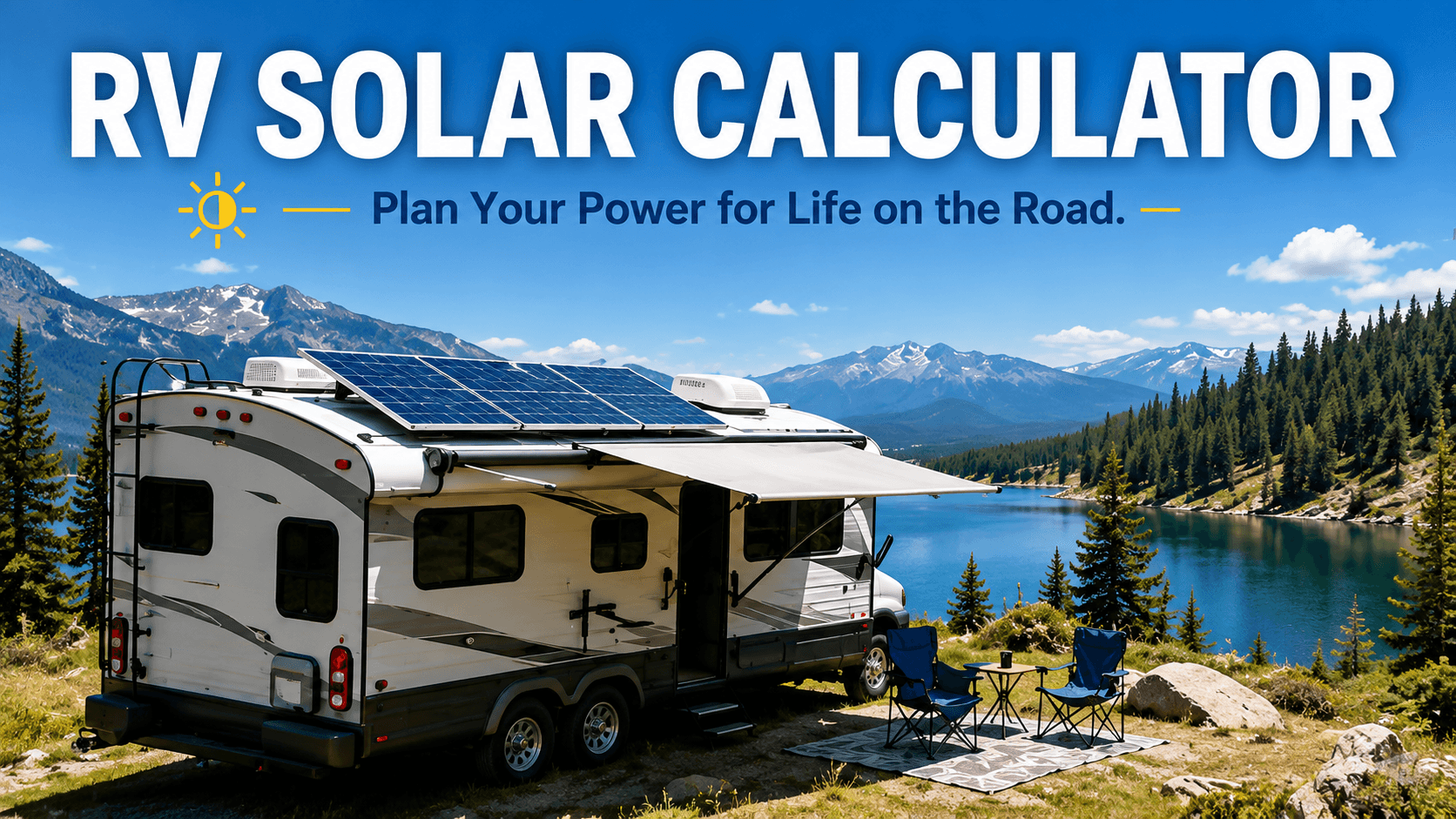
| After introduction | RV parked in sunny campsite with roof solar panels | rv-solar-panels-campsite.jpg | RV with solar panels used for solar RV calculator planning | RV solar sizing starts with daily energy use, not guesswork. |
| After calculator formula section | Simple visual of watts, hours, batteries, and panels | solar-rv-calculator-formula.png | Solar RV calculator formula for panels batteries and inverter | A good RV solar calculator estimates loads, storage, and charging needs. |
| Near mini case study | Travel trailer with laptop and off-grid workspace | rv-solar-remote-work-setup.jpg | RV solar setup for remote work and boondocking | Remote workers often need more battery capacity and backup days. |
External Source Suggestions
Use these reputable sources when expanding or updating this article:
- U.S. Department of Energy: Solar photovoltaic basics and solar-plus-storage basics
- NREL PVWatts: Solar production estimates by location and system design
- U.S. Energy Information Administration: Electricity price data
- Manufacturer manuals for specific batteries, charge controllers, and inverters
- RV electrical safety resources and product installation manuals
FAQ
What is a solar RV calculator?
A solar RV calculator estimates how many solar panels, batteries, and inverter capacity you need based on your daily appliance usage, backup days, sun exposure, and system efficiency.
How much solar do I need for my RV?
It depends on your daily watt-hour use. A light weekend setup may need a few hundred watts of solar, while a boondocking or remote-work setup may need 700W, 1,000W, or more. Calculate your loads before buying.
How many batteries do I need for RV solar?
Battery size depends on daily energy use, backup days, voltage, and usable battery capacity. For example, 1,600 Wh per day with two backup days and 80% usable capacity requires about 4,000 Wh of battery storage.
Can a 100W solar panel run an RV refrigerator?
Sometimes, but often not by itself. A 100W panel may help recharge a battery, but refrigerator energy use depends on wattage, duty cycle, weather, insulation, and battery capacity.
Is 400 watts of solar enough for an RV?
For modest loads, 400W can be enough. For remote work, heavy electronics, cooking appliances, or boondocking, you may need more solar and battery storage.
Can RV solar run a microwave?
Yes, if the inverter and battery bank can support the microwave’s wattage and surge requirements. The microwave may run for a short time, but it draws high power while operating.
Do I need an inverter for RV solar?
You need an inverter if you want to power AC appliances from your batteries. DC appliances, such as many RV lights and 12V refrigerators, may not need inverter power.
Is an RV solar kit worth it?
An RV solar kit can be worth it if it matches your actual energy use, camping style, and budget. It may be less useful if you mostly stay at campgrounds with hookups or if the kit is poorly sized for your loads.
Conclusion
A solar RV calculator helps you avoid guessing before buying panels, batteries, and inverters.
The key is to start with daily watt-hours, then calculate battery capacity, backup days, solar panel wattage, and inverter size. Your real result depends on location, shade, weather, season, roof space, appliance use, battery type, and system design.
For RVs, solar is often about freedom, quiet power, and better off-grid comfort. For homes, solar decisions usually depend more on electric rates, incentives, installer quotes, financing, payback period, and long-term savings.
Use the Solar ROI Calculator to estimate your home solar savings, payback period, and ROI before comparing installer quotes.