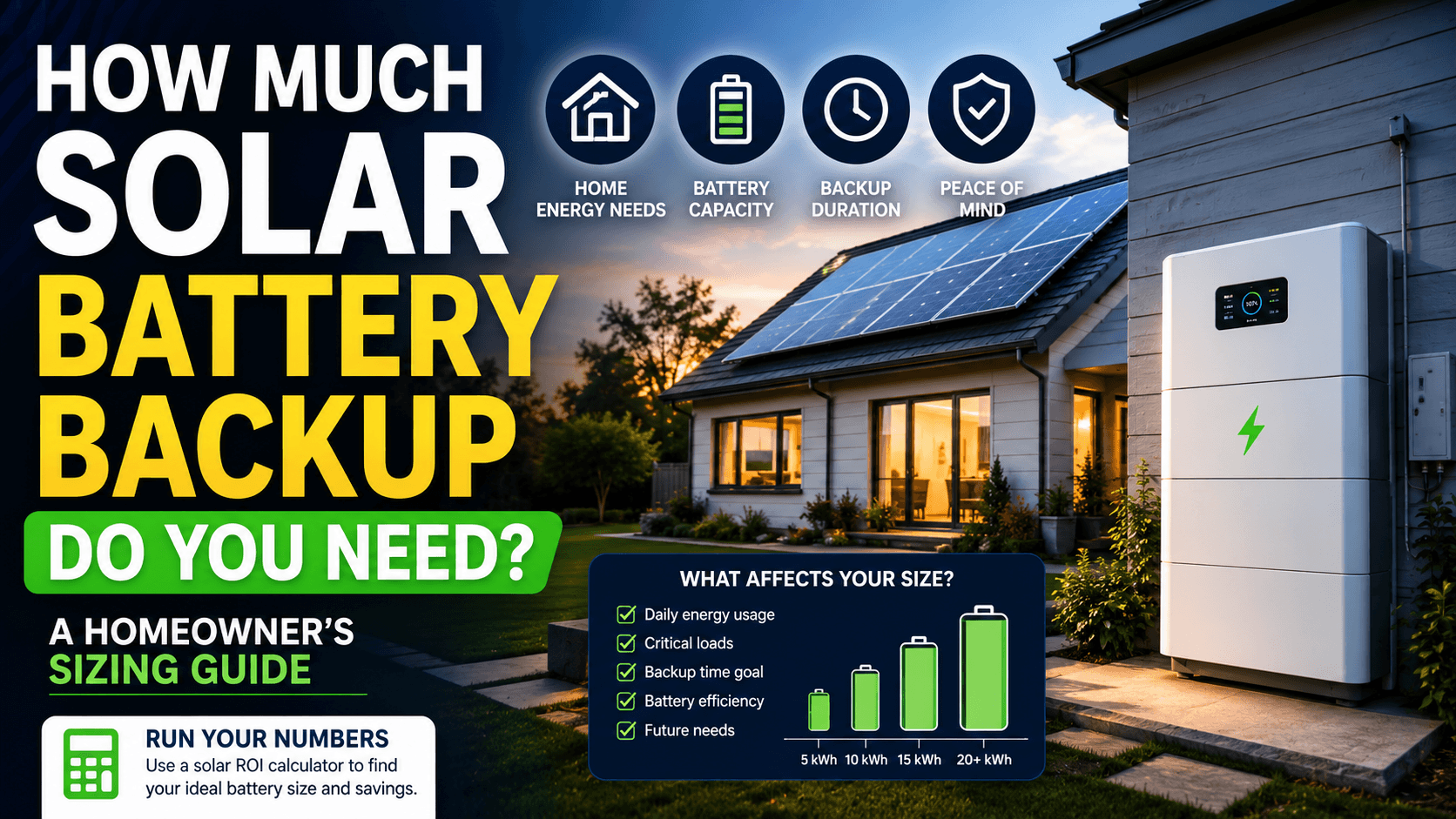
How Much Solar Battery Backup Do You Need? A Homeowner’s Sizing Guide

How Much Solar Battery Backup Do You Need

Solar Battery Size Calculator Guide: How Much Backup Do You Need?

A solar battery can make your home more resilient, help you use more of your own solar energy, and provide backup power during outages. But before you add battery storage to a solar quote, the real question is this: how much backup do you actually need, and what does that mean for Solar Battery ROI?

The answer depends on your electricity use, outage goals, utility rate plan, net metering rules, system size, available incentives, financing, and which appliances you want to keep running. A battery that is too small may not cover your essentials. A battery that is too large may increase your cost without improving your payback enough to justify it.

This guide explains how to estimate solar battery size, how to think about backup power, what affects Solar Battery ROI, and how to compare solar-only vs. solar-plus-battery options before talking with installers.

Before requesting quotes, you can use the Solar ROI Calculator to estimate how system size, electricity rates, incentives, and battery costs may affect your long-term return.

What Is Solar Battery ROI?

Solar Battery ROI measures whether the financial value of adding battery storage is worth the extra cost over time.

A solar battery can create value by:

  • Storing excess solar power for evening use
  • Reducing grid electricity purchases during expensive peak-rate hours
  • Providing backup power during outages
  • Helping you use more of your own solar energy
  • Improving the value of solar in areas with lower export credits
  • Supporting energy independence and resilience

However, battery ROI is different from solar panel ROI.

Solar panels produce electricity that can directly reduce your electric bill. Batteries do not create electricity by themselves. They store electricity and shift when you use it.

That means a battery’s financial value depends heavily on your utility rules, rate plan, and backup needs. The U.S. Department of Energy explains that battery storage can help homeowners store solar energy for later use, including at night or during outages.

If your main goal is financial return, compare battery storage separately from the solar panel system itself. You can estimate the solar-only payback first with the Solar Payback Calculator, then compare that result with a solar-plus-battery scenario.

How Solar Batteries Work With Home Solar

A typical solar-plus-battery system works like this:

  1. Solar panels produce electricity during the day.
  2. Your home uses solar power first.
  3. Extra solar energy charges the battery.
  4. Once the battery is full, remaining excess power may go to the grid, depending on your utility’s net metering or export rules.
  5. In the evening, during peak-rate periods, or during an outage, the battery sends stored energy back to your home.

Not every battery installation backs up the whole home. Many systems are designed to power a critical loads panel, which may include essentials such as:

  • Refrigerator
  • Wi-Fi router
  • Selected lights
  • Phone charging
  • Medical device circuit
  • Garage door opener
  • Sump pump
  • Furnace fan
  • A few key outlets

Whole-home backup usually requires more battery capacity, more inverter power, and careful load planning. If you want to understand how your solar system size affects battery charging, read How Much Solar Power Do I Need? System Size Explained.

How Much Solar Battery Backup Do You Need?

The right solar battery size starts with your backup goal.

Some homeowners only want enough power to keep food cold, phones charged, and Wi-Fi running during short outages. Others want overnight backup, protection from time-of-use rates, or near whole-home backup.

Those are very different goals.

Backup Goal Typical Use Case Battery Size Direction
Essential backup Refrigerator, Wi-Fi, lights, small outlets Smaller battery may work
Overnight backup Essentials through the night Moderate battery capacity
Time-of-use savings Store solar and use it during peak-rate hours Depends on rate plan
Larger appliance backup Furnace fan, sump pump, well pump, selected appliances Larger battery may be needed
Whole-home backup Most home circuits during outages Usually requires multiple batteries
Extended outage support Multi-day backup with solar recharge Requires detailed system design

A homeowner who only wants refrigerator, lights, and Wi-Fi during a short outage may need far less storage than someone who wants central air conditioning, electric cooking, laundry, or EV charging.

Step 1: List the Loads You Want to Back Up

Start by listing the appliances and circuits you want the battery to support.

Do not begin with your total monthly electric bill. Your bill shows total energy use, but backup sizing depends on which loads run at the same time and how long they need to run.

Here is a simple example:

Appliance or Load Estimated Power Hours Used Estimated Daily Energy
Refrigerator 150 watts average 10 hours 1.5 kWh
Wi-Fi router 15 watts 24 hours 0.36 kWh
LED lights 60 watts 5 hours 0.3 kWh
Laptop and phone charging 100 watts 3 hours 0.3 kWh
Furnace fan 400 watts 3 hours 1.2 kWh
Miscellaneous outlets 200 watts 2 hours 0.4 kWh
Estimated total 4.06 kWh/day

This is only an example. Actual usage depends on the appliance, home size, climate, season, and homeowner behavior.

For a broader estimate of solar system size, production, and savings, use the Solar Panels Calculator.

Step 2: Adjust for Usable Battery Capacity

A battery’s listed capacity is not always the same as the amount of energy you can use.

For example, a battery may be advertised as 10 kWh, but the usable capacity may be lower because some energy is reserved to protect battery health or maintain backup reserve.

Battery Nameplate Capacity Assumed Usable Share Approximate Usable Capacity
10 kWh 90% 9 kWh
13.5 kWh 90% 12.15 kWh
20 kWh 90% 18 kWh

If your critical loads use about 4 kWh per day, a battery with about 9 kWh of usable capacity may cover roughly two days of limited essential use before solar recharge, assuming conservative usage and mild weather.

Actual performance depends on your system settings, battery model, inverter, weather, and loads.

Step 3: Consider Solar Recharge During an Outage

A battery does not always have to carry your home alone. If your solar panels can recharge the battery during the day, your backup can last longer.

Solar recharge depends on:

  • Weather
  • Season
  • Roof direction
  • Shade
  • Solar panel size
  • Battery charge settings
  • Inverter design
  • Whether the system is configured to recharge while disconnected from the grid
  • Installer design choices

This is why battery sizing should be modeled together with expected solar production. For production estimates, the PVWatts Calculator Guide explains how homeowners can estimate solar output using location, roof direction, system size, and sunlight assumptions.

Solar Battery Size Calculator Formula

You can use this simple formula to estimate your starting battery size:

Battery size needed = Daily backup energy use × Desired backup days ÷ Usable battery percentage

Example:

  • Daily critical loads: 5 kWh
  • Desired backup duration: 1.5 days
  • Usable battery share: 90%

5 × 1.5 ÷ 0.90 = 8.33 kWh

In this example, the homeowner may want a battery with at least about 9 kWh of nameplate capacity before considering surge loads, solar recharge, backup reserve settings, or installer recommendations.

Backup Scenario Estimated Daily Backup Use Battery Capacity Direction
Light essentials 3–5 kWh/day Small to moderate battery
Essentials plus furnace fan 5–8 kWh/day Moderate battery
Larger backup loads 8–15+ kWh/day Larger battery or multiple units
Whole-home comfort Highly variable Detailed load calculation required

Use this as a planning estimate, not a final design. Your installer should calculate both energy needs and power output needs.

What Affects Solar Battery ROI?

Solar Battery ROI depends on how much value the battery creates compared with its cost.

The strongest financial cases usually happen when a battery helps avoid expensive grid electricity or makes solar more useful under your utility’s rate structure.

Factors That Can Improve Solar Battery ROI

Factor Why It Matters
High electricity rates Stored solar offsets more expensive power
Time-of-use rates Battery can discharge during peak-rate periods
Lower export credits Storing solar may be worth more than sending it to the grid
Frequent outages Backup value becomes more important
Incentives or rebates Lower net cost can improve payback
Proper system sizing Avoids paying for unused battery capacity
Strong solar production More solar energy may be available to charge the battery

Electricity prices vary by state and utility, so battery savings should be modeled locally. The U.S. Energy Information Administration publishes electricity price data showing that residential electricity rates differ significantly across the country.

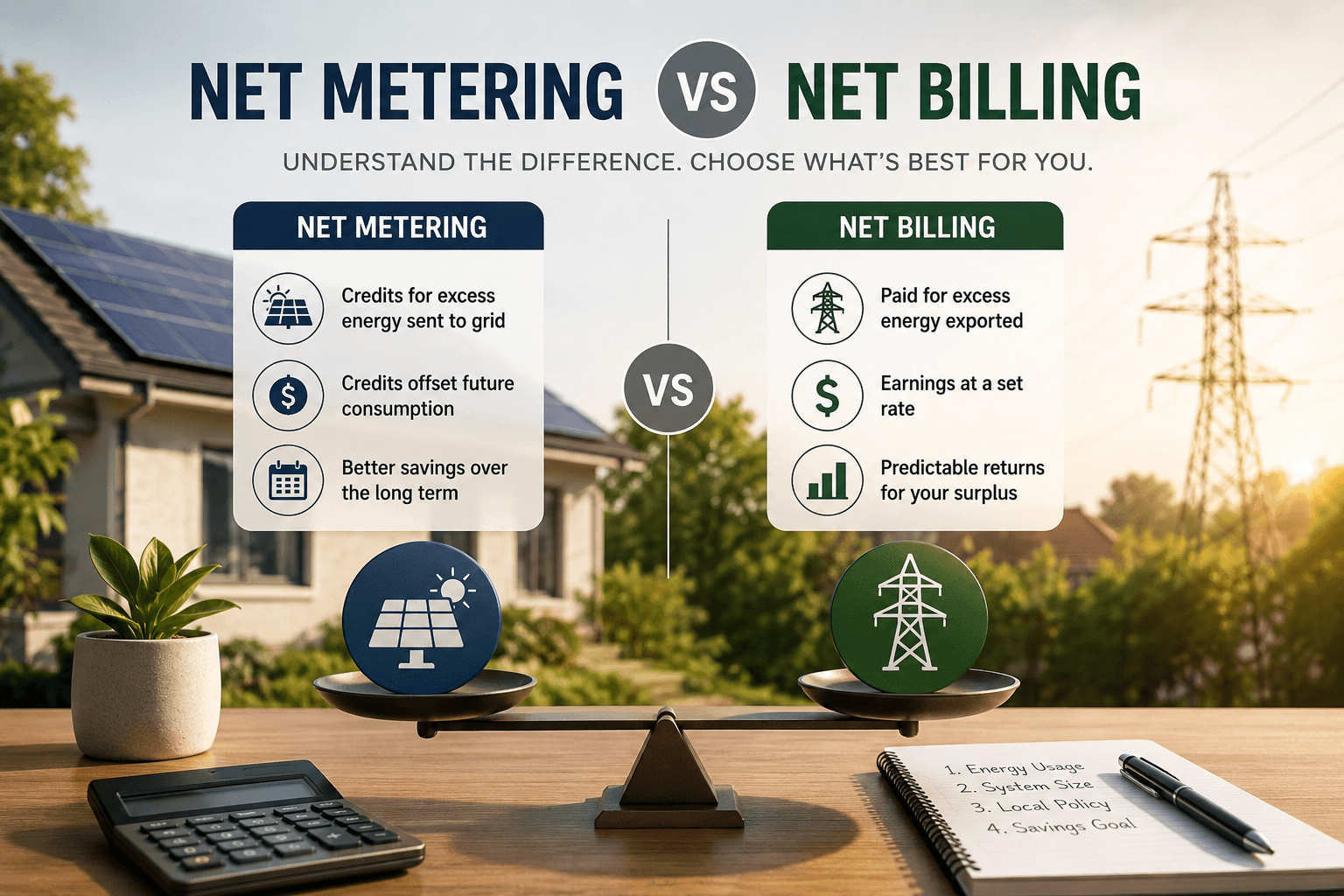
If net metering is a major part of your savings estimate, read Net Metering Explained for Solar Homeowners before assuming your exported solar power will receive full retail value.

Factors That Can Reduce Solar Battery ROI

Factor Why It Matters
Strong full-retail net metering Exporting solar may already be financially valuable
Low electricity rates Stored energy offsets cheaper grid power
Oversized battery Extra capacity may sit unused
High financing costs Interest can extend the payback period
Low outage risk Backup value may be less important
Poor system design Battery may not support the loads you expect
Weak solar production Battery may rely more on grid charging

A battery may still be worth it for peace of mind, even if the financial payback is longer. But it is important to separate bill savings from backup value.

Simple Solar Battery ROI Formula

A basic battery ROI estimate can start with this formula:

Solar battery payback period = Net battery cost ÷ Estimated annual battery value

Where:

  • Net battery cost means installed battery cost minus applicable incentives or rebates.
  • Estimated annual battery value may include bill savings from stored solar, time-of-use savings, and any personal value you assign to backup power.

Example:

Item Assumption
Installed battery cost $14,000
Estimated incentive value $4,200
Net battery cost $9,800
Estimated annual bill savings from battery $500
Simple payback from bill savings only 19.6 years

This is not a prediction or quote. It is a simplified example showing why battery savings should be calculated separately from solar panel savings.

If your solar-only system has a faster payback, adding a battery may extend the combined payback period. If your utility has high peak rates or low export credits, the battery may provide more financial value.

To compare both scenarios, run the numbers through the Solar ROI Calculator and review your payback with and without storage.

Federal Tax Credit and Battery Storage

Battery incentives can affect Solar Battery ROI, but eligibility rules matter.

The IRS states that qualified battery storage technology must have a capacity of at least 3 kilowatt-hours to qualify for the Residential Clean Energy Credit. Homeowners should verify current rules, installation timing, ownership requirements, and tax eligibility before relying on any credit.

Battery incentives can also vary by state, utility, or local program. For broader incentive planning, use the Solar Incentives Calculator and review Federal Solar Tax Credit 2026: What Homeowners Need to Know.

This article is for educational purposes only and is not tax, legal, or financial advice.

Mini Case Study: Sizing Battery Backup for a Suburban Home

Here is a realistic example of how a homeowner might think about backup battery size.

Homeowner Goal

The homeowner wants backup for:

  • Refrigerator
  • Wi-Fi
  • Kitchen lights
  • Bedroom lights
  • Phone and laptop charging
  • Gas furnace fan
  • A few outlets

They do not need to run central air conditioning, an electric oven, a clothes dryer, or EV charging during an outage.

Estimated Daily Backup Use

Load Group Estimated Daily Energy
Food storage 1.5 kWh
Internet and electronics 0.8 kWh
Lighting 0.5 kWh
Furnace fan 1.5 kWh
Miscellaneous outlets 0.7 kWh
Total 5.0 kWh/day

The homeowner wants about 24 hours of backup without assuming solar recharge.

Calculation:

5.0 kWh ÷ 0.90 usable capacity = 5.56 kWh minimum nameplate capacity

However, this homeowner may choose a larger battery because:

  • Appliances can surge when starting
  • Furnace fan use may increase in cold weather
  • Cloudy weather may reduce solar recharge
  • Some battery capacity may be reserved
  • The homeowner may want a safety margin

A practical installer discussion might start around a battery near the 10 kWh range, then refine the design based on actual loads, solar production, inverter capacity, and budget.

What Could Change the Result?

Actual results may change based on:

  • Location
  • Electricity rates
  • Roof conditions
  • Utility rules
  • Net metering policy
  • Incentives
  • Solar production
  • Battery model
  • Financing terms
  • Backup load selection
  • Installer design

Before accepting a quote, compare the total cost, projected bill savings, and payback period using the Solar Quote Comparison Calculator.

Solar Battery ROI vs. Solar Panel ROI

Solar panels and batteries should be evaluated separately because they create value in different ways.

Feature Solar Panels Solar Battery
Main purpose Produce electricity Store and shift electricity
Primary financial value Offset grid electricity Improve self-use, peak-rate savings, backup
ROI driver Solar production and electric rate Rate plan, net metering, outage value
Payback clarity Usually easier to estimate More dependent on utility rules
Best use Long-term bill reduction Backup and energy management

In many homes, solar panels may have a clearer financial payback than batteries. Batteries can still make sense when backup power, time-of-use savings, or reduced export credits are important.

For a step-by-step explanation of solar return, read How to Calculate Solar ROI: Step-by-Step Guide.

Common Mistakes When Sizing a Solar Battery

Mistake 1: Trying to Back Up Everything

Whole-home backup sounds convenient, but it can require a much larger and more expensive system.

Large electric loads can drain batteries quickly, including:

  • Central air conditioning
  • Electric resistance heat
  • Electric oven
  • Clothes dryer
  • Pool pump
  • EV charger
  • Large well pump

A better starting point is to decide which circuits truly matter during an outage.

Mistake 2: Ignoring Net Metering Rules

Net metering can strongly affect battery ROI.

If your utility gives strong credit for exported solar energy, storing that energy may be less financially valuable. If export credits are low, using more solar onsite may become more attractive.

Learn more in Net Metering Explained for Solar Homeowners.

Mistake 3: Comparing Only Battery Price

Do not compare battery quotes only by sticker price.

Compare:

  • Nameplate capacity
  • Usable capacity
  • Continuous power output
  • Surge power capability
  • Warranty
  • Backup capability
  • Critical load panel cost
  • Inverter compatibility
  • Expandability
  • Monitoring features
  • Installer experience

A cheaper battery is not always the better deal if it does not support the loads you need.

Mistake 4: Forgetting Financing Costs

A battery financed over many years may cost much more than the cash price after interest.

If you plan to finance solar-plus-storage, compare monthly payment, total interest, incentives, and ownership terms. The Solar Financing Calculator can help you understand how financing affects total cost and payback.

For a deeper comparison, read Solar Financing Comparison: Cash vs. Loans vs. Leases vs. PPAs.

Mistake 5: Assuming Incentives Automatically Apply

Do not assume a battery qualifies for every incentive.

Rules may depend on:

  • Battery capacity
  • Installation date
  • Whether the system is new or used
  • Ownership structure
  • Tax liability
  • Utility program limits
  • State or local requirements

Always verify current incentive rules before signing a contract.

How to Compare Solar Battery Quotes

When you receive solar battery quotes, ask each installer to explain the assumptions clearly.

Quote Item Question to Ask
Battery capacity Is this nameplate capacity or usable capacity?
Backup loads Which circuits will be backed up?
Solar recharge Can the battery recharge from solar during an outage?
Power output Can it start my key appliances?
Incentives Which incentives are included in the price?
Warranty What capacity is expected at the end of warranty?
Financing What is the total cost after interest?
Monitoring Can I see charge, discharge, and backup reserve?
Utility savings What rate plan assumptions are being used?
Installation scope Is a critical loads panel included?

A quote should not simply say “battery included.” It should explain what the battery will actually do for your home.

Before signing, use this guide: How to Compare Solar Quotes: A Homeowner Checklist.

When a Solar Battery May Be Worth It

A solar battery may be worth considering if:

  • You experience outages often
  • You work from home and need reliable power
  • Your utility has expensive peak-rate periods
  • Your net metering credits are lower than retail electricity rates
  • You want to use more of your own solar energy
  • You have medical, safety, or comfort backup needs
  • You are already installing solar and want integrated storage

A battery may be less financially attractive if:

  • Your utility offers strong full-retail net metering
  • You rarely lose power
  • Your electricity rates are low
  • You would need multiple batteries for the loads you expect
  • Financing costs are high
  • You mainly want the shortest possible payback period

If your main question is whether solar itself makes sense first, read Is Solar Worth It? Honest Financial Guide for Homeowners.

Expert Tips for Better Battery Sizing

Use these tips before choosing battery capacity:

  • Start with critical loads, not whole-home usage.
  • Ask installers to separate solar savings from battery savings.
  • Compare solar-only and solar-plus-battery payback periods.
  • Check whether your utility rate plan rewards peak-hour discharge.
  • Confirm whether the battery can recharge from solar during outages.
  • Leave room for seasonal changes in solar production.
  • Avoid oversizing unless backup comfort is worth the added cost.
  • Review warranty terms and usable capacity, not just brand name.
  • Run your numbers before comparing installer quotes.

The Solar Cost Calculator can help estimate total project cost, while the Solar Savings Calculator can help estimate how much solar may reduce your electric bill.

External Source Suggestions

For fact-checking and homeowner research, review these reputable sources:

  • U.S. Department of Energy homeowner solar guidance
  • IRS Residential Clean Energy Credit information
  • DSIRE incentive database
  • U.S. Energy Information Administration electricity price data
  • Your state energy office
  • Your local utility’s net metering and time-of-use rate pages

Image Suggestions

Placement Description File Name SEO Alt Text Caption
After introduction Home solar panels connected to battery storage solar-battery-roi-home-backup.jpg Solar Battery ROI for home backup system Solar battery sizing depends on backup goals, utility rules, and electricity usage.
Near sizing formula Battery sizing worksheet graphic solar-battery-size-calculator-example.png Solar battery size calculator example for homeowners Estimate daily backup loads before choosing battery capacity.
Near quote section Homeowner comparing solar and battery quotes compare-solar-battery-quotes.jpg Comparing Solar Battery ROI and installer quotes A detailed quote should show usable capacity, backed-up circuits, and savings assumptions.

FAQ

Is a solar battery worth it for ROI?

A solar battery may be worth it if it helps you avoid high peak electricity rates, use more of your own solar energy, or reduce the impact of low export credits. However, Solar Battery ROI varies by utility rules, incentives, system cost, and backup needs.

How many solar batteries do I need to run a house?

It depends on whether you want essential backup or whole-home backup. Many homeowners start by backing up critical loads. Whole-home backup may require multiple batteries, especially if you want to run large appliances.

What size solar battery do I need for overnight backup?

Estimate your critical loads in kWh, multiply by the number of hours or days you want backup, then adjust for usable battery capacity. For example, 5 kWh of daily critical loads may require more than 5 kWh of nameplate battery capacity.

Does a solar battery qualify for the federal tax credit?

The IRS states that qualified battery storage technology must have a capacity of at least 3 kilowatt-hours for the Residential Clean Energy Credit. Homeowners should verify current rules and consult a qualified tax professional.

Does a battery improve solar payback?

Sometimes. A battery can improve savings under certain time-of-use rates or weak net metering rules. In other cases, it may lengthen the overall payback period because it adds cost. Use a Solar Payback Calculator to compare solar-only and solar-plus-battery options.

Can solar panels charge a battery during an outage?

Many solar-plus-storage systems can recharge during outages, but it depends on inverter design, battery settings, safety equipment, and installation configuration. Confirm this with your installer before signing a contract.

What is the best way to calculate Solar Battery ROI?

The best method is to compare net battery cost against estimated annual value from bill savings, time-of-use savings, incentives, and backup needs. A Solar ROI Calculator can help model these variables before comparing quotes.

Conclusion

The right solar battery size is not always the biggest battery you can buy. It is the battery that matches your backup goals, daily critical loads, solar production, utility rules, and budget.

For many homeowners, Solar Battery ROI depends less on the battery brand and more on how the system is designed. A properly sized battery can provide useful backup and better control over solar energy. An oversized or poorly modeled battery can increase costs without improving payback enough to justify it.

Before choosing a system, estimate your backup loads, compare solar-only vs. solar-plus-battery savings, review incentives carefully, and use the Solar ROI Calculator to calculate your solar ROI and payback period with realistic assumptions.

Share the Post:

Related Posts