Best Roof Direction for Solar Panels: South, East, or West?
What is the best roof direction for solar panels: south, east, or west?
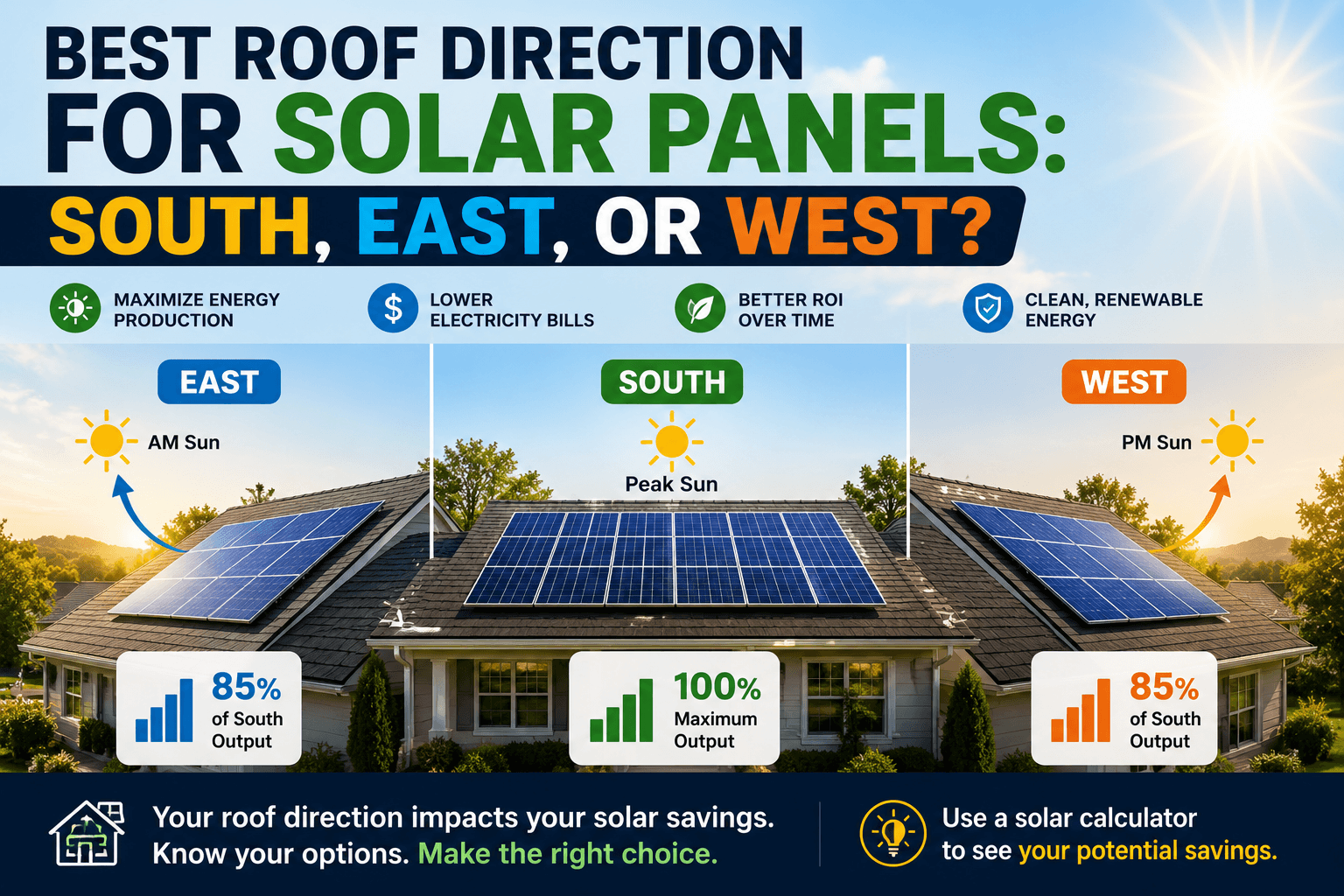
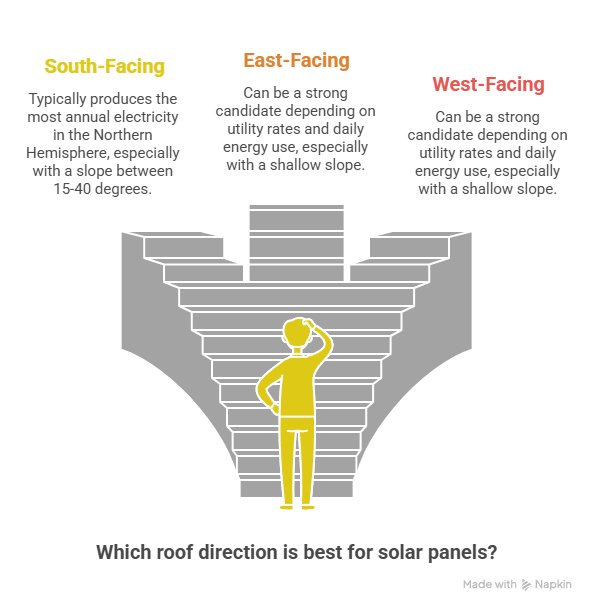
For many homeowners, the answer is not as simple as “south is best.” South-facing solar panels usually produce the most annual electricity in the Northern Hemisphere, but east- and west-facing roofs can still be strong candidates depending on your utility rates, daily energy use, roof shape, shade, net metering rules, and system design.
The U.S. Department of Energy says solar panels typically perform best on unshaded, south-facing roofs with a slope between 15 and 40 degrees, though other roof directions may also be suitable. The same guidance notes that southeast to southwest orientations can work well, especially when roof slope is shallow.
This guide explains how roof direction affects solar production, savings, payback period, and ROI so you can make a more confident decision before speaking with installers.
Want to test your own numbers? Use the MySolarROI solar ROI calculator to estimate how roof direction, system cost, incentives, and electricity rates may affect your solar payback period.
What Does “Roof Direction” Mean for Solar Panels?
Roof direction refers to the compass direction your solar panels face. In solar design, this is often called azimuth.
For many solar tools, azimuth is measured in degrees from true north:
| Direction | Common Azimuth |
|---|---|
| North | 0° |
| East | 90° |
| South | 180° |
| West | 270° |
NREL’s PVWatts calculator is commonly used to estimate grid-connected solar PV production, and it allows users to model system performance based on inputs such as location, system size, tilt, and orientation.
For a typical U.S. homeowner, the most important point is this:
South-facing panels usually produce the most total annual energy, but east and west panels may better match when your household uses electricity.
That difference matters because solar value is not only about how many kilowatt-hours your system produces. It is also about when those kilowatt-hours are produced and how your utility credits excess solar energy.
Best Roof Direction for Solar Panels: Quick Comparison
| Roof Direction | Best For | Main Advantage | Main Trade-Off |
|---|---|---|---|
| South-facing | Maximum annual production | Strong all-day sunlight exposure | May not always match afternoon/evening usage |
| Southwest-facing | Afternoon production and strong total output | Useful for later-day electricity use | Slightly less ideal than true south in many cases |
| Southeast-facing | Morning production and strong total output | Good for morning-heavy usage | Less late-day output |
| West-facing | Afternoon and early evening production | Can help with time-of-use rates | Usually lower annual production than south |
| East-facing | Morning production | Helpful for morning loads | Lower afternoon production |
| North-facing | Usually least favorable in the U.S. | Sometimes usable on shallow or special roofs | Often much lower production, more careful modeling needed |
Is South Really the Best Direction for Solar Panels?
In most of the United States, south-facing solar panels are usually the best direction for maximum annual electricity production.
That is because south-facing panels receive strong sunlight across more of the day. They generally capture sunlight from late morning through afternoon, which helps total yearly output.
The Department of Energy describes south-facing, unshaded roofs with a 15–40 degree slope as typically best for solar performance, while also noting that other roof types may still be suitable.
South-Facing Solar Panels Are Often Best If:
- Your goal is maximum annual kWh production
- Your roof has little shade
- Your utility offers strong net metering
- Your electricity use is spread throughout the day
- You have a simple roof plane with enough usable space
- You are trying to reduce payback period through higher production
South-Facing Solar Panels May Not Always Be Best If:
- The south roof plane is heavily shaded
- The south side has vents, dormers, or limited usable space
- Your west-facing roof is larger and cleaner
- Your utility has time-of-use rates that make afternoon electricity more valuable
- Your household uses much more power later in the day
In other words, south is often the best starting point, but it is not the only direction worth considering.
Are East-Facing Solar Panels Worth It?
Yes, east-facing solar panels can be worth it, especially if your household uses more electricity in the morning.
East-facing panels produce more power earlier in the day. They can be helpful for homes where morning electricity use is high because of:
- Electric water heating
- Heat pumps
- Morning air conditioning
- Home offices
- Breakfast and appliance use
- EV charging before leaving for work, if scheduled in the morning
The trade-off is that east-facing panels usually produce less afternoon energy than south- or west-facing panels. That can matter if your utility’s highest rates occur later in the day or if your home uses most electricity after school or work.
East-Facing Roofs Work Best When:
- The roof is mostly unshaded
- Morning energy use is high
- The roof has enough space for the needed system size
- Net metering is available or battery storage is part of the plan
- The installer can model expected production clearly
An east-facing roof is not automatically a bad solar roof. It just needs a more careful savings estimate.
For a broader estimate, you can compare system size and production assumptions using the solar panels calculator.
Are West-Facing Solar Panels Worth It?
Yes, west-facing solar panels can also be worth it, especially for homeowners who use more electricity in the afternoon and early evening.
West-facing panels usually produce more electricity later in the day than east-facing panels. That can be useful if your household has higher electricity use from:
- Air conditioning
- Cooking
- Laundry
- EV charging after work
- Kids returning from school
- Evening appliance use
- Time-of-use rates with higher late-day prices
West-facing panels may produce less total annual electricity than south-facing panels in many locations, but the electricity they produce may line up better with when your household needs power.
West-Facing Roofs Work Best When:
- Afternoon electricity use is high
- Your utility charges higher rates later in the day
- The roof has low shade in the afternoon
- The west roof plane is larger or simpler than the south plane
- You want to reduce grid usage during late-day peak periods
A west-facing system is especially worth modeling if your utility uses time-of-use billing. In that case, a slightly lower annual output may still have strong financial value if more production happens during expensive hours.
South vs. East vs. West: Which Saves the Most Money?
The roof direction that produces the most electricity is not always the roof direction that saves the most money.
Solar savings depend on several factors:
| Factor | Why It Matters |
|---|---|
| Annual solar production | More kWh can reduce more grid electricity use |
| Time of production | Energy may be more valuable during high-rate periods |
| Net metering rules | Determines how excess solar power is credited |
| Electricity rate | Higher rates can increase the value of solar production |
| Shade | Can reduce production even on a “perfect” roof direction |
| System cost | Higher costs can lengthen payback period |
| Incentives | Eligible incentives may reduce net cost |
| Financing | Loan interest and terms can affect ROI |
| Battery storage | Can shift solar energy into evening use |
The Department of Energy notes that rooftop solar potential depends on factors such as roof size, shade, direction, and location. It also clarifies that rooftop potential is not the same as economic potential because cost and market factors also matter.
That is why homeowners should avoid judging a solar quote based only on roof direction.
A better question is:
Which design gives me the best payback and long-term value after accounting for my roof, rate plan, incentives, and energy use?
How Shade Can Matter More Than Roof Direction
A lightly shaded west-facing roof may outperform a heavily shaded south-facing roof.
Shade from trees, chimneys, dormers, nearby buildings, or roof peaks can reduce solar output. Even partial shade can matter, especially if it affects panels during high-production hours.
Before deciding whether your roof direction is good or bad, check:
- Morning shade
- Midday shade
- Afternoon shade
- Seasonal tree coverage
- Chimneys and vents
- Neighboring buildings
- Roof obstructions
- Snow or debris patterns in colder regions
A good installer should provide a shade analysis and production estimate, not just a general statement that your roof direction is “fine.”
What About Southeast and Southwest Roofs?
Southeast and southwest roofs are often excellent for solar.
In many cases, they perform close to south-facing roofs, especially when the roof pitch is moderate and shade is low. DOE guidance says any orientation between southeast and southwest can work well, and orientation becomes less important on shallower slopes.
Southeast-Facing Roofs
Southeast roofs produce more energy earlier in the day than southwest roofs. They may be useful if your home has stronger morning electricity use.
Southwest-Facing Roofs
Southwest roofs produce more energy later in the day. They may be especially useful in hot climates where air conditioning demand increases in the afternoon.
For many homeowners, southeast or southwest is not a compromise that ruins solar. It is often a practical and financially reasonable option.
What If My Roof Faces North?
In the Northern Hemisphere, north-facing roofs are usually the least favorable for solar panels.
That does not always mean solar is impossible, but it usually means the project needs more careful review. A north-facing roof may still be considered if:
- The roof pitch is very shallow
- Other roof planes are unavailable
- Electricity rates are very high
- There is strong net metering
- Ground-mounted solar is not possible
- The system design can still produce enough energy
However, many homeowners with north-facing roofs may get better results from:
- Using a garage roof
- Using an east or west roof plane
- Installing a ground-mounted system
- Considering a pergola or carport solar design
- Looking into community solar, where available
Mini Case Study: South vs. West Roof Direction
Here is a simplified example to show how roof direction can affect solar payback.
Homeowner Assumptions
| Assumption | Example |
|---|---|
| System size | 7 kW |
| Gross system cost | $21,000 |
| Estimated net cost after eligible incentives | $14,700 |
| Estimated annual production, south-facing roof | 10,000 kWh |
| Estimated annual production, west-facing roof | 8,800 kWh |
| Electricity value | $0.18 per kWh |
| Financing | Cash purchase for simplicity |
Simple Savings Estimate
| Roof Direction | Estimated Annual Production | Estimated Annual Savings |
|---|---|---|
| South-facing | 10,000 kWh | $1,800 |
| West-facing | 8,800 kWh | $1,584 |
Simple Payback Estimate
| Roof Direction | Net Cost | Estimated Annual Savings | Simple Payback |
|---|---|---|---|
| South-facing | $14,700 | $1,800 | 8.2 years |
| West-facing | $14,700 | $1,584 | 9.3 years |
In this example, the south-facing system has a shorter simple payback period because it produces more annual electricity.
But the result could change if the west-facing system produces more power during expensive afternoon hours, avoids shade, fits more panels, or better matches household usage.
Actual results depend on location, roof conditions, utility rules, incentives, electricity rates, financing, equipment, and system design.
Use the MySolarROI solar cost calculator to test how system cost and incentives may affect your payback period.
How Roof Direction Affects Solar ROI
Solar ROI depends on the relationship between cost and long-term savings.
Roof direction affects ROI because it influences solar production. But it is only one part of the calculation.
A Higher-Production Roof May Improve ROI If:
- The installed cost is reasonable
- The system offsets expensive electricity
- Incentives reduce net cost
- Net metering credits are favorable
- Shade is limited
- The homeowner stays in the home long enough
A Lower-Production Roof May Still Have Good ROI If:
- Electricity rates are high
- The system cost is competitive
- The roof has minimal shade
- Energy production aligns with household usage
- Battery storage improves self-consumption
- Incentives help reduce upfront cost
That is why the best roof direction for solar panels should be evaluated through payback and ROI, not just annual production.
How to Choose the Best Solar Panel Direction for Your Home
Use this step-by-step process before comparing quotes.
1. Identify Your Usable Roof Planes
Look at each roof section and note whether it faces:
- South
- Southeast
- Southwest
- East
- West
- North
Also consider garage roofs, sheds, patio covers, and ground-mount options if your main roof is not ideal.
2. Check Shade at Different Times of Day
A roof that looks sunny at noon may be shaded in the morning or afternoon.
Ask installers to explain:
- Which roof planes are shaded
- When shade occurs
- How shade affects estimated production
- Whether optimizers or microinverters are recommended
- Whether tree trimming is practical
3. Compare Production Estimates
Ask each installer for estimated annual kWh production by roof plane.
Do not accept a quote that only shows system size in kilowatts. A 7 kW system on one roof may produce more energy than a 7 kW system on another roof.
4. Review Your Utility Rate Plan
If your utility has time-of-use rates, west-facing production may be more valuable than it first appears.
If your utility has strong one-to-one net metering, maximum annual production may matter more.
Because utility rules vary by location and can change, homeowners should check current net metering and billing policies directly with their utility or state energy office.
5. Calculate Payback and ROI
Once you know cost, production, incentives, and estimated savings, calculate:
- Net system cost
- Annual bill savings
- Simple payback period
- Long-term savings
- ROI
- Financing impact
You can estimate these faster with the MySolarROI solar ROI calculator.
Common Mistakes Homeowners Make
| Mistake | Why It Can Hurt Your Decision | Better Approach |
|---|---|---|
| Assuming only south-facing roofs work | East and west roofs can still be viable | Compare modeled production and savings |
| Ignoring shade | Shade can reduce output more than direction | Request a shade analysis |
| Comparing only system size | Same kW size can produce different kWh | Compare annual production estimates |
| Forgetting utility rate structure | Timing of production affects savings | Review net metering and time-of-use rates |
| Overlooking roof condition | Old roofs may need replacement first | Check roof age before installation |
| Accepting vague savings claims | Unsupported estimates can be misleading | Ask for assumptions and calculations |
| Ignoring financing costs | Interest can reduce ROI | Compare cash, loan, lease, and PPA options |
Expert Tips for Better Solar Quote Comparisons
Before signing a contract, ask each installer:
- Which roof planes are you using and why?
- What azimuth and tilt assumptions are in the design?
- What is the estimated annual kWh production?
- How much shade loss is included?
- What utility rate plan did you use for savings?
- Are net metering credits included?
- How are incentives handled?
- What happens to payback if production is 10% lower?
- Is the roof condition suitable for a 25+ year system?
- How does this design compare with an east-west or south-only layout?
These questions help you compare quotes based on real assumptions instead of sales claims.
Image Suggestions
| Placement | Image Description | File Name | SEO Alt Text | Caption |
|---|---|---|---|---|
| After introduction | Simple roof diagram showing south, east, and west solar panel directions | best-roof-direction-solar-panels.jpg | Best roof direction for solar panels on south, east, and west-facing roofs | South usually produces the most annual solar energy, but east and west roofs can still work well. |
| In comparison section | Chart-style visual comparing morning, midday, and afternoon solar production | solar-panel-direction-production-chart.jpg | Solar panel direction production comparison for east, south, and west roofs | East panels produce earlier, south panels peak around midday, and west panels produce later in the day. |
| Near case study | Homeowner reviewing solar quote and roof direction options | homeowner-solar-roof-direction-quote.jpg | Homeowner comparing solar roof direction and payback estimates | Roof direction should be compared with shade, system cost, utility rates, and incentives. |
External Source Suggestions
For accuracy and trust, link to these resources where relevant:
- U.S. Department of Energy: Homeowner’s Guide to Solar
- U.S. Department of Energy: Solar Energy Guide for Homebuilders
- NREL: PVWatts Calculator
- DSIRE: State solar incentives and policies
- Your local utility’s net metering or solar billing page
FAQ
What is the best roof direction for solar panels?
In most of the U.S., the best roof direction for solar panels is south-facing because it usually produces the most annual electricity. However, southeast, southwest, east, and west-facing roofs can still work depending on shade, utility rates, roof space, and household energy use.
Are west-facing solar panels better than east-facing panels?
West-facing panels are often better for afternoon and early evening electricity use, while east-facing panels are better for morning production. The better option depends on when your home uses the most power and how your utility charges for electricity.
Do solar panels have to face south?
No. South-facing panels often produce the most annual energy in the Northern Hemisphere, but solar panels do not have to face south to be useful. East- and west-facing roofs can still produce meaningful electricity and savings.
Is an east-facing roof bad for solar?
An east-facing roof is not automatically bad for solar. It may produce less afternoon electricity than a south- or west-facing roof, but it can work well for homes with strong morning electricity use and limited shade.
Is a west-facing roof good for solar?
A west-facing roof can be good for solar, especially if your home uses more power later in the day or your utility has higher afternoon rates. A production and savings estimate can show whether it makes financial sense.
What roof direction is worst for solar panels?
In the Northern Hemisphere, north-facing roofs are usually the least favorable for solar because they typically receive less direct sunlight. However, roof pitch, shade, location, and alternative mounting options should still be reviewed.
Does roof angle matter more than direction?
Both matter, but direction often has a major impact on production. DOE guidance says south-facing roofs with a slope between 15 and 40 degrees typically perform best, though other roofs may be suitable too.
Should I install panels on both east and west roof planes?
An east-west solar design can make sense when it increases total system size, spreads production across the day, or better matches household usage. Ask your installer to model east-only, west-only, south-only, and combined designs if your roof allows it.
Conclusion
The best roof direction for solar panels is usually south-facing if your goal is maximum annual production. But east- and west-facing roofs can still be worthwhile, especially when they have less shade, more usable space, or better alignment with your household’s electricity use.
The smartest decision is not based on direction alone. It comes from comparing roof orientation, shade, system size, electricity rates, utility rules, incentives, financing, and expected payback.
Before comparing installer quotes, run your numbers with the MySolarROI solar ROI calculator. It can help you estimate solar savings, payback period, and ROI based on the assumptions that matter most.