Solar Quote Red Flags: What Homeowners Should Watch For

Solar quote red flags checklist

Solar Quote Red Flags: What Homeowners Should Watch For

A solar quote can look simple at first: system size, monthly payment, estimated savings, and a promise that your electric bill may drop.

But the details matter.

The biggest solar quote red flags usually appear in the assumptions behind the numbers: electricity rates, incentives, financing terms, system production, roof conditions, net metering rules, warranty coverage, and who owns the system.

Most homeowners do not need to become solar experts before comparing quotes. But you do need to know when a proposal is incomplete, too optimistic, or written in a way that makes the deal hard to evaluate.

Solar savings depend on your location, roof direction, shading, electricity rates, utility rules, system design, incentives, and financing. The U.S. Department of Energy recommends avoiding pushy sales tactics, understanding financing options, and working with qualified solar professionals when shopping for solar.

Before you sign anything, use this guide to review the quote carefully. You can also run the numbers through the MySolarROI solar ROI calculator to compare estimated savings, payback period, and long-term return using your own assumptions.

Why Solar Quote Red Flags Matter

A solar quote is not just a price sheet. It is a financial forecast.

A good quote should help you understand:

  • What the system costs
  • How much electricity it may produce
  • How much of that electricity you may use
  • How your utility credits excess solar energy
  • Whether incentives are available
  • How financing changes your total cost
  • How long the payback period may be
  • What happens if you sell your home
  • What is covered by warranties

A weak quote often skips those details and focuses only on a low monthly payment or an impressive lifetime savings number.

That is risky because even two homes in the same state can have different solar economics if they have different roof conditions, usage patterns, utility rates, financing terms, or net metering rules.

For a broader financial overview, see Is Solar Worth It? Honest Financial Guide for Homeowners.

Quick Solar Quote Red Flags Checklist

Red Flag Why It Matters What to Ask
“No electric bill” promise Most grid-tied homeowners still have fixed charges or minimum bills “What charges remain after solar?”
Missing cash price Loan quotes can hide the true system cost “What is the cash price before financing?”
Incentives shown as guaranteed Credits and rebates depend on eligibility and current rules “Who qualifies and who claims the incentive?”
No production estimate Savings cannot be checked without expected kWh output “What annual kWh production are you using?”
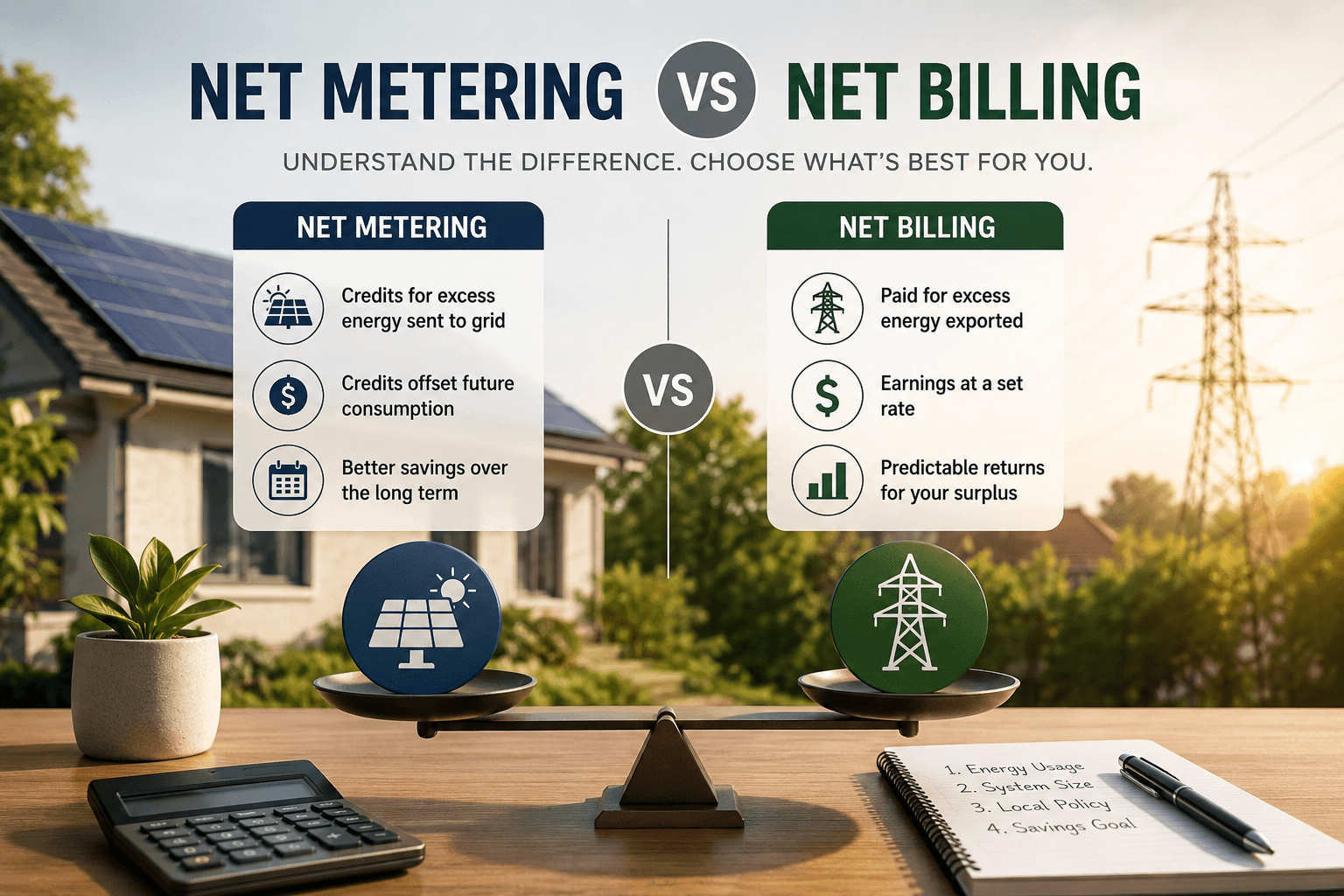
No net metering explanation Export credits affect savings and payback “How does my utility credit excess solar?”
Vague equipment details Panel, inverter, and battery specs affect performance and warranties “Which exact models are included?”
Pressure to sign today Good quotes should survive comparison “Can I review this for a few days?”
Weak warranty language Different warranties cover different issues “What is covered, by whom, and for how long?”

For a deeper quote-by-quote review, use the Solar Quote Comparison Calculator or read the Solar Quote Comparison Checklist.

Red Flag #1: The Quote Promises You Will Eliminate Your Electric Bill

Be careful with any solar quote that says your electric bill will disappear.

Solar can reduce your utility bill, sometimes significantly, but most grid-connected homeowners still receive a bill. That bill may include fixed customer charges, grid connection fees, minimum bills, taxes, or other charges that solar production does not fully offset.

A better quote will explain:

  • Your current monthly electricity usage
  • Estimated solar production
  • Expected self-consumption
  • Utility export credit rules
  • Remaining utility charges
  • Seasonal differences between summer and winter bills

Ask the installer to show a month-by-month savings estimate, not just a yearly average.

You can compare the quote’s savings estimate with your own scenario using the Solar Savings Calculator.

Red Flag #2: The Quote Does Not Show the Cash Price

One of the clearest solar panel quote red flags is a proposal that shows only a monthly loan payment.

Monthly payments are useful, but they do not tell you the full cost. A financed quote should clearly separate:

  1. Cash system price
  2. Loan amount
  3. Interest rate
  4. Loan term
  5. Dealer fee or financing fee
  6. Monthly payment
  7. Total payments over the life of the loan
  8. Any assumptions about applying incentives to the loan balance

The FTC advises homeowners comparing solar financing to ask about upfront costs, APR, payment changes, balloon payments, loan terms, liens, and cancellation rights before signing.

Better question to ask

“What is the total cost if I pay cash, and what is the total cost if I finance?”

That one question can reveal whether the quote is built around a low monthly payment instead of a fair total price.

For a detailed breakdown of financing options, read Solar Financing Comparison: Cash vs. Loans vs. Leases vs. PPAs or use the Solar Financing Calculator.

Red Flag #3: Incentives Are Treated Like Guaranteed Discounts

A solar quote should never treat incentives as automatic unless eligibility is clearly explained.

For 2026 quotes, homeowners should be especially careful with federal tax credit claims. The IRS states that the Residential Clean Energy Credit equaled 30% of qualified clean energy property costs installed from 2022 through December 31, 2025, and that the credit is not available for property placed in service after December 31, 2025.

This is not tax advice. Homeowners should confirm eligibility with a qualified tax professional and check current IRS guidance before relying on any incentive estimate.

That does not mean every incentive is gone. State, local, and utility programs may still exist. A quote should clearly identify which incentives are included, who receives them, and whether they are current.

Watch out for these incentive problems

  • The quote subtracts a tax credit without explaining eligibility.
  • The salesperson says “everyone qualifies.”
  • A lease or PPA quote implies you receive incentives even though you do not own the system.
  • The quote includes an outdated rebate or incentive.
  • The payback period depends on a credit that may not apply to you.

If you want to estimate how incentives may affect your numbers, use the Solar Incentives Calculator and review Federal Solar Tax Credit 2026: What Homeowners Need to Know.

Red Flag #4: Savings Are Based on Unclear Electricity Rate Assumptions

Your solar savings depend heavily on your electricity rate.

A homeowner paying a high utility rate may see different economics than a homeowner with low rates, even if both install the same system. EIA electricity data shows that residential electricity prices vary by state and change over time, which is why quote assumptions should be checked carefully.

A quote should clearly show:

  • Your current electricity rate
  • Expected annual rate escalation
  • Whether the estimate uses flat or time-of-use rates
  • How export credits are valued
  • Whether fixed charges, minimum bills, or demand charges apply

A common mistake

Some quotes assume electricity rates will rise quickly every year. Rate increases may happen, but a quote should not rely on aggressive escalation assumptions without showing how they affect savings.

Ask for two versions:

  • A conservative estimate
  • A higher-rate-increase estimate

Then compare both in the Solar Payback Calculator. For more detail, read Solar Payback Period Explained.

Red Flag #5: The System Size Does Not Match Your Usage

A solar system should be sized around your actual electricity usage, roof space, sunlight, and utility rules.

A quote may be too large if it is designed to offset more electricity than you realistically use or if your utility gives low credit for exported power. It may be too small if it ignores expected future usage, such as an electric vehicle, heat pump, pool, or home addition.

Ask the installer to show:

  • Your last 12 months of kWh usage
  • Proposed system size in kW
  • Estimated annual production in kWh
  • Estimated offset percentage
  • Panel count and wattage
  • Roof planes used
  • Shading assumptions

Use the Solar Panels Calculator to check whether the proposed system size makes sense. You can also read How Much Solar Power Do I Need? for a practical sizing explanation.

Red Flag #6: The Quote Does Not Explain Net Metering or Export Credits

Net metering rules can make or break a solar savings estimate.

If your utility gives full retail credit for excess electricity sent to the grid, your savings may be stronger. If your utility uses lower avoided-cost credits, time-of-use export rates, or monthly credit limits, your savings may be lower.

A good solar quote should explain:

  • What happens when your system produces more than your home uses
  • Whether credits roll over monthly
  • Whether credits expire
  • Whether credits are retail rate, avoided cost, or another value
  • Whether your rate plan changes after going solar

This is one of the most important questions to ask before signing because two homes with similar systems can have different payback periods under different utility rules.

For a clearer explanation, read Net Metering Explained for Solar Homeowners.

Red Flag #7: Equipment Details Are Too Vague

A quote that says “premium panels” or “Tier 1 equipment” is not detailed enough.

You should see the exact:

  • Panel manufacturer and model
  • Panel wattage
  • Inverter type and model
  • Racking system
  • Battery model, if included
  • Monitoring platform
  • Main panel upgrade, if needed
  • Roof work, if included

This helps you compare quotes fairly. A cheaper quote may use different equipment, omit upgrades, or exclude items another installer included.

For more context on panel performance, read Solar Panel Efficiency: What Really Matters and Solar Panel Output Calculator Guide.

Red Flag #8: Warranties Sound Strong but Are Not Specific

Solar warranties can be confusing because several warranties may apply at once.

Ask for each warranty in writing:

Warranty Type What It Usually Covers Red Flag
Panel product warranty Defects in the physical panel No manufacturer warranty document
Panel performance warranty Output degradation over time No clear production threshold
Inverter warranty Inverter failure or defects Short term or unclear replacement process
Workmanship warranty Installer labor and installation quality Vague “covered by us” language
Roof penetration warranty Leaks related to solar installation Excludes too many roof conditions
Battery warranty Battery capacity and cycles No usable capacity or cycle terms

A warranty is only useful if you know who backs it, what is excluded, and how claims are handled.

If the quote includes battery storage, compare the battery assumptions with Solar Battery ROI: Is Battery Storage Worth It? and How Much Solar Battery Backup Do You Need?.

Red Flag #9: The Installer Uses High-Pressure Sales Tactics

Pressure is one of the most important solar installer warning signs.

The Department of Energy specifically lists “Don’t give in to pushy sales tactics” as a smart shopping tip for solar homeowners. It also recommends talking to certified installers and understanding financing options before committing.

Be cautious if a salesperson says:

  • “This price is only good today.”
  • “You do not need to read the contract.”
  • “The government will pay for it.”
  • “Your utility bill will be zero.”
  • “Everyone qualifies for the tax credit.”
  • “Do not get other quotes.”

A reputable installer should give you time to review the proposal, compare bids, and ask questions.

For a broader myth-checking guide, see Solar Myths Debunked: 25 Facts Homeowners Need.

Red Flag #10: The Quote Does Not Identify Who Does the Work

Some companies sell solar but subcontract the installation.

Subcontracting is not automatically bad, but you should know who is responsible for:

  • Site survey
  • Engineering
  • Permitting
  • Installation
  • Inspection
  • Interconnection
  • Warranty service
  • Roof repairs if damage occurs

Ask whether the company uses in-house crews, subcontractors, or a combination. Also ask who you call if there is a warranty issue after installation.

The DOE notes that NABCEP certification is an industry-standard certification for solar professionals, and homeowners can search for certified professionals by name, certification number, and location.

Mini Case Study: How One Quote Can Look Better Than It Is

Assumptions for this example:

  • Homeowner’s current electric bill: $180/month
  • Annual electricity cost: $2,160
  • Solar quote cash price: $24,000
  • Financed price after fees and interest: $32,000 total payments
  • Estimated first-year savings: $1,650
  • Claimed payback using cash price: 14.5 years
  • More realistic payback using financed total: 19.4 years

Simple math:

Calculation Result
Cash price ÷ first-year savings $24,000 ÷ $1,650 = 14.5 years
Financed total ÷ first-year savings $32,000 ÷ $1,650 = 19.4 years
Difference 4.9 years longer

This does not mean the system is a bad deal. It means the quote should not present a cash-price payback period if the homeowner is financing the system and paying more over time.

Actual results may change based on electricity rates, roof conditions, system production, utility rules, battery use, incentives, maintenance, and how long the homeowner stays in the home.

Before comparing installer quotes, use the Solar Cost Calculator and Solar ROI Calculator to test cash price, financing, payback period, and long-term return.

Questions to Ask Before Signing a Solar Contract

Use this list before you sign:

  1. What is the cash price before financing?
  2. What is the total financed cost?
  3. What annual kWh production is assumed?
  4. What electricity rate is used?
  5. What utility export credit is assumed?
  6. What incentives are included?
  7. Who is eligible to claim those incentives?
  8. What exact equipment is included?
  9. Are batteries included or optional?
  10. Is a main panel upgrade included?
  11. Is roof work included?
  12. Who handles permitting and interconnection?
  13. Who installs the system?
  14. What warranties apply?
  15. What happens if production is lower than estimated?
  16. What happens if I sell my home?
  17. What cancellation rights do I have?

How to Compare Solar Quotes Fairly

To compare solar quotes, put each proposal into the same format.

Comparison Point Quote A Quote B Quote C
Cash price
System size
Estimated annual kWh
Cost per watt
First-year savings
Payback period
Financing APR
Total financed cost
Panel model
Inverter model
Battery included?
Installer warranty
Net metering assumption

For a full quote comparison process, read How to Compare Solar Quotes: A Homeowner Checklist.

You can also use the Solar Calculator Comparison guide if you want to understand which calculator is best for cost, savings, ROI, payback, or quote comparison.

External Source Suggestions

When fact-checking a quote, homeowners should review:

  • U.S. Department of Energy homeowner solar guidance for smart shopping tips, installer qualifications, and red flags.
  • FTC solar consumer advice for ownership, leases, PPAs, financing, and bid comparison questions.
  • IRS Residential Clean Energy Credit guidance for current federal tax credit rules and eligibility.
  • DSIRE for state, local, and utility solar incentive research.
  • EIA electricity price data to check rate assumptions.

Image Suggestions

Placement Description File Name SEO Alt Text Caption
After introduction Homeowner reviewing solar quote with calculator and utility bill solar-quote-red-flags-checklist.jpg Homeowner checking solar quote red flags before signing contract Review solar quote assumptions before comparing installer offers.
Before checklist Visual checklist of solar quote warning signs solar-quote-red-flags-checklist-table.png Solar quote red flags checklist for homeowners Use a checklist to compare cost, savings, incentives, and warranties.
Mini case study section Payback comparison graphic for cash vs financed solar solar-payback-cash-vs-loan.png Solar payback comparison between cash price and financed solar cost Financing can change the true solar payback period.

FAQ: Solar Quote Red Flags

What is the biggest red flag in a solar quote?

The biggest red flag is a quote that promises savings without showing the assumptions. You should see system size, production, electricity rate, net metering rules, incentives, financing terms, and remaining utility charges.

Should a solar quote show the cash price?

Yes. Even if you plan to finance, the quote should show the cash price. Without it, you cannot tell how much financing changes the total cost.

Are solar tax credits guaranteed?

No. Tax credits depend on current law, eligibility, ownership structure, installation timing, and your tax situation. Never rely on a quote that treats a tax credit as a guaranteed discount without explaining the rules.

Is a solar lease a red flag?

Not always. A lease may work for some homeowners, but it is different from owning the system. You should understand payments, escalators, transfer rules, maintenance, incentives, and what happens when you sell your home.

What should I compare between solar quotes?

Compare cash price, system size, estimated production, cost per watt, equipment, warranties, financing terms, payback period, net metering assumptions, and installer reputation.

How many solar quotes should I get?

Many homeowners benefit from getting at least three quotes. This makes it easier to spot unusually high prices, missing equipment, aggressive savings assumptions, or weak warranty terms.

Can solar really reduce my electric bill?

Yes, solar can reduce electric bills, but the amount depends on your usage, system production, electricity rates, utility rules, roof conditions, incentives, and financing. Most homeowners should expect some remaining utility charges.

Conclusion

The most important solar quote red flags are not always obvious. A quote may look attractive because it shows a low monthly payment, a large lifetime savings number, or a short payback period. But those numbers only matter if the assumptions are realistic.

Before signing, check the cash price, financing terms, system production, electricity rate, incentive eligibility, net metering rules, equipment, warranties, and installer responsibilities.

Run your numbers before comparing installer quotes. Use the MySolarROI Solar ROI Calculator to estimate solar savings, payback period, and ROI based on your own assumptions.

Share the Post:

Related Posts