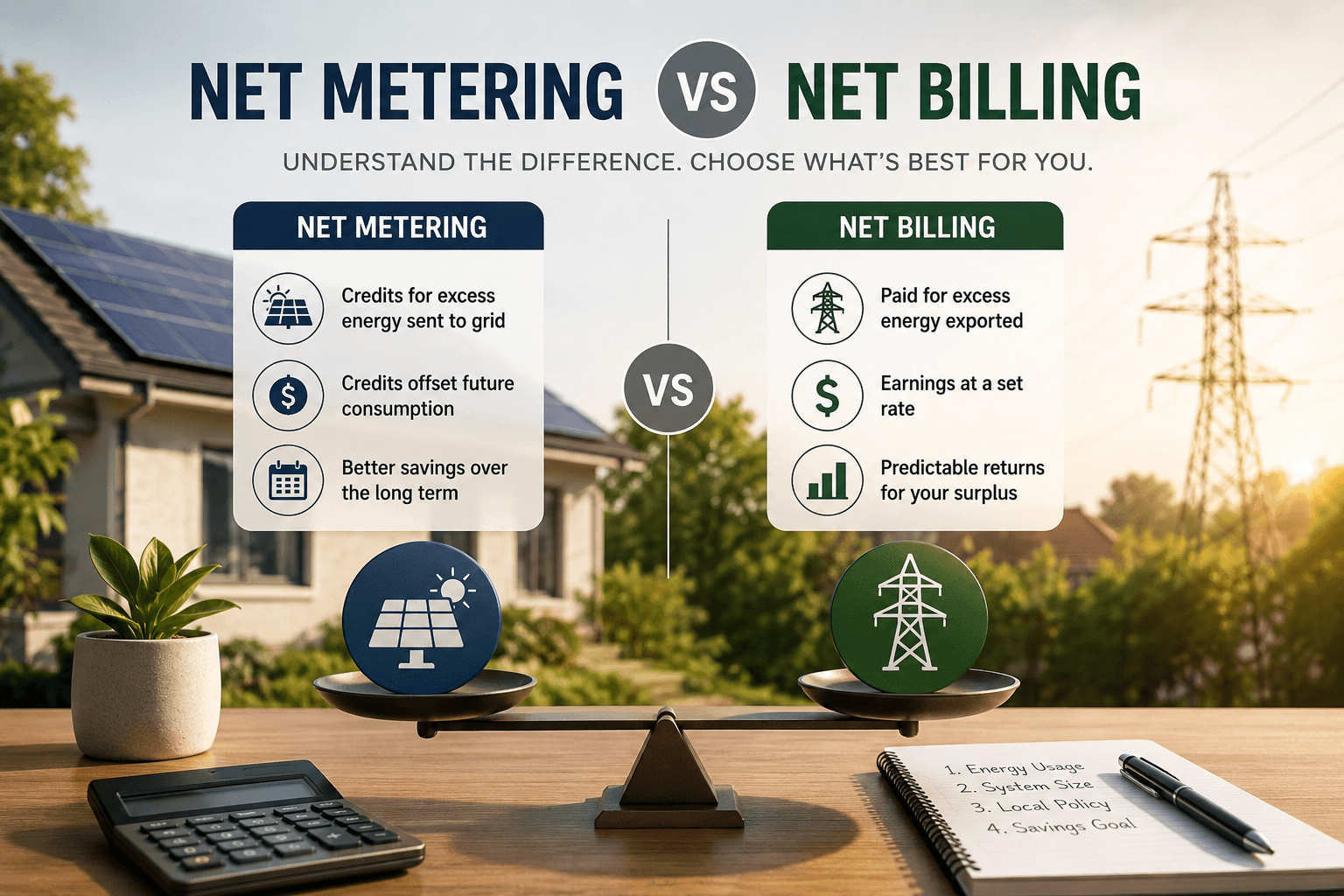
If you are comparing solar quotes, one of the most important questions is not just “How much will the system cost?” It is also “How will my utility credit the extra electricity my panels send to the grid?”
That is where net metering vs net billing matters.
Both policies can help homeowners receive value for excess solar production, but they do not work the same way. Net metering usually credits exported solar energy closer to the retail electricity rate. Net billing often credits exports at a lower or separate rate based on the value of that electricity to the grid.
That difference can affect your monthly savings, solar payback period, battery decision, system size, and long-term solar ROI.
Actual results depend on your location, utility rules, electricity rate plan, roof conditions, system design, financing, incentives, and whether your household can use more solar power during the day. Before comparing installer quotes, use the MySolarROI solar ROI calculator to estimate how utility credits may affect your payback period and long-term savings.
Net Metering vs Net Billing: The Simple Difference
The simplest way to compare the two:
| Policy | How excess solar is credited | Why it matters |
|---|---|---|
| Net metering | Exports often offset electricity usage at or near the retail rate | Usually more favorable for bill savings |
| Net billing | Exports are credited at a separate export rate, often lower than the retail rate | Makes self-consumption and batteries more important |
| Buy-all, sell-all | You buy all electricity from the utility and sell all solar production separately | Less common for standard residential rooftop solar |
NREL explains that distributed solar compensation generally depends on how consumption and generation are measured and billed, with net energy metering, net billing, and buy-all/sell-all as major structures.
The key homeowner takeaway: the value of your solar electricity depends on when you use it, when you export it, and how your utility credits it.
What Is Net Metering?
Net metering is a billing arrangement that allows a solar homeowner to send excess electricity to the grid and receive bill credits.
For example, your panels may produce more electricity than your home uses at noon. That extra power flows to the grid. Later, when your panels are not producing enough electricity, such as at night, you pull power from the grid.
Under traditional net metering, exported electricity may offset imported electricity on your bill. In many older net metering programs, the credit value has been close to the retail electricity rate, though details vary by state and utility.
Example of Net Metering
Let’s say your home uses 1,000 kWh in a month.
Your solar panels produce 900 kWh.
During the month:
- You use some solar power directly in your home.
- You export some solar power to the grid.
- You import electricity at night or during cloudy periods.
If your utility applies strong net metering credits, your bill may be based mostly on your net usage after solar credits, plus fixed charges, minimum bills, taxes, or other non-bypassable charges.
Why Net Metering Can Improve Solar Payback
Net metering can make solar more financially attractive because exported electricity may receive a higher credit value.
That can:
- Increase bill savings
- Shorten the payback period
- Reduce the need for a battery strictly for financial reasons
- Make a larger solar system more reasonable if exports are well credited
But net metering rules are not the same everywhere. Some states have reduced export credit values, added time-of-use rates, or moved new solar customers into net billing-style structures. DSIRE is a commonly used source for checking current state-level renewable energy policies and incentives.
What Is Net Billing?
Net billing also gives homeowners value for exported solar electricity, but the math is different.
Instead of simply netting energy use and solar exports at the same retail rate, net billing usually separates:
- Electricity you buy from the grid
- Electricity your solar system exports to the grid
You may buy electricity at the retail rate and receive export credits at a different rate. That export rate may be based on avoided cost, wholesale value, time-of-use value, or another utility-approved formula.
California’s Net Billing Tariff is one example. The CPUC explains that, as with net metering, onsite generation first serves onsite usage, but exported generation is credited at a rate reflecting its value to the grid.
Example of Net Billing
Assume:
| Item | Example amount |
|---|---|
| Retail electricity rate | $0.28 per kWh |
| Export credit rate | $0.08 per kWh |
| Solar exported to grid | 300 kWh |
| Solar used directly in home | 500 kWh |
In this example:
- Solar used directly in the home avoids buying power at $0.28/kWh.
- Solar exported to the grid earns $0.08/kWh.
- Self-used solar is worth more than exported solar.
That changes the strategy. Under net billing, it may be better to size the system around your daytime usage, shift more appliance use into solar-producing hours, or consider whether a battery improves your numbers.
Why the Difference Matters for Solar Savings
Net metering vs net billing can change the value of the exact same solar system.
A system that looks excellent under full retail net metering may have a longer payback period under lower export credits. That does not mean solar is automatically a bad decision under net billing. It means the design and savings assumptions need to be more precise.
The Main Savings Difference
| Question | Under net metering | Under net billing |
|---|---|---|
| Is exported solar valuable? | Often yes, especially if credited near retail rates | Yes, but often at a lower rate |
| Does daytime self-use matter? | Helpful, but sometimes less critical | Very important |
| Does battery storage become more valuable? | Sometimes | Often more relevant |
| Should you oversize the system? | Maybe, depending on annual usage and rules | Be careful; excess exports may be worth less |
| Does rate plan matter? | Yes | Often even more |
A common mistake is assuming every kWh your panels produce saves the full retail electricity rate. That may be reasonable in some net metering programs, but it can overstate savings under net billing.
Use the MySolarROI solar cost calculator to compare system cost, incentives, and savings assumptions before relying on a quote’s payback estimate.
How Net Metering and Net Billing Affect Payback Period
Solar payback period is the time it takes for your cumulative savings to recover your net upfront cost.
The basic formula is:
Solar payback period = Net solar cost ÷ Annual solar savings
Utility credit rules affect the annual savings part of the formula.
Payback Example
Assume a homeowner installs a solar system with a net cost of $16,000 after eligible incentives.
| Scenario | Estimated annual savings | Estimated payback |
|---|---|---|
| Strong net metering credits | $2,000 | 8 years |
| Lower net billing export credits | $1,500 | 10.7 years |
| Net billing with better self-consumption | $1,750 | 9.1 years |
These are simplified examples, not savings guarantees. Actual results depend on location, electricity rates, roof conditions, system size, incentives, financing, utility rules, and household energy use.
The lesson is clear: export credit value can materially change solar payback.
For a more specific estimate, run your numbers through the MySolarROI solar ROI calculator before comparing installer proposals.
Why Net Billing Can Make Batteries More Important
Under traditional net metering, the grid can act almost like a financial storage system because exported solar may offset later electricity use at a favorable credit rate.
Under net billing, exported electricity may be worth less than electricity you avoid buying from the utility. That makes it more valuable to use your own solar power directly.
A battery may help by storing midday solar production for evening use. But a battery also adds cost, so it does not automatically improve ROI.
Battery Decision Table
| Situation | Battery may help financially? | Why |
|---|---|---|
| Low export credits | Possibly | More solar can be used at home instead of exported |
| High evening electricity rates | Possibly | Stored solar may offset expensive grid power |
| Strong retail net metering | Less likely for pure savings | Export credits may already be valuable |
| Frequent outages | Maybe, but for resilience | Backup value is different from ROI |
| High battery cost | Depends | Added cost may lengthen payback |
A battery can be useful, but homeowners should separate two questions:
- Do I want backup power?
- Does the battery improve my financial return?
Those are related, but not the same.
How to Read Your Utility’s Solar Credit Rules
Before signing a solar contract, look for these details in your utility’s solar tariff or interconnection documents.
1. Export Credit Rate
Ask: How much do I receive for excess solar sent to the grid?
The answer may be:
- Retail rate
- Avoided cost rate
- Wholesale-based rate
- Time-varying export rate
- Monthly or annual credit structure
2. Retail Electricity Rate
Ask: How much do I pay when I buy electricity from the grid?
The bigger the gap between your retail rate and export rate, the more important self-consumption becomes.
3. Time-of-Use Rates
Some utilities charge more during certain hours. If evening electricity is expensive and midday exports are credited lower, your solar savings may depend heavily on load shifting or battery storage.
4. Credit Rollover Rules
Ask:
- Do credits roll over monthly?
- Do credits expire?
- Are excess annual credits paid out?
- Are credits paid at retail, avoided cost, or another rate?
5. Fixed Charges and Minimum Bills
Even with solar, most homeowners still pay some utility charges. Solar may reduce energy charges, but it may not eliminate fixed customer charges, taxes, or grid-related fees.
Mini Case Study: Same Home, Different Credit Rules
Here is a simplified homeowner example.
Assumptions:
| Assumption | Example |
|---|---|
| Monthly electric bill before solar | $180 |
| Estimated system cost after incentives | $17,000 |
| Annual solar production | 9,000 kWh |
| Retail electricity rate | $0.24/kWh |
| Export share | 35% of solar production |
| Direct self-use share | 65% of solar production |
Scenario A: Favorable Net Metering
If most exported solar receives a credit close to the retail rate, more of the system’s production may translate into bill savings.
Simplified annual value:
9,000 kWh × $0.24 = $2,160
Estimated payback:
$17,000 ÷ $2,160 = 7.9 years
Scenario B: Net Billing With Lower Export Credits
Now assume:
- 65% of solar is used directly at home
- 35% is exported
- Direct solar offsets $0.24/kWh electricity
- Exported solar earns $0.08/kWh
Simplified annual value:
| Solar use | kWh | Value | Annual value |
|---|---|---|---|
| Used directly at home | 5,850 | $0.24/kWh | $1,404 |
| Exported to grid | 3,150 | $0.08/kWh | $252 |
| Total estimated annual value | — | — | $1,656 |
Estimated payback:
$17,000 ÷ $1,656 = 10.3 years
This does not mean net billing makes solar unattractive. It means homeowners need to understand export rates before accepting a savings estimate.
What could change the result?
- Higher retail electricity rates
- Better daytime self-consumption
- Different system size
- Battery storage
- Time-of-use rates
- Incentives
- Financing costs
- Roof orientation and shading
- Utility policy changes
Common Mistakes Homeowners Make
Mistake 1: Assuming All Solar kWh Have the Same Value
Under net billing, a kWh used inside your home may be worth more than a kWh exported to the grid.
Mistake 2: Ignoring Utility Rate Plans
Your rate plan can matter as much as your system size. Time-of-use rates can change when solar is most valuable.
Mistake 3: Oversizing Without Checking Export Rules
A larger system may produce more energy, but if much of that energy is exported at a low rate, ROI may not improve as much as expected.
Mistake 4: Treating Battery Backup as Automatic Savings
Batteries can improve self-consumption and resilience, but they add cost. Always compare solar-only vs solar-plus-battery payback.
Mistake 5: Relying Only on Installer Savings Projections
Installer estimates can be useful, but homeowners should verify the assumptions. Ask how the quote models export credits, electricity rate inflation, system degradation, financing, and fixed utility charges.
Questions to Ask Before Signing a Solar Quote
Before choosing an installer, ask:
- Does my utility use net metering, net billing, or another export credit structure?
- What export credit rate did you use in the savings estimate?
- Does the estimate include fixed utility charges?
- Are credits monthly, annual, or time-based?
- How much of my solar production is expected to be used directly at home?
- What happens if my utility changes rates later?
- Does a battery improve my payback, or mainly provide backup power?
- What assumptions are used for electricity rate increases?
You can also use the MySolarROI solar panels calculator to estimate how system size and production may affect your savings.
External Source Suggestions
For the most current local rules, homeowners should verify policies with official or authoritative sources such as:
- DSIRE for state-level solar incentives and policy information
- NREL for distributed solar compensation research
- Your state public utility commission
- Your electric utility’s current solar tariff
- U.S. Department of Energy homeowner solar resources
Because net metering and net billing rules can change, always verify current program details before signing a contract.
FAQ: Net Metering vs Net Billing
Is net billing worse than net metering?
Net billing is often less favorable than traditional full-retail net metering because exported solar may receive a lower credit. However, solar can still make financial sense if electricity rates are high, system costs are reasonable, incentives apply, and you use a good share of solar power at home.
Does net billing mean solar is not worth it?
No. Net billing changes the math, but it does not automatically make solar a poor investment. It makes system sizing, self-consumption, rate plans, and battery analysis more important.
What is the biggest difference between net metering and net billing?
The biggest difference is how exported solar electricity is credited. Net metering often offsets usage more directly, while net billing usually separates electricity imports and exports and may credit exports at a different rate.
Should I get a battery if my utility uses net billing?
Maybe. A battery may help if export credits are low and evening electricity rates are high. But batteries add cost, so compare solar-only and solar-plus-battery payback before deciding.
Can utility solar credit rules change?
Yes. Net metering and net billing policies can change through state regulators, utility filings, or legislation. Existing customers may sometimes be grandfathered under older rules, but this depends on the specific program.
Do solar panels eliminate my electric bill?
Usually not completely. Even with solar, homeowners may still pay fixed charges, minimum bills, taxes, grid fees, or charges for electricity imported from the grid.
How do I know which policy my utility uses?
Check your utility’s solar tariff, your state public utility commission website, DSIRE, or ask your installer to show the exact export credit assumption used in your proposal.
Conclusion
Net metering vs net billing is one of the most important solar savings questions homeowners should understand before signing a quote.
Net metering may provide stronger value for exported solar, especially when credits are close to the retail electricity rate. Net billing can still work well, but it usually rewards homeowners who use more solar power directly, size their system carefully, understand time-of-use rates, and evaluate battery storage with realistic numbers.
The best next step is to run your own estimate. Use the MySolarROI solar ROI calculator to see how system cost, incentives, electricity rates, export credits, and payback period may affect your solar decision.